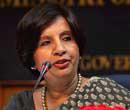
India, US closer than ever: Nirupama Rao

July 3, 2012
nir
Washington, July 3: Indian Ambassador Nirupama Rao has said shared economic, diplomatic and security goals have brought the two nations and their peoples closer than ever.

The recently concluded annual strategic dialogue between India and the US had led to several important advancements in their strategic partnership, she wrote in "The Hill", an influential Washington newspaper focusing on Congressional politics.

"These include enhanced cooperation on many fronts, including in health and education for sustainable development, in the effort to bolster energy security and in the quest to improve business-to-business relations between our two nations," Rao said.

Secretary of State Hillary Clinton had hailed a preliminary agreement between Westinghouse and the Nuclear Power Corporation of India on setting up a nuclear power project to generate electricity, in Gujarat State as "a significant step toward the fulfilment" of the landmark 2008 nuclear agreement between the US and India, she noted.

"We agree, and would add that there was a lot more progress to highlight in other realms, too," Rao said underlining that India's External Affairs Minister S.M. Krishna, emphasised that the US and India will continue to make progress and work in tandem on many issues especially in trade and business.

On trade, the two leaders announced that they would work toward completing a bilateral treaty that would boost investment and trade between the US and India. Cooperation on defence-related matters, maritime and Internet security, counter terrorism and trade would also be taken forward, Rao said.

Another major area of common purpose concerned Afghanistan, she said noting the US and India have been working separately to find ways to ensure Afghanistan's long-term peace and stability.

"Today, the path is open for closer coordination as India and the US now plan to work together -- along with Afghanistan -- to promote improvements in Afghan farming, mining, energy and infrastructure," Rao wrote.

"This new, trilateral effort is yet another demonstration of the like-mindedness of the US and India on security issues and their joint determination to do even more to prevent the spread of worldwide terrorism."

Comments

Add new comment

  • Coastaldigest.com reserves the right to delete or block any comments.
  • Coastaldigset.com is not responsible for its readers’ comments.
  • Comments that are abusive, incendiary or irrelevant are strictly prohibited.
  • Please use a genuine email ID and provide your name to avoid reject.
Agencies
May 27,2020

New Delhi, May 27: India’s fourth recession since Independence, first since liberalisation, and perhaps the worst to date is here, according to rating agency, Crisil.

CRISIL sees the Indian economy shrinking 5 per cent in fiscal 2021 (on-year), because of the Covid-19 pandemic. The first quarter will suffer a staggering 25 per cent contraction.

About 10 per cent of gross domestic product (GDP) in real terms could be permanently lost. "So going back to the growth rates seen before the pandemic is unlikely in the next three fiscals", Crisil said.

Crisil has revised its earlier forecast downwards. "Earlier, on April 28, we had slashed our prediction to 1.8 per cent growth from 3.5 per cent growth. Things have only gone downhill since", it said.

While we expect non-agricultural GDP to contract 6 per cent, agriculture could cushion the blow by growing at 2.5 per cent.

In the past 69 years, India has seen a recession only thrice as per available data in fiscals 1958, 1966 and 1980. The reason was the same each time a monsoon shock that hit agriculture, then a sizeable part of the economy.

"The recession staring at us today is different," it added. For one, agriculture could soften the blow this time by growing near its trend rate, assuming a normal monsoon. Two, the pandemic-induced lockdowns have affected most non-agriculture sectors. And three, the global disruption has upended whatever opportunities India had on the exports front.

Economic conditions have slid precipitously since the April-end forecast of 1.8 per cent GDP growth for fiscal 2021 (baseline), Crisil said.

On the lockdown extension, it said that the government has extended the lockdown four times to deal with the rising number of cases, curtailing economic activity severely (lockdown 4.0 is ending on May 31).

The first quarter of this fiscal will be the worst affected. June is unlikely to see major relaxations as the Covid-19 affliction curve is yet to flatten in India.

"Not only will the first quarter be a washout for the non-agricultural economy, services such as education, and travel and tourism among others, could continue to see a big hit in the quarters to come. Jobs and incomes will see extended losses as these sectors are large employers," Crisil said.

CRISIL also foresees economic activity in states with high Covid-19 cases to suffer prolonged disruption as restrictions could continue longer.

A rough estimate based on a sample of eight states, which contribute over half of India's GDP, shows that their 'red zones' (as per lockdown 3.0) contributed 42 per cent to the state GDP on average regardless of the share of such red zones.

On average, the orange zones contribute 46 per cent, while the green zones where activity is allowed to be close to normal contribute only 12 per cent to state GDP.

The economic costs are higher than earlier expectations, according to Crisil. The economic costs now beginning to show up in the hard numbers are far worse than initial expectations.

Industrial production for March fell by over 16%. The purchasing managers indices for the manufacturing and services sectors were at 27.4 and 5.4, respectively, in April, implying extraordinary contraction. That compares with 51.8 and 49.3, respectively, in March.

Exports contracted 60.3 per cent in April, and new telecom subscribers declined 35 per cent, while railway freight movement plunged 35 per cent on-year.

"Indeed, given one of the most stringent lockdowns in the world, April could well be the worst performing month for India this fiscal," it said.

Added to that is the economic package without enough muscle. The government recently announced a Rs 20.9 lakh crore economic relief package to support the economy. The package has some short-term measures to cushion the economy, but sets its sights majorly on reforms, most of which will have payoffs only over the medium term.

"We estimate the fiscal cost of this package at 1.2 per cent of GDP, which is lower than what we had assumed in our earlier estimate (when we foresaw a growth in GDP)," it said.

"We believe a catch-up to the pre-crisis trend level of GDP growth will not be possible in the next three fiscals despite policy support. Under the base case, we estimate a 10 per cent permanent loss to real GDP (from the decadal-trend level), assuming average growth of about 7 per cent between fiscals 2022 and 2024," Crisil said.

Interestingly, after the Global Financial Crisis (GFC), a sharp growth spurt helped catch up with the trend within two years. GDP grew 8.2 per cent on average in the two fiscals following the GFC. Massive fiscal spending, monetary easing and swift global recovery played a role in a V-shaped recovery.

To catch-up would require average GDP growth to surge to 11 per cent over the next three fiscals, something that has never happened before.

The research said that successive lockdowns have a non-linear and multiplicative effect on the economy a two-month lockdown will be more than twice as debilitating as a one-month imposition, as buffers keep eroding.

Partial relaxations continue to be a hindrance to supply chains, transportation and logistics. Hence, unless the entire supply chain is unlocked, the impact of improved economic activity will be subdued.

Therefore, despite the stringency of lockdown easing a tad in the third and the fourth phases, their negative impact on GDP is expected to massively outweigh the benefits from mild fiscal support and low crude oil prices, especially in the April-June quarter. "Consequently, we expect the current quarter's GDP to shrink 25 per cent on-year," it said.

Counting lockdown 4.0, Indians have had 68 days of confinement. S&P Global estimates that one month of lockdown shaves 3 per cent off annual GDP on average across Asia-Pacific.

Since India's lockdown has been the most stringent in Asia, the impact on economic growth will be correspondingly larger.

Google's Community Mobility Reports show a sharp fall in movement of people to places of recreation, retail shops, public transport and workplace travel. While data for May shows some improvement in India, mobility trends are much below the average or baseline, and lower compared with countries such as the US, South Korea, Brazil and Indonesia.


Comments

Add new comment

  • Coastaldigest.com reserves the right to delete or block any comments.
  • Coastaldigset.com is not responsible for its readers’ comments.
  • Comments that are abusive, incendiary or irrelevant are strictly prohibited.
  • Please use a genuine email ID and provide your name to avoid reject.
Agencies
January 15,2020

Mumbai, Jan 15: Michael Debabrata Patra took over as Deputy Governor of the Reserve Bank of India (RBI) on Wednesday.

He was an Executive Director of India's central bank before being elevated to the post of Deputy Governor.

An RBI release said that as Deputy Governor, Patra will look after Monetary Policy Department including Forecasting and Modelling Unit (MPD/MU), Financial Markets Operations Department (FMOD), Financial Markets Regulation Department.

He will also look after Market Intelligence (FMRD/MI), International Department (Intl. D), Department of Economic and Policy Research (DEPR), Department of Statistics and Information Management (including Data and Information Management Unit) (DSIM/DIMU), Corporate Strategy and Budget Department (CSBD) and Financial Stability Unit.

Patra, a career central banker since 1985, has worked in various positions in the Reserve Bank of India.

As Executive Director, he was a member of the Monetary Policy Committee (MPC) of RBI, which is invested with the responsibility of monetary policy decision making in India. He will continue to be an ex-officio member of the MPC as Deputy Governor.

Prior to this, he was Principal Adviser of the Monetary Policy Department, Reserve Bank of India between July 2012 and October 2014.

He has worked in the International Monetary Fund (IMF) as Senior Adviser to Executive Director (India) during December 2008 to June 2012, when he actively engaged in the work of the IMF's Executive Board through the period of the global financial crisis and the ongoing Euro area sovereign debt crisis.

The release said that his book "The Global Economic Crisis through an Indian Looking Glass" vividly captures this experience.

He has also published papers in the areas of inflation, monetary policy, international trade and finance, including exchange rates and the balance of payments.

A fellow of the Harvard University where he undertook post-doctoral research in the area of financial stability, he has a PhD in Economics from the Indian Institute of Technology, Mumbai.

He will hold the post for three years or until further orders. The post fell vacant after Viral Acharya resigned on July 23 last year.

Comments

Add new comment

  • Coastaldigest.com reserves the right to delete or block any comments.
  • Coastaldigset.com is not responsible for its readers’ comments.
  • Comments that are abusive, incendiary or irrelevant are strictly prohibited.
  • Please use a genuine email ID and provide your name to avoid reject.
News Network
April 16,2020

Thiruvananthapuram, Apr 16: Seven fresh cases of COVID-19 were reported from Kerala on Thursday, taking the total number of active cases to 147 in the state,even as over 88,000 people are under observation.

On Wednesday, only one positive case had been reported, thelowest in weeks.

While Kannur reported four cases, two were from Kozhikode and one from Kasaragod, Chief Minister Pinarayi Vijayan told reportershere.

Five of those affected had come from abroad, while two have got it through contact with infected people.

Samples of 27 people, including 24 from the worst affected Kasaragod, have turned negative on Thursday.

He said 394 coronavirus cases have so farbeen detected from the state.

Over 80,000 people are under observation, including 532 in various hospitals.

Vijayan said 17,400 samples have been sent for testing of which 16,459 have returned negative.

Comments

Add new comment

  • Coastaldigest.com reserves the right to delete or block any comments.
  • Coastaldigset.com is not responsible for its readers’ comments.
  • Comments that are abusive, incendiary or irrelevant are strictly prohibited.
  • Please use a genuine email ID and provide your name to avoid reject.