



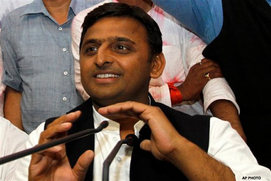
UP CM's Rs 80 crore gift fails to enthuse rivals

July 3, 2012

akhilesh

New Delhi, July 3: Uttar Pradesh Chief Minister Akhilesh Yadav's largesse to the MLAs failed to get the anticipated support from the political parties with his bitter rivals - the BJP and the BSP - rejecting the proposal that the legislators can use Constituency Development Funds to buy personal vehicles.

Akhilesh said each of the 403 MLAs in the Uttar Pradesh Assembly can use up to Rs 20 lakh out of the Rs 5 crore allotted during a five-year tenure to buy vehicles. If all the MLAs buy a vehicle worth Rs 20 lakh, the cost to the state exchequer would be more than Rs 80 crore.

However, the BJP and the BSP strongly objected to Akhilesh’s proposal saying the decision would send a wrong signal to the people of the state; the Samajwadi Party defended it saying that it's not obligatory to but a personal vehicle using the fund.

BSP leader Swami Prasad Maurya said, "Giving car through this order is completely wrong. It gives wrong impression. No BSP MLA will take any car through this order." BJP leader Lakshmi Narayan, said, "This decision is completely wrong and it gives wrong impression. No BJP MLA will take any car through this order."

The SP has defended the decision of Akhilesh Yadav. Senior SP leader Azam Khan said, "This order came out after the increase in MLA fund for those who are not able to afford it and it is not compulsory that they should buy it. They will only become owner when they pay in full."

Earlier, as promised in its party manifesto, the SP government entitled MLAs to purchase four-wheelers worth upto Rs 20 lakh from their local area development fund, which was also increased by Rs 25 lakh.

"Despite a financial crisis, the SP government has fulfilled all the promises it made in the party manifesto in the budget. We entitle MLAs to purchase vehicles upto Rs 20 lakh from their local area development fund", Chief Minister Akhilesh Yadav announced in the state Assembly.

He said that value of the vehicle will be depreciated per year and after the end of five years the MLAs could deposit the depreciated amount and hand over their vehicle.

"This will help MLAs, who did not have money to buy the vehicle", Akhilesh said adding that the government would not give any amount for maintenance of the vehicles.

The decision, however, was not appreciated by the opposition, which termed that it would send a wrong message as the money for development was spend on the vehicle.

"The decision to buy vehicles will not send a good message to the electorate. Even, MLAs buying vehicles on their own money would look as if they used public money for the purpose. We, BJP members, will not purchase vehicles from the development fund", BJP leader Hukum Singh said.

BSP leader Swami Prasad Maurya also said that the decision would not send a good message to the public and added that separate arrangements would be made for the purpose of purchasing vehicles.

"BSP members will not be utilising their development fund for vehicles", Maurya said.

Congress leader Pramod Tiwari aired the same view and said that Akhilesh should increase the MLA area development fund and reminded him about the announcement made by SP supremo Mulayam Singh Yadav in the House in 2007.

"Your father had announced to increase MLA fund by Rs 25 lakh in 2007 but could not do so. Now you have to rid you father of this 'karj' (obligation)", Tiwari said.

Following this, the Chief Minister later announced to increase the MLA fund by Rs 25 lakh--from 1.25 crore to Rs 1.5 crore.

The Chief Minister earlier informed the House and sought its support for importing coal, if it was not made available by the Centre.

"The state is not getting coal links to run 10 thermal power plants. We want support to run them on imported coal. The state government will ensure that power thus generated would be on competitive rates", Yadav said while the members supported the move.

The CM also announced that two Lohia villages would be selected for development on advise of concerned MLAs and demanded by them while Parliamentary minister assured piped water supply in two villages on request of MLAs.

Akhilesh also announced honorarium of Rs five thousand to Vidhan Sabha staff besides providing torch, cycle and uniform to chowkidars in all the districts.

As per law, Constituency Development Funds are to be used for development work and not for personal benefits.

Comments

Add new comment

  • Coastaldigest.com reserves the right to delete or block any comments.
  • Coastaldigset.com is not responsible for its readers’ comments.
  • Comments that are abusive, incendiary or irrelevant are strictly prohibited.
  • Please use a genuine email ID and provide your name to avoid reject.
News Network
March 26,2020

Mar 26: As Kashmir reported its first COVID-19 death on Thursday, Islamic scholars urged people to follow the Ministry of Home Affairs guidelines on funeral and burial of those who die due to coronavirus pandemic.

“Medical science can’t be ignored and whatever directions there are in the (MHA) guidelines should be followed. As far as the funeral of the person, only family members should participate in the funeral and burial after wearing the protection kits,” the scholars said.

The MHA has stressed that there should be no bathing, kissing, hugging and reciting of verses while the body should be transported in a secured bag. Health experts have stressed that the grave for the person should be dug eight feet deep instead of normal six feet.

“The body of the person should be transported in a secured bag and the vehicle in which he is transported has to be decontaminated by the trained staff who should be wearing N-95 masks and protection equipment,” read the MHA guidelines.

Kashmir witnessed the first death of a COVID-19 patient from uptown city Hyderpora, who had a travel history of outside J&K as he was part of a ‘Tableegi Jamaat’.

Dr Naveed, Head of Department, at Chest Diseases Hospital Srinagar, said that no one from the family should go closer to the body and if someone from the family wants to see the face, he/she has to wear a complete protective gear.

“Burial bath is not recommended for the body. Grave for him should be dug eight feet deep instead of normal six feet,” he said.

As far as funeral prayers, he said, those intending to offer funeral should wear protective gear and maintain sufficient distance between the body and people.

Comments

Add new comment

  • Coastaldigest.com reserves the right to delete or block any comments.
  • Coastaldigset.com is not responsible for its readers’ comments.
  • Comments that are abusive, incendiary or irrelevant are strictly prohibited.
  • Please use a genuine email ID and provide your name to avoid reject.
News Network
January 23,2020

Mumbai, Jan 23: Rashmi Sahijwala never expected to start working at the age of 59, let alone join India’s gig economy—now she is part of an army of housewives turning their homes into “cloud kitchens” to feed time-starved millennials.

Asia’s third-largest economy is battling a slowdown so sharp it is creating a drag on global growth, the International Monetary Fund said Monday, but there are some bright spots.

The gig economy, aided by cheap mobile data and abundant labour, has flourished in India, opening up new markets across the vast nation.

Although Indian women have long battled for access to education and employment opportunities, the biggest hurdle for many is convincing conservative families to let them leave home.

But new apps like Curryful, Homefoodi, and Nanighar are tapping the skills of housewives to slice, dice and prepare meals for hungry urbanites from the comfort of their homes.

The so-called cloud kitchens—restaurants that have no physical presence and a delivery-only model—are rising in popularity as there is a boom in food delivery apps such as Swiggy and Zomato.

“We want to be the Uber of home-cooked food,” said Ben Mathew, who launched Curryful in 2018, convinced that housewives were a huge untapped resource.

His company—which employs five people for the app’s daily operations—works with 52 women and three men, and the 31-year-old web entrepreneur hopes to get one million female chefs on-board by 2022.

“We usually train them in processes of sanitisation, cooking, prep time and packaging... and then launch them on the platform,” Mathew told news agency.

One of the first housewives to join Curryful in November 2018 shortly after its launch, Sahijwala was initially apprehensive, despite having four decades of experience in the kitchen.

But backed by her children, including her son who gave her regular feedback about her proposed dishes, she took the plunge.

Since then, she’s undergone a crash course in how to run a business, from creating weekly menus to buying supplies from wholesale markets to cut costs.

The learning curve was steep and Sahijwala switched from cooking everything from scratch to preparing curries and batters for breads in advance to save time and limit leftovers.

She even bought a massive freezer to store fruits and vegetables despite her husband’s reservations about the cost.

“I told him that I am a professional now,” she told news agency.

‘Internet restaurants’

Kallol Banerjee, co-founder of Rebel Foods which runs 301 cloud kitchens backing up 2,200 “internet restaurants”, was among the first entrepreneurs to embrace the concept in 2012.

“We could do more brands from one kitchen and cater to different customer requirements at multiple price points,” Banerjee told AFP.

The chefs buy the ingredients, supply the cookware and pay the utility bills.

The apps—which make their money through charging commission, such as more than 18 percent per order for Curryful—offer training and supply the chefs with containers and bags to pack the food in.

Curryful chef Chand Vyas, 55, spent years trying to set up a lunch delivery business but finally gave up after failing to compete with dabbawalas, Mumbai’s famously efficient food porters.

Today Vyas works seven hours a day, five days a week in her kitchen, serving up a bevy of Indian vegetarian staples, from street food favourites to lentils and rice according to the app’s weekly set menus.

“I don’t understand marketing or how to run a business but I know how to cook. So, the current partnership helps me focus on just that while Curryful takes care of the rest,” Vyas told AFP.

She pockets up to $150 (Rs 10,000 approx) a month after accounting for the commissions and costs, but hopes to earn more as the orders increase.

In contrast, a chef at a bricks-and-mortar restaurant takes home a monthly wage of between $300 (Rs 20,000 approx) and $1,000 (Rs 70,000) approx for working six days a week.

With India’s cloud kitchen sector expected to reach $1.05 billion by 2023, according to data platform Inc42, other companies are also keen to get a slice of the action.

Swiggy, for example, has invested 2.5 billion rupees ($35.3 million) in opening 1,000 cloud kitchens across the nation.

Back in her Mumbai kitchen, Sahijwala is elated to have embarked on a career at an age when her contemporaries are eyeing retirement.

Over the past year, she has seen her profit grow to $200 (Rs 15,000 approx) a month, but more importantly, she said, “My passion has finally found an outlet.

“I am just glad life has given me this chance.”

Comments

Add new comment

  • Coastaldigest.com reserves the right to delete or block any comments.
  • Coastaldigset.com is not responsible for its readers’ comments.
  • Comments that are abusive, incendiary or irrelevant are strictly prohibited.
  • Please use a genuine email ID and provide your name to avoid reject.
Agencies
July 30,2020

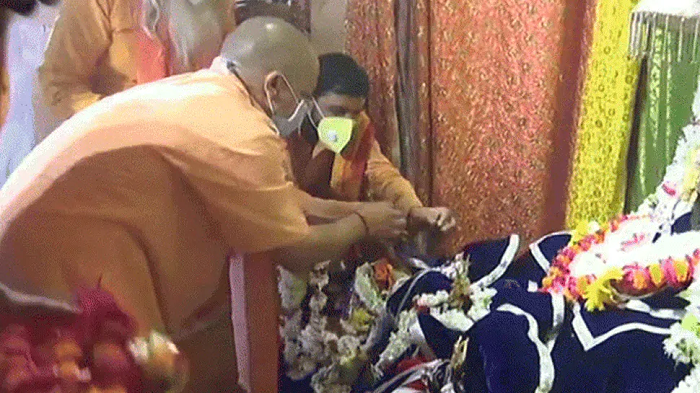
Ahead of the grand foundation stone-laying ceremony of the Ram Temple on August 5, Ayodhya priest and 16 police personnel, involved in the mega event on August 5, have tested positive for COVID-19. Priest Pradeep Das is one of the four priests who regularly perform puja at the Ram Temple site in Ayodhya.

Das has been placed under home quarantine and contact tracing is underway, reported.

Meanwhile, Uttar Pradesh police and Sashastra Seema Bal have been put on high alert in the districts bordering Nepal ahead of Prime Minister Narendra Modi's visit to Ayodhya on August 5.

PM Modi likely to launch postal stamps on Ram Temple, Ramayana during Ayodhya visit: Report
Counterfeit products create Rs 1-lakh-crore hole in economy, incidents up 24% in 2019: Report
On July 29, Uttar Pradesh reported a record single-day spike of 3,570 COVID-19 cases, taking the infection tally to more than 77,000, while 33 fresh fatalities pushed the death toll to 1,530.

"There are 29,997 active COVID-19 cases in the state and 45,807 patients have been discharged after treatment," Additional Chief Secretary, Medical and Health, Amit Mohan Prasad told reporters. "The death toll due to the disease has reached 1,530," he said.

Comments

Add new comment

  • Coastaldigest.com reserves the right to delete or block any comments.
  • Coastaldigset.com is not responsible for its readers’ comments.
  • Comments that are abusive, incendiary or irrelevant are strictly prohibited.
  • Please use a genuine email ID and provide your name to avoid reject.