



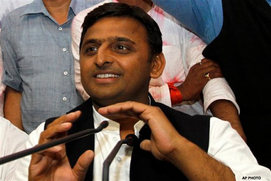
UP CM's Rs 80 crore gift fails to enthuse rivals

July 3, 2012

akhilesh

New Delhi, July 3: Uttar Pradesh Chief Minister Akhilesh Yadav's largesse to the MLAs failed to get the anticipated support from the political parties with his bitter rivals - the BJP and the BSP - rejecting the proposal that the legislators can use Constituency Development Funds to buy personal vehicles.

Akhilesh said each of the 403 MLAs in the Uttar Pradesh Assembly can use up to Rs 20 lakh out of the Rs 5 crore allotted during a five-year tenure to buy vehicles. If all the MLAs buy a vehicle worth Rs 20 lakh, the cost to the state exchequer would be more than Rs 80 crore.

However, the BJP and the BSP strongly objected to Akhilesh’s proposal saying the decision would send a wrong signal to the people of the state; the Samajwadi Party defended it saying that it's not obligatory to but a personal vehicle using the fund.

BSP leader Swami Prasad Maurya said, "Giving car through this order is completely wrong. It gives wrong impression. No BSP MLA will take any car through this order." BJP leader Lakshmi Narayan, said, "This decision is completely wrong and it gives wrong impression. No BJP MLA will take any car through this order."

The SP has defended the decision of Akhilesh Yadav. Senior SP leader Azam Khan said, "This order came out after the increase in MLA fund for those who are not able to afford it and it is not compulsory that they should buy it. They will only become owner when they pay in full."

Earlier, as promised in its party manifesto, the SP government entitled MLAs to purchase four-wheelers worth upto Rs 20 lakh from their local area development fund, which was also increased by Rs 25 lakh.

"Despite a financial crisis, the SP government has fulfilled all the promises it made in the party manifesto in the budget. We entitle MLAs to purchase vehicles upto Rs 20 lakh from their local area development fund", Chief Minister Akhilesh Yadav announced in the state Assembly.

He said that value of the vehicle will be depreciated per year and after the end of five years the MLAs could deposit the depreciated amount and hand over their vehicle.

"This will help MLAs, who did not have money to buy the vehicle", Akhilesh said adding that the government would not give any amount for maintenance of the vehicles.

The decision, however, was not appreciated by the opposition, which termed that it would send a wrong message as the money for development was spend on the vehicle.

"The decision to buy vehicles will not send a good message to the electorate. Even, MLAs buying vehicles on their own money would look as if they used public money for the purpose. We, BJP members, will not purchase vehicles from the development fund", BJP leader Hukum Singh said.

BSP leader Swami Prasad Maurya also said that the decision would not send a good message to the public and added that separate arrangements would be made for the purpose of purchasing vehicles.

"BSP members will not be utilising their development fund for vehicles", Maurya said.

Congress leader Pramod Tiwari aired the same view and said that Akhilesh should increase the MLA area development fund and reminded him about the announcement made by SP supremo Mulayam Singh Yadav in the House in 2007.

"Your father had announced to increase MLA fund by Rs 25 lakh in 2007 but could not do so. Now you have to rid you father of this 'karj' (obligation)", Tiwari said.

Following this, the Chief Minister later announced to increase the MLA fund by Rs 25 lakh--from 1.25 crore to Rs 1.5 crore.

The Chief Minister earlier informed the House and sought its support for importing coal, if it was not made available by the Centre.

"The state is not getting coal links to run 10 thermal power plants. We want support to run them on imported coal. The state government will ensure that power thus generated would be on competitive rates", Yadav said while the members supported the move.

The CM also announced that two Lohia villages would be selected for development on advise of concerned MLAs and demanded by them while Parliamentary minister assured piped water supply in two villages on request of MLAs.

Akhilesh also announced honorarium of Rs five thousand to Vidhan Sabha staff besides providing torch, cycle and uniform to chowkidars in all the districts.

As per law, Constituency Development Funds are to be used for development work and not for personal benefits.


Comments

Add new comment

  • Coastaldigest.com reserves the right to delete or block any comments.
  • Coastaldigset.com is not responsible for its readers’ comments.
  • Comments that are abusive, incendiary or irrelevant are strictly prohibited.
  • Please use a genuine email ID and provide your name to avoid reject.
Agencies
June 8,2020

New Delhi, Jun 8: Union Human Resource Development Minister Ramesh Pokhriyal Nishank has said that CBSE board results can be declared by August 15. The results of both class 10 and 12 will be declared at an interval of just a few days.

However, the decision to open schools will be taken after August keeping in mind the current COVID-19 situation. At present, the Ministry of Human Resource Development has not set any date for reopening schools.

Nishank said during a discussion "We hope that the results of both 10th and 12th class will be declared by August 15. These include the results of previous exams and the results of examinations in July."

On the issue of reopening of schools, Nishank said "after August the process of opening schools will be started."

A final decision in this regard will be taken only after assessing the prevailing conditions. According to the HRD ministry, after August, new sessions will also start in universities.

Meanwhile, the Arvind Kejriwal government in Delhi has also written to the HRD ministry on the subject of reopening schools. Delhi Education Minister Manish Sisodia said in the letter, "Delhi Chief Minister Arvind Kejriwal said some time ago that we have to learn to live with coronavirus. So it would be better to open schools with proper safety measures."

Sisodia said that first of all, we have to assure every child that they are important to us. Everyone has equal rights over the physical and intellectual environment of his school. Education cannot progress beyond online classes only. It would be impossible to pursue education only by calling older children to school and keeping younger children at home.

Several private schools have also suggested measures to the HRD ministry to open schools and safety in schools during this period. However, the ministry is not in a hurry to reopen schools at present. According to senior officials of the ministry, at present, preparations are being made to conduct the remaining board exams of class 10 and 12 between July 1 and 15.

After the examinations, the first priority is to declare the results. Only then can the process of reopening school colleges begin.

Comments

Add new comment

  • Coastaldigest.com reserves the right to delete or block any comments.
  • Coastaldigset.com is not responsible for its readers’ comments.
  • Comments that are abusive, incendiary or irrelevant are strictly prohibited.
  • Please use a genuine email ID and provide your name to avoid reject.
Agencies
April 23,2020

New Delhi, Apr 23: The nationwide lockdown in India which started about a month ago has impacted nearly 40 million internal migrants, the World Bank has said.

The lockdown in India has impacted the livelihoods of a large proportion of the country's nearly 40 million internal migrants. Around 50,000 60,000 moved from urban centers to rural areas of origin in the span of a few days, the bank said in a report released on Wednesday.

According to the report -- 'COVID-19 Crisis Through a Migration Lens' -- the magnitude of internal migration is about two-and-a-half times that of international migration.

Lockdowns, loss of employment, and social distancing prompted a chaotic and painful process of mass return for internal migrants in India and many countries in Latin America, it said.

Thus, the COVID-19 containment measures might have contributed to spreading the epidemic, the report said.

Governments need to address the challenges facing internal migrants by including them in health services and cash transfer and other social programmes, and protecting them from discrimination, it said.

World Bank said that coronavirus crisis has affected both international and internal migration in the South Asia region.

As the early phases of the crisis unfolded, many international migrants, especially from the Gulf countries, returned to countries such as India, Pakistan, and Bangladesh until travel restrictions halted these flows.

Some migrants had to be evacuated by governments, such as those of China and Iran, it said.

Before the coronavirus crisis, migrant outflows from the region were robust, the report said.

The number of recorded, primarily low-skilled emigrants from India and Pakistan rose in 2019 relative to the prior year but is expected to decline in 2020 due to the pandemic and oil price declines impacting the Gulf countries.

In India, the number of low-skilled emigrants seeking mandatory clearance for emigration rose slightly by eight percent to 368,048 in 2019.

In Pakistan, the number of emigrants jumped 63 per cent to 6,25,203 in 2019, largely due to a doubling of emigration to Saudi Arabia, it said.

According to the bank, migration flows are likely to fall, but the stock of international migrants may not decrease immediately, since migrants cannot return to their countries due to travel bans and disruption to transportation services.

In 2019, there were around 272 million international migrants.

The rate of voluntary return migration is likely to fall, except in the case of a few cross-border migration corridors in the South (such as Venezuela-Colombia, Nepal-India, Zimbabwe South Africa, Myanmar-Thailand), it said.

Migrant workers tend to be vulnerable to the loss of employment and wages during an economic crisis in their host country, more so than native-born workers.

Lockdowns in labour camps and dormitories can also increase the risk of contagion among migrant workers.

Many migrants have been stranded due to the suspension of transport services. Some host countries have granted visa extensions and temporary amnesty to migrant workers, and some have suspended the involuntary return of migrants, it said.

Observing that government policy responses to the COVID-19 crisis have largely excluded migrants and their families back home, the World Bank said there is a strong case for including migrants in the near-term health strategies of all countries, given the externalities associated with the health status of an entire population in the face of a highly contagious pandemic.

The Bank said governments would do well to consider short, medium and long-term interventions to support stranded migrants, remittance infrastructure, loss of subsistence income for families back home, and access to health, housing, education, and jobs for migrant workers in host/transit countries and their families back home.

The pandemic has also highlighted the global shortage of health professionals and an urgent need for global cooperation and long-term investments in medical training, it said.

Comments

Add new comment

  • Coastaldigest.com reserves the right to delete or block any comments.
  • Coastaldigset.com is not responsible for its readers’ comments.
  • Comments that are abusive, incendiary or irrelevant are strictly prohibited.
  • Please use a genuine email ID and provide your name to avoid reject.
News Network
June 9,2020

Jun 9: Prime Minister Narendra Modi wants all 1.3 billion Indians to be “vocal for local” — meaning, to not just use domestically made products but also to promote them. As an overseas citizen living in Hong Kong, I’m doing my bit by very vocally demanding Indian mangoes on every trip to the grocery. But half the summer is gone, and not a single slice so far.

My loss is due to India’s COVID-19 lockdown, which has severely pinched logistics, a perennial challenge in the huge, infrastructure-starved country. But more worrying than the disruption is the fruity political response to it. Rather than being a wake-up call for fixing supply chains, the pandemic seems to be putting India on an isolationist course. Why?

Granted that the liberal view that trade is good and autarky bad isn’t exactly fashionable anywhere right now. What makes India’s lurch troublesome is that the pace and direction of economic nationalism may be set by domestic business interests. The Indian liberals, many of whom are Western-trained academics, authors and — at least until a few years ago — policy makers, want a more competitive economy. They will be powerless to prevent the slide.

Modi’s call for a self-reliant India has been echoed by Home Minister Amit Shah, the cabinet’s unofficial No. 2, in a television interview. If Indians don’t buy foreign-made goods, the economy will see a jump, he said. The strategy — although it’s too nebulous yet to call it that — has a geopolitical element. A military standoff with China is under way, apparently triggered by India’s completion of a road and bridge near the common border in the tense Himalayan region of Ladakh. It’s very expensive to fight even a limited war there. With India’s economy flattened by COVID, New Delhi may be looking for ways to restore the status quo and send Beijing a signal.

Economic boycotts, such as Chinese consumers’ rejection of Japanese goods over territorial disputes in the East China Sea, are well understood as statecraft. In these times, it’s not even necessary to name an enemy. An undercurrent of popular anger against China, the source of both the virus and India’s biggest bilateral trade deficit, is supposed to do the job. But is it ever that easy?

A hastily introduced policy to stock only local goods in police and paramilitary canteens became a farcical exercise after the list of banned items ended up including products by the local units of Colgate-Palmolive Co., Nestle SA, and Unilever NV, which have had significant Indian operations for between 60 and 90 years, as well as Dabur India Ltd., a New Delhi-based maker of Ayurveda brands. The since-withdrawn list demonstrates the practical difficulty of bureaucrats trying to find things in a globalized world that are 100% indigenous.

Free-trade champions fret that the prime minister, whom they saw as being on their side six years ago, is acting against their advice to dismantle statist controls on land, labor and capital to help make the country more competitive. Engage with the world more, not less, they caution. But Modi also has to satisfy the Rashtriya Swayamsevak Sangh, the umbrella Hindu organisation that gets him votes. Its backbone of small traders, builders and businessmen — the RSS admits only men — was losing patience with the anemic economy even before the pandemic. Now, they’re in deep trouble, because India’s broken financial system won’t deliver even state-guaranteed loans to them.

The U.S.-China tensions — over trade, intellectual property, COVID responsibility and Hong Kong’s autonomy — offer a perfect backdrop. A dire domestic economy and trouble at the border provide the foreground. Big business will dial economic nationalism up and down to hit a trifecta of goals: Block competition from the People's Republic; make Western rivals fall in line and do joint ventures; and tap deep overseas capital markets. The first goal is being achieved with newly placed restrictions on investment from any country that shares a land border with India. The second aim is to be realized by corporate lobbying to influence India's whimsical economic policies. As for the third objective, with the regulatory environment becoming tougher for U.S.-listed Chinese companies like Alibaba Group Holding Ltd., an opportunity may open up for Indian firms.

All this may bring India Shenzhen-style enclaves of manufacturing and trade, but it will concentrate economic power in fewer hands, something that worries liberals. They’re moved by the suffering of India’s low-wage workers, who have borne the brunt of the COVID shutdown. But when their vision of a more just society and fairer income distribution prompts them to make common cause with the ideological Left, they’re quickly repelled by the Marxist voodoo that all cash, property, bonds and real estate held by citizens or within the nation “must be treated as national resources available during this crisis.” Who will invest in a country that does that instead of just printing money?

At the same time, when liberals look to the business class, they see a sudden swelling of support for ideas like a universal basic income. They wonder if this isn’t a ploy by industry to outsource part of the cost of labor to the taxpayer. Slogans like Modi’s vocal-for-local stir the pot and thicken the confusion. The value-conscious Indian consumer couldn’t give two hoots for calls to buy Indian, but large firms will know how to exploit economic nationalism. One day soon, I’ll get my mangoes — from them.

Comments

Add new comment

  • Coastaldigest.com reserves the right to delete or block any comments.
  • Coastaldigset.com is not responsible for its readers’ comments.
  • Comments that are abusive, incendiary or irrelevant are strictly prohibited.
  • Please use a genuine email ID and provide your name to avoid reject.