



India's street children bank on the future

July 6, 2012
street_child

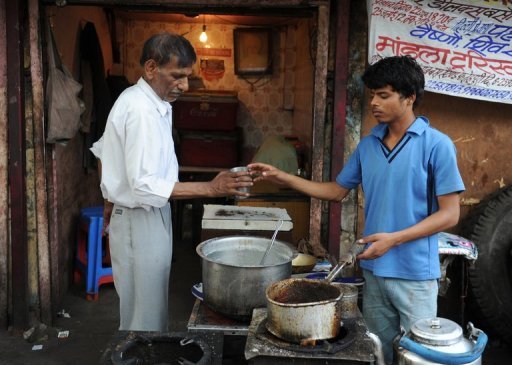
New Delhi, July 6: Ram Singh, 17, earns just one dollar from the 100 cups of tea he makes every day outside Delhi railway station, but each evening, after packing up, he goes to the bank and deposits nearly half of it.

Singh holds an account at a special bank, run for — and mostly by — Indian street children, that keeps what little money they have safe and seeks to instill the idea that savings, however meagre, are important.

Just one among millions of street children who rely on menial jobs for survival, Singh is determined to make his work pay some sort of future dividend.

“I’m smart, but that alone isn’t enough to start a business.

“I save money everyday, hoping to start something of my own. Someday soon,” he said as he served glasses of India’s ubiquitous, spicy milk tea in sweltering heat at a stall near the teeming train station.

The Children’s Development Khazana (treasure chest) opened its first office in New Delhi 2001 and has since spread across the country and overseas with 300 affiliated branches in India, Nepal, Bangladesh, Afghanistan, Sri Lanka and Kyrgyzstan.

Delhi counts 12 branches with around 1,000 child clients aged between nine and 17.

The brightly painted metal cubicles which serve as teller counters are located in shelters that provide children with free meals and sleeping mats, as well as school classes.

The branches are run almost entirely by and for the children, with account holders electing two volunteer managers from the group every six months.

“Children who make money by begging or selling drugs are not allowed to open an account. This bank is only for children who believe in hard work,” said Karan, a 14-year-old “manager”.

During the day, Karan earns a pittance washing up at wedding banquets or other events. In the evening, he sits at his desk to collect money from his friends, update their pass books and close the bank.

“Some account holders want to withdraw their money. I ask them why and give it to them if other children approve. Everyone earns five per cent interest on their savings.”

An adult staff member is always present to collect the takings at the end of each day, depositing the cash in a nationalised bank to earn the interest component.

Sharon Jacob, who works for the rights group Butterflies that set up the bank, said it aimed to give the children a genuine stake in their own future.

“They work in shops as hawkers or porters but they never had a safe place to keep their money. They were always cheated of it or somebody also stole their money,” Jacob said.

“So this is a place where they could keep their money safely and they are also taught life skills, how to manage their finances. They are taught budgeting, they are taught democratic participation,” Jacob said.

Child labour is officially illegal in India but millions of boys and girls have no choice but to earn a living to support themselves or help their families.

Many move to the cities from rural areas, seeking an escape from grinding poverty or abusive homes.

“I ran away from home at the age of 11 after my father beat me for stealing a kitchen appliance,” said Samir who works in a sweatshop.

“For days I slept on a railway platform. I was beaten by the police and even harassed by the drug peddlers. I wanted to go back home but was ashamed of myself.”

Now 14, Samir lives in the children’s shelter and holds an account in the bank.

“I have saved 4,000 rupees (Dh257) in the last seven months. It’s a good feeling to have some money. I will buy a shirt and a watch for my father and send it to him to seek his apology.”

“He might forgive me and ask me to be with him at home.”


Comments

Add new comment

  • Coastaldigest.com reserves the right to delete or block any comments.
  • Coastaldigset.com is not responsible for its readers’ comments.
  • Comments that are abusive, incendiary or irrelevant are strictly prohibited.
  • Please use a genuine email ID and provide your name to avoid reject.
News Network
July 26,2020

New Delhi, Jul 26: India reported a spike of 48,661 coronavirus cases in the last 24 hours, said the Union Ministry of Health and Family Welfare on Sunday.

The total COVID-19 positive cases stand at 13,85,522, including 4,67,882 active cases, 8,85,577 cured/discharged/migrated, it added.
With 705 deaths in the last 24 hours, the cumulative toll reached 32,063.

Maharashtra has reported 3,66,368 coronavirus cases, the highest among states and Union Territories in the country.

A total of 2,06,737 cases have been reported from Tamil Nadu till now, while Delhi has recorded a total of 1,29,531 coronavirus cases.

According to the Indian Council of Medical Research (ICMR), 4,42,263 samples were tested for coronavirus on Saturday and overall 1,62,91,331 samples have been tested so far.

Comments

Add new comment

  • Coastaldigest.com reserves the right to delete or block any comments.
  • Coastaldigset.com is not responsible for its readers’ comments.
  • Comments that are abusive, incendiary or irrelevant are strictly prohibited.
  • Please use a genuine email ID and provide your name to avoid reject.
Agencies
March 22,2020

New Delhi, Mar 22: The exercise to update the National Population Register (NPR) and the first phase of the Census 2021, scheduled to begin from April 1, are likely to be deferred for an indefinite period due to Coronavirus pandemic, officials said.

A formal order on this effect is expected within a day or two.

Discussions are going on at the highest level of the government and in all probability, the NPR and house listing phase of the Census work will be deferred till the threat of the Coronavirus is over, a home ministry official said.

The exercise to update NPR and the housing listing phase of the Census is scheduled to be carried out across the country from April 1 to September 30.

Last week, the home ministry had said the preparation for the Census 2021 and updation of the NPR were at its peak and they will begin from April 1.

The ministry said this after a conference of the Directors of the Census Operations on status of preparatory work around Census 2021 and NPR updation.

There has been opposition from several state governments to the NPR and some of the assemblies even adopted resolutions expressing reservations on the exercise.

The states which have been opposing the NPR include Kerala, West Bengal, Punjab, Rajasthan, Chhattisgarh and Bihar.

However, most of them also said they will cooperate with the house listing phase of the Census.

The objective of the NPR is to create a comprehensive identity database of every usual resident in the country.

The database would contain demographic as well as biometric particulars, they said.

The notification for the house listing census and NPR exercise came recently amid furore over the contentious Citizenship Amendment Act (CAA).

The home ministry officials said most of the states have notified provisions related to the NPR.

The NPR is a register of usual residents of the country. It is being prepared at the local (village/sub-town), subdistrict, district, state and national levels under provisions of the Citizenship Act, 1955 and the Citizenship (Registration of Citizens and Issue of National Identity Cards) Rules, 2003.

The data for NPR was last collected in 2010 along with the house listing phase of the Census 2011. Updating of this data was done during 2015 by conducting door to door survey.

While updating the register in 2015, the government has asked details like Aadhaar and their mobile number.

This time, the information related to their driving licence and voter ID card may also be gathered, the officials said, adding that PAN card details will not be collected as part of this exercise.

Though information regarding the place of birth of parents will be sought, it is up to the residents whether to respond the question as it is voluntary.

For the purposes of the NPR, a 'resident' is defined as a person who has lived in a local area for the past six months or more, or a person who intends to reside in that area for the next six months.

The law compulsorily seeks to register every citizen of India and issue a national identity card.

The demographic details of every individual are required for every usual resident: name, relationship to head of household, father's name, mother's name, spouse's name (if married), sex, date of birth, marital status, place of birth, nationality (as declared), present address of usual residence, duration of stay at present address, permanent residential address, occupation, educational qualification.

The Union Cabinet has approved Rs 3,941.35 crore for the NPR exercise.

Comments

Add new comment

  • Coastaldigest.com reserves the right to delete or block any comments.
  • Coastaldigset.com is not responsible for its readers’ comments.
  • Comments that are abusive, incendiary or irrelevant are strictly prohibited.
  • Please use a genuine email ID and provide your name to avoid reject.
News Network
January 31,2020

Jan 31: President Ram Nath Kovind on Friday hailed the contentious Citizenship Amendment Act as "historic" in his address to joint sitting of both houses of Parliament, prompting protests by some opposition members.

He also said that debate and discussion on any issue strengthens democracy while violence during protests weaken it.

"The Citizenship Amendment Act is a historic law. It has fulfilled wishes of our founding fathers including Mahatma Gandhi," he said.

"Debate and discussions strengthen democracy, but violence during protests weaken democracy," he said without directly referring to the anti-CAA protests in the country some of which have witnessed violence.

In a reference to abrogation of Article 370, Kovind said there is happiness among people of India that people in Jammu and Kashmir and Ladakh have got rights on par with the rest of the country.

The president said Parliament has created record in the first seven months of the new government headed by Narendra Modi by enacting several landmark legislations.

"My government is taking strong steps for making this decade as India's decade and this century as India's century," he said.

Comments

Add new comment

  • Coastaldigest.com reserves the right to delete or block any comments.
  • Coastaldigset.com is not responsible for its readers’ comments.
  • Comments that are abusive, incendiary or irrelevant are strictly prohibited.
  • Please use a genuine email ID and provide your name to avoid reject.