



India's street children bank on the future

July 6, 2012
street_child

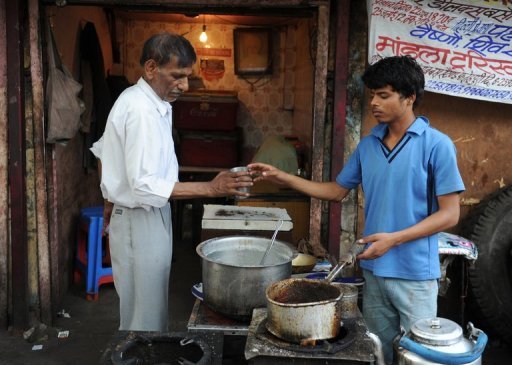
New Delhi, July 6: Ram Singh, 17, earns just one dollar from the 100 cups of tea he makes every day outside Delhi railway station, but each evening, after packing up, he goes to the bank and deposits nearly half of it.

Singh holds an account at a special bank, run for — and mostly by — Indian street children, that keeps what little money they have safe and seeks to instill the idea that savings, however meagre, are important.

Just one among millions of street children who rely on menial jobs for survival, Singh is determined to make his work pay some sort of future dividend.

“I’m smart, but that alone isn’t enough to start a business.

“I save money everyday, hoping to start something of my own. Someday soon,” he said as he served glasses of India’s ubiquitous, spicy milk tea in sweltering heat at a stall near the teeming train station.

The Children’s Development Khazana (treasure chest) opened its first office in New Delhi 2001 and has since spread across the country and overseas with 300 affiliated branches in India, Nepal, Bangladesh, Afghanistan, Sri Lanka and Kyrgyzstan.

Delhi counts 12 branches with around 1,000 child clients aged between nine and 17.

The brightly painted metal cubicles which serve as teller counters are located in shelters that provide children with free meals and sleeping mats, as well as school classes.

The branches are run almost entirely by and for the children, with account holders electing two volunteer managers from the group every six months.

“Children who make money by begging or selling drugs are not allowed to open an account. This bank is only for children who believe in hard work,” said Karan, a 14-year-old “manager”.

During the day, Karan earns a pittance washing up at wedding banquets or other events. In the evening, he sits at his desk to collect money from his friends, update their pass books and close the bank.

“Some account holders want to withdraw their money. I ask them why and give it to them if other children approve. Everyone earns five per cent interest on their savings.”

An adult staff member is always present to collect the takings at the end of each day, depositing the cash in a nationalised bank to earn the interest component.

Sharon Jacob, who works for the rights group Butterflies that set up the bank, said it aimed to give the children a genuine stake in their own future.

“They work in shops as hawkers or porters but they never had a safe place to keep their money. They were always cheated of it or somebody also stole their money,” Jacob said.

“So this is a place where they could keep their money safely and they are also taught life skills, how to manage their finances. They are taught budgeting, they are taught democratic participation,” Jacob said.

Child labour is officially illegal in India but millions of boys and girls have no choice but to earn a living to support themselves or help their families.

Many move to the cities from rural areas, seeking an escape from grinding poverty or abusive homes.

“I ran away from home at the age of 11 after my father beat me for stealing a kitchen appliance,” said Samir who works in a sweatshop.

“For days I slept on a railway platform. I was beaten by the police and even harassed by the drug peddlers. I wanted to go back home but was ashamed of myself.”

Now 14, Samir lives in the children’s shelter and holds an account in the bank.

“I have saved 4,000 rupees (Dh257) in the last seven months. It’s a good feeling to have some money. I will buy a shirt and a watch for my father and send it to him to seek his apology.”

“He might forgive me and ask me to be with him at home.”


Comments

Add new comment

  • Coastaldigest.com reserves the right to delete or block any comments.
  • Coastaldigset.com is not responsible for its readers’ comments.
  • Comments that are abusive, incendiary or irrelevant are strictly prohibited.
  • Please use a genuine email ID and provide your name to avoid reject.
News Network
May 21,2020

New Delhi, May 21: As many as 5,609 new COVID-19 cases were reported in India in the last 24 hours, taking the total number of cases in the country to 1,12,359 according to the Union Ministry of Health and Family Welfare.

Out of the total cases, 63,624 are active cases, 45,300 patients have been cured/discharged or have migrated and 3,435 deaths have been reported.

With 39,297 cases in total, Maharashtra remains the worst affected state in the country, followed by Tamil Nadu (13,191 cases), Gujarat (12,537 cases), and Delhi (11,088 cases).

The nationwide lockdown imposed as a precautionary measure to contain the spread of coronavirus has been extended till May 31.

Comments

Add new comment

  • Coastaldigest.com reserves the right to delete or block any comments.
  • Coastaldigset.com is not responsible for its readers’ comments.
  • Comments that are abusive, incendiary or irrelevant are strictly prohibited.
  • Please use a genuine email ID and provide your name to avoid reject.
News Network
June 25,2020

New Delhi, Jun 25: India registered its worst single-day increase in COVID-19 cases on Thursday, recording more than 16,000 coronavirus infections, to push the overall tally to 4.73 lakh as the number of fatalities also jumped by 418, the Union Health Ministry said.

This was the sixth consecutive day when coronavirus cases increased by more than 14,000. On June 20, the country registered an increase of 14,516 cases. On June 21, the increase was of 15,413 cases; 14,821 cases on June 22; 14,933 cases on June 23; and 15,968 cases on June 24.

Consequently, India added 92,573 cases since June 20, and over 2.82 lakh this month since June 1.

The health ministry data updated at 8am on Thursday showed the daily tally increased by the highest-ever 16,922 cases to reach 4,73,105, while the total deaths climbed to 14,894 with 418 new fatalities.

However, according to the data, the recovery rate has improved to 57.43 per cent. The number of active cases stands at 1,86,514 while 2,71,696 people have recovered; one patient has migrated.

The total number of confirmed cases included foreigners.

According to ICMR, a total of 75,60,782 samples have been tested up to June 24 with 2,07,871 samples being tested on Wednesday.

Of the 418 new deaths, 208 were in Maharashtra, 64 in Delhi, 33 in Tamil Nadu, 25 in Gujarat, 14 in Karnataka, 11 in West Bengal, 10 each in Rajasthan and Haryana, nine in Madhya Pradesh, eight each in Uttar Pradesh and Punjab, five each in Andhra Pradesh, Telangana and Uttarakhand.

Bihar, Goa and Jammu and Kashmir have reported one COVID-19 fatality each.

Of the total fatalities, Maharashtra tops the tally with 6,739 deaths followed by Delhi (2,365), Gujarat (1,735), Tamil Nadu (866), Uttar Pradesh (596), West Bengal (591), Madhya Pradesh (534), Rajasthan (375) and Telangana (225).

The COVID-19 death toll reached 188 in Haryana, 164 in Karnataka, 124 in Andhra Pradesh, 113 in Punjab, 88 in Jammu and Kashmir, 57 in Bihar, 35 in Uttarakhand, 22 in Kerala and 17 in Odisha.

Chhattisgarh has registered 12 deaths, Jharkhand 11, Assam and Puducherry nine each, Himachal Pradesh eight, Chandigarh six, Goa two and Meghalaya, Tripura and Ladakh have reported one fatality each.

More than 70 per cent deaths took place due to comorbidities, the health ministry said.

Maharashtra has reported the highest number of cases at 1,42,900 followed by Delhi at 70,390, Tamil Nadu at 67,468, Gujarat at 28,943, Uttar Pradesh at 19,557, Rajasthan at 16,009 and West Bengal at 15,173, according to ministry data.

The number of COVID-19 cases has gone up to 12,448 in Madhya Pradesh, 12,010 in Haryana, 10,444 in Telangana,10,331 in Andhra Pradesh and 10,118 in Karnataka.

It has risen to 8,209 in Bihar, 6,422 in Jammu and Kashmir, 6,198 in Assam and 5,752 in Odisha. Punjab has reported 4,627 novel coronavirus infections so far, while Kerala has 3,603 cases.

A total of 2,623 people have been infected by the virus in Uttarakhand, 2,419 in Chhattisgarh, 2,207 in Jharkhand, 1,259 in Tripura, 970 in Manipur, 951 in Goa, 941 in Ladakh and 806 in Himachal Pradesh.

Puducherry has recorded 461 COVID-19 cases, Chandigarh has 420, Nagaland has 347, Arunachal Pradesh has 158 and Mizoram has 142 cases.

Dadra and Nagar Haveli and Daman and Diu together have reported 120 COVID-19 cases.

Sikkim has 84, Andaman and Nicobar Islands has registered 56 infections so far while Meghalaya has recorded 46 cases.

"Our figures are being reconciled with the ICMR (Indian Council of Medical Research)," the ministry said, adding 8,493 cases are being reassigned to states.

State-wise distribution is subject to further verification and reconciliation, it added.

Comments

Add new comment

  • Coastaldigest.com reserves the right to delete or block any comments.
  • Coastaldigset.com is not responsible for its readers’ comments.
  • Comments that are abusive, incendiary or irrelevant are strictly prohibited.
  • Please use a genuine email ID and provide your name to avoid reject.
News Network
January 3,2020

Dhaka, Jan 3: Bangladesh's paramilitary force chief said on Thursday that a total of 445 Bangladeshi nationals returned from India in last two months following the publication of the National Register of Citizens (NRC) by the Indian government.

Border Guard Bangladesh (BGB) Director General Maj Gen Md Shafeenul Islam disclosed the figure during a press briefing here.

"About 1,000 people were arrested in 2019 for illegal border crossings from India to Bangladesh, with 445 of them returning home in November and December," he said.

After verifying their identities through local representatives, BGB came to know that all the intruders are Bangladeshis, Islam said, adding that 253 cases were lodged against them for illegal trespass, while initial investigations found that at least three of them were human traffickers.

The BGB Director said the trespassing did not create any tension between the border forces of Bangladesh and India.

Last week, Islam visited India where he said that the creation of the NRC is completely an "internal affair" of India and the cooperation between the border guarding forces of the two countries is very good.

He said the BGB will continue to do its work of preventing illegal border crossings as per its mandate.

A BGB delegation, led by Islam, was on a bilateral visit to India to hold DG-level border talks with its counterparts, the Border Security Force (BSF).

The talks took place from December 26-29, during which a host of issues related to cross-border smuggling and activities of criminals and others along the 4,096-km-long front were discussed.

Responding to a question, Islam said, "No discussion was held at the conference over the (NRC) issue".

He said during the five-day talks held in New Delhi, the BGB demanded that the BSF should take effective steps to prevent killings of Bangladeshis on frontiers as casualty figures sharply rose in 2019.

"The number of border killings in 2019 was highest in the last four years. As per our calculation, the number of such unexpected deaths was 35," the BGB chief said.

However, the BSF estimate of the casualty figure is much lower than our calculation, he said.

Islam said the BSF is following the policy of maintaining maximum restraint and minimal use of force even after being attacked by "armed border offenders".

A statement issued by the BSF last month in New Delhi after the conclusion of the DG-level talks said, "On the concern of the BGB regarding the death of Bangladeshi nationals on borders, it was informed to them that a non-lethal weapon policy is strictly followed by BSF personnel on borders.

"Firing is resorted to only in self-defence, when BSF patrols are gheraoed and attacked by ‘dah’ (a sharp-edged weapon) etc. It was specified that the BSF does not discriminate between criminals based on nationality," it said.

Comments

Add new comment

  • Coastaldigest.com reserves the right to delete or block any comments.
  • Coastaldigset.com is not responsible for its readers’ comments.
  • Comments that are abusive, incendiary or irrelevant are strictly prohibited.
  • Please use a genuine email ID and provide your name to avoid reject.