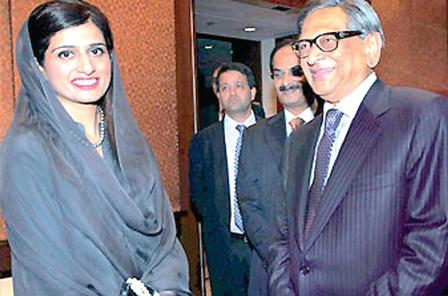
Krishna meets Khar, discusses terror

July 8, 2012

tokyo

Tokyo, July 8: External Affairs Minister S.M. Krishna Sunday met his Pakistani counterpart Hina Rabbani Khar here and pressed Islamabad to act on disclosures made by 26/11 handler Abu Jundal that links Pakistani state agencies with the Mumbai terror attack.

The meeting between Krishna and Khar took place on the sidelines of the international conference on Afghanistan in the Japanese capital.

Krishna raised the disclosures made by Abu Jundal, which corroborate claims of David Headly, another 26/11 plotter now in the US custody, about the involvement of Pakistani state actors in the 2008 attack.

The issue figured prominently in discussions between Indian Foreign Secretary Ranjan Mathai and his Pakistani counterpart Jalil Abbas Jilani in New Delhi this month.

India had then asked Pakistan to act on the information on Jundal's disclosures and underlined that bringing perpetrators of 26/11 carnage to justice would be the biggest confidence building measure between the two countries.

Pakistan has denied the involvement of state actors in the Mumbai attack and offered a joint probe into Jindal's disclosures.


Comments

Add new comment

  • Coastaldigest.com reserves the right to delete or block any comments.
  • Coastaldigset.com is not responsible for its readers’ comments.
  • Comments that are abusive, incendiary or irrelevant are strictly prohibited.
  • Please use a genuine email ID and provide your name to avoid reject.
News Network
January 10,2020

Mumbai, Jan 10: India’s oil demand growth is set to overtake China by mid-2020s, priming the country for more refinery investment but making it more vulnerable to supply disruption in the Middle East, the International Energy Agency (IEA) said on Friday.

India’s oil demand is expected to reach 6 million barrels per day (bpd) by 2024 from 4.4 million bpd in 2017, but its domestic production is expected to rise only marginally, making the country more reliant on crude imports and more vulnerable to supply disruption in the Middle East, the agency said.

China’s demand growth is likely to be slightly lower than that of India by the mid-2020s, as per IEA’s China estimates given in November, but the gap would slowly become bigger thereafter.

“Indian economy is and will become even more exposed to risks of supply disruptions, geopolitical uncertainties and the volatility of oil prices,” the IEA said in a report on India’s energy policies.

Brent crude prices topped USD 70 a barrel on rising geopolitical tensions in the Middle East, putting pressure on emerging markets such as India. Like the rest of Asia, India is highly dependent on Middle East oil supplies with Iraq being its largest crude supplier.

India, which ranks No 3 in terms of global oil consumption after China and the United States, ships in over 80 per cent of its oil needs, of which 65 per cent is from the Middle East through the Strait of Hormuz, the IEA said.

The IEA, which coordinates release of strategic petroleum reserves (SPR) among developed countries in times of emergency, said it is important for India to expand its reserves.

REFINERY INVESTMENTS

India is the world’s fourth largest oil refiner and a net exporter of refined fuel, mainly gasoline and diesel.

India has drawn plans to lift its refining capacity to about 8 million bpd by 2025 from the current about 5 million bpd.

The IEA, however, forecasts India’s refining capacity to rise to 5.7 million bpd by 2024.

This would make “India a very attractive market for refinery investment,” IEA said.

Drawn to India’s higher fuel demand potential, global oil majors like Saudi Aramco, BP, Abu Dhabi National Oil Co and Total are looking at investing in India’s oil sector.

Saudi Aramco and ADNOC aim to own a 50 per cent stake in a planned 1.2-million bpd refinery in western Maharashtra state, for which land is yet to be acquired.

Comments

Add new comment

  • Coastaldigest.com reserves the right to delete or block any comments.
  • Coastaldigset.com is not responsible for its readers’ comments.
  • Comments that are abusive, incendiary or irrelevant are strictly prohibited.
  • Please use a genuine email ID and provide your name to avoid reject.
Agencies
May 27,2020

Global health experts on Wednesday said novel coronavirus is here to stay for more than a year and called for aggressive testing to prevent its spread.

In an interaction with Congress leader Rahul Gandhi, health experts Professor Ashish Jha and Professor Johan Giesecke talked about the COVID-19 pandemic as part of the series being aired on Congress social media channels.

While Jha exuded confidence that a vaccine will be available in a year's time, Prof Giesecke said India should practice a lockdown that is as 'soft' as possible, as a severe lockdown will ruin its economy very quickly.

"When the economy is opened up after lockdown, you have to create confidence among people," Harvard health expert Ashish Jha told Gandhi.

Jha is a professor of Global Health at TH Chan School of Public Health and Director, Harvard Global Health institute.

He said coronavirus is a '12-18 months' problem and the world is not going to be free of this till 2021.

The expert also called for the need for aggressive testing strategy for high-risk areas.

Gandhi, while interacting with the experts, said life is going to change post COVID-19.

"If 9/11 was a new chapter, this will be a new book," he remarked.

Professor Johan Giesecke, former chief scientist, European Centre for Disease Prevention and Control said India should have a 'soft lockdown'.

"The situation that India is in, I think, you should have a soft lockdown, as soft as possible," he said.

"I think for India, you will ruin your economy very quickly if you have a severe lockdown. It is better, skip the lockdown, take care of the old and the frail...," he noted.

Comments

Add new comment

  • Coastaldigest.com reserves the right to delete or block any comments.
  • Coastaldigset.com is not responsible for its readers’ comments.
  • Comments that are abusive, incendiary or irrelevant are strictly prohibited.
  • Please use a genuine email ID and provide your name to avoid reject.
News Network
July 24,2020

New Delhi, Jul 24: The Delhi High Court on Friday asked the ICMR to come out with a clarification that mobile number, government-issued identity card, photographs or even a residential proof ought not to be insisted upon for Covid-19 test of mentally ill homeless persons.

According to an Indian Council of Medical Research (ICMR) advisory of June 19, every person who was to be tested for Covid-19 has to provide a government-issued identity proof and should have a valid phone number for tracing and tracking the individual and his/her contacts.

A bench of Chief Justice D N Patel and Justice Prateek Jalan said that ICMR should issue a clarification by way of a circular or an official order that the identity proof, address proof and mobile number are not required for testing mentally ill homeless persons.

The high court said a camp can be organised for testing such persons as is being done across Delhi for others.

"Guidelines have to be given by you (ICMR). You put it in black and white for the states'' benefit. You only need to clarify in two-three lines that mobile number, address proof and identity cards are not required for testing mentally ill homeless persons," it said.

"Use your powers for the public at large. Once you do so (issue the clarification), all states will comply," the bench added.

Additional Solicitor General Chetan Sharma, appearing for ICMR, sought time to take instructions from the government regarding the observations made by the bench.

The high court, thereafter, listed the matter for further hearing on August 7.

The bench was hearing a PIL moved by advocate Gaurav Kumar Bansal seeking directions to ICMR and Delhi government to issue guidelines for Covid-19 testing of mentally ill homeless persons in the national capital.

Coronavirus India update: State-wise total number of confirmed cases, deaths on July 24

The high court on July 9 had asked the ICMR to consider the plight of the mentally ill homeless persons and see whether they can be tested without insisting upon a mobile number, government issue identity card and residential address proof.

The bench had said to ICMR that many homeless mentally ill persons are institutionalised or in shelter homes and therefore, traceable, so there was no need for their identity proof or phone numbers to test them for Covid-19.

In response to the court''s query, ICMR has filed an affidavit stating that the purpose behind the submission of government identity card and telephone number was to ensure proper tracking and treatment of positive cases and their contacts as ''Test/Track/Treat'' is the best strategy for control of Covid-19 pandemic. 

It further said that since health was a state subject, the concerned state health authority may consider adopting a suitable protocol to ensure that the strategy of ''Test/Track/Treat'' is followed and the grievance raised in the PIL is also addressed.

ICMR, in its affidavit, has said that it has only advised facilitating contact tracing as well as tracking of the Covid-19 infected patients.

"The modalities regarding the contact tracing as well as tracking of the Covid-19 infected patients completely falls under the domain of IDSP. NCDC and state health authorities. 

"ICMR is a research organization and the contact tracing, as well as tracking of the Covid-19 infected patients, is not under the domain of ICMR," it has said in its affidavit.

Bansal has claimed in his petition that the Delhi government has not taken seriously the lack of guidelines with respect to Covid-19 testing of mentally ill homeless persons.

Coronavirus Worldometer | 15 countries with the highest number of cases, deaths due to the Covid-19 pandemic

He has said the high court had on June 9 directed it to address the grievances raised by him in another PIL with regard to mentally ill homeless persons in accordance with law, rules, regulations and government policy.

He said that on June 13 he also sent a representation to the Chief Secretary of Delhi government for providing treatment to mentally ill homeless persons in the national capital who have no residence proof. 

However, nothing was done by the Delhi government, he had told the court.

Comments

Add new comment

  • Coastaldigest.com reserves the right to delete or block any comments.
  • Coastaldigset.com is not responsible for its readers’ comments.
  • Comments that are abusive, incendiary or irrelevant are strictly prohibited.
  • Please use a genuine email ID and provide your name to avoid reject.