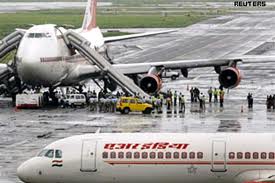
Air India plane makes emergency landing in Pakistan

July 9, 2012

india

New Delhi, July 9: An Air India plane made an emergency landing at Nawabshah airport in Sindh in Pakistan on Monday at 3:30 am. The flight, Airbus 319, was on it's way from Abu Dhabi to New Delhi.

Local media reports say all 130 passengers on board the Air India flight were still inside the plane, but were safe. The flight was forced to land due to a suspected hydraulic failure.

A relief plane will take off from Delhi for the Nawabshah Airport at 10:30am. A technical team will also be taken on the relief plane to repair the damaged aircraft.

The captain of the Airbus aircraft, going from Abu Dhabi to New Delhi, contacted Pakistani authorities and sought permission for an emergency landing after detecting the problem with the hydraulic system, Civil Aviation Authority spokesman Pervez George told PTI.

In New Delhi, an Air India spokesperson said, "The aircraft was flying over Pakistan air space when the pilot saw a warning light in the cockpit and sought permission to land at the nearest airport which was Nawabshah."

The captain preferred to have the passengers remain on board the aircraft though Pakistani authorities had offered to allow them to disembark, George said.


Comments

Add new comment

  • Coastaldigest.com reserves the right to delete or block any comments.
  • Coastaldigset.com is not responsible for its readers’ comments.
  • Comments that are abusive, incendiary or irrelevant are strictly prohibited.
  • Please use a genuine email ID and provide your name to avoid reject.
News Network
January 15,2020

New Delhi, Jan 15: The mother of 23-year-old paramedic student, who was raped and brutally assaulted by six men in December 2012, on Tuesday said she knew that the curative petitions of the convicts will be rejected and is confident that they will be hanged on January 22.

Her remarks came after the Supreme Court on Tuesday refused to stay the execution of two of the four death row convicts in the 2012 Nirbhaya gang rape and murder case while dismissing their curative petitions against their conviction and capital punishment.

"The curative please had to be rejected. This was the third time they had gone to the Supreme Court. Whatever pleas they file, we are ready to face them and we will fight it out. We feel that they will be hanged on January 22. We want that to happen," Nirbhaya's mother told PTI over phone.

The four convicts -- Vinay Sharma (26), Mukesh Kumar (32), Akshay Kumar Singh (31) and Pawan Gupta (25) -- are to be hanged on January 22 at 7 am in Tihar jail as a Delhi court issued their death warrants on January 7.

Vinay and Mukesh had filed curative petitions on January 9.

Shortly after the apex court refused to stay the execution of two of them, Mukesh moved a mercy petition before President Ram Nath Kovind.

Mukesh also approached the Delhi High Court for quashing the death warrant. The high court is expected to take up his petition on Wednesday.

Comments

Add new comment

  • Coastaldigest.com reserves the right to delete or block any comments.
  • Coastaldigset.com is not responsible for its readers’ comments.
  • Comments that are abusive, incendiary or irrelevant are strictly prohibited.
  • Please use a genuine email ID and provide your name to avoid reject.
News Network
February 24,2020

New Delhi, Feb 24: They hail from vastly different backgrounds — Donald Trump is the son of a property tycoon while Narendra Modi is a descendant of a poor tea-seller.

Yet the two teetotallers, loved by right-wing nationalists in their home countries, share striking similarities that have seen them forge a close personal bond, analysts say.

Ahead of the American leader's first official visit to India, which begins in Modi's home state of Gujarat on Monday, the world's biggest democracy has gone out of its way to showcase the chemistry between them.

In Gujarat's capital Ahmedabad, large billboards with the words "two dynamic personalities, one momentous occasion" and "two strong nations, one great friendship" have gone up across the city.

"There's a lot that Trump and Modi share in common, and not surprisingly these convergences have translated into a warm chemistry between the two," Michael Kugelman of the Washington-based Wilson Center said.

"Personality politics are a major part of international diplomacy today. The idea of closed-door dialogue between top leaders has often taken a backseat to very public and spectacle-laden summitry."

Since assuming the top political office in their respective countries — Modi in 2014 and Trump in 2017 — the two men have been regularly compared to each other.

Trump, 73, and Modi, 69, both command crowds of adoring flag-waving supporters at rallies. A virtual cult of personality has emerged around them, with their faces and names at the centre of their political parties' campaigns.

A focus of Trump's administration has been his crackdown on migrants, including a travel ban that affects several Muslim-majority nations, among others, while critics charge that Modi has sought to differentiate Muslims from other immigrants through a contentious citizenship law that has sparked protests.

Both promote their countries' nationalist and trade protectionist movements — Trump with his "America First" clarion call and Modi with his "Make in India" mantra.

And while they head the world's largest democracies, critics have described the pair as part of a global club of strongmen that includes Russia's Vladimir Putin and Brazil's Jair Bolsonaro.

"There are many qualities that Trump and Modi share — a love for political grandstanding and an unshakable conviction that they can achieve the best solutions or deals," former Indian diplomat Rakesh Sood said.

Modi and Trump have sought to use their friendship to forge closer bonds between the two nations, even as they grapple with ongoing tensions over trade and defence.

Despite sharing many similarities in style and substance, analysts say there are some notable differences between the pair.

Modi is an insider who rose through the ranks of the Bharatiya Janata Party after starting out as a cadre in Rashtriya Swayamsevak Sangh.

Trump is a businessman and a political outsider who has in some sense taken over the Republican Party.

"Modi is a more conventional leader than is Trump in that he hasn't sought to revolutionise the office he holds in the way that Trump has," said Kugelman, a longtime observer of South Asian politics.

He added that genuine personal connections between leaders of both countries have helped to grow the partnership.

"George Bush and Manmohan Singh, Barack Obama and Singh, Obama and Modi, now Modi and Trump — there has been a strong chemistry in all these pairings that has clearly helped the relationship move forward," he added.

Trump has also stood by the Indian leader during controversial decisions, including his revocation of autonomy for Kashmir and his order for jets to enter Pakistani territory following a suicide bombing.

Analysts said the leaders would use the visit to bolster their image with voters.

A mega "Namaste Trump" rally in Ahmedabad on Monday will be modelled after the "Howdy, Modi" Houston extravaganza last year when the Indian leader visited the US and the two leaders appeared before tens of thousands of Indian-Americans at a football stadium.

"The success of this visit... will have a positive impact on his (Trump's) re-election campaign and the people of Indian origin who are voters in the US — a majority of them are from Gujarat," former Indian diplomat Surendra Kumar said.

"On the Indian side, the fact that Prime Minister Modi... (shares) such warmth, bonhomie and informality with the most powerful man on Earth adds to his stature... as well as with hardcore supporters."


Comments

Add new comment

  • Coastaldigest.com reserves the right to delete or block any comments.
  • Coastaldigset.com is not responsible for its readers’ comments.
  • Comments that are abusive, incendiary or irrelevant are strictly prohibited.
  • Please use a genuine email ID and provide your name to avoid reject.
News Network
June 19,2020

Jun 19: Ten Indian Army soldiers including four officers were released by the China’s People’s Liberation Army (PLA) on Friday capping three days of hard negotiations that followed the bloody battle at the eastern Ladakh’s Galwan valley on Monday.

The 10 jawans returned around 5.30 PM on Friday to Patrol Point 14 (PP-14) after Indian team leader Major Gen. Abhijit Bapat, the commanding officer of the Third Div made it clear to the Chinese that there couldn’t be any progress in the disengagement talks unless the soldiers were returned safely.

Asked to comment on the release of Indian soldiers, the Indian Army maintained silence. The force released a brief statement on Thursday stating that all its men were accounted for.

However, the extent of the brutal clash can be gauged from the fact that 76 Indian Army soldiers are still in the hospital out of which 58 soldiers have “minor injuries” and “should be back on duty within a week”, according to Army sources.

Return of the Indian soldiers has been the main point of negotiations for the last two days. The situation is now calmer at areas near PP-14 in the Galwan valley after the return of Indian soldiers even though large numbers of troops from both sides are still present in the area.

Meanwhile analysis of satellite images has revealed a large presence of Chinese troops in the northern banks of Pangong Tso, a disputed territory for years.

“In the past month, Chinese forces have become an overwhelming majority in the disputed areas (on the north bank of the 135 km long lake). Significant positions have been constructed between Fingers 4 and 5, including around 500 structures, fortified trenches and a new boat shed over 20 km further forward than previously. More structures appear to be under construction,” says a report published in the Strategist, the journal of the Australian Strategic Policy Institute.

“The scale and provocative nature of these new Chinese outposts is hard to overstate: 53 different forward positions have been built, including 19 that sit exactly on the ridge line separating Indian and Chinese patrols,” says the report, accompanied by satellite images showing overwhelming PLA presence.

The June 6 Corps Commander level meeting between the Indian and PLA armies did not result in a solution to the contentious muscle flexing by the Chinese on the shores of the Pangong lake. The meeting ended with the conclusion that more Lt Gen level talks between the two armies were needed to resolve such issues.

Comments

Add new comment

  • Coastaldigest.com reserves the right to delete or block any comments.
  • Coastaldigset.com is not responsible for its readers’ comments.
  • Comments that are abusive, incendiary or irrelevant are strictly prohibited.
  • Please use a genuine email ID and provide your name to avoid reject.