


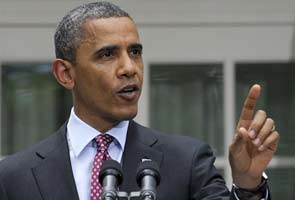
Obama not properly informed, says Government on reforms remark; Opposition slams him

July 16, 2012

obama16

New Delhi, July 16: India has dismissed Barack Obama's statement that the investment climate in India is "deteriorating," suggesting that the US President is "not properly informed" about the country's strong economic fundamentals. And that certain "international lobbies" are attempting such misinformation. Mr Obama's weekend statement has raised the hackles of not just the government, but also opposition parties of every hue.

The US President had said on Sunday, "In too many sectors, such as retail, India limits or prohibits the foreign investment that is necessary to create jobs in both our countries, and which is necessary for India to continue to grow... there appears to be a growing consensus in India that the time may be right for another wave of economic reforms to make India more competitive in the global economy."

Corporate Affairs Minister M Veerappa Moily made a strong rejoinder saying, "Certain international lobbies like Vodafone are spreading this kind of a story and Obama was not properly informed about the things that are happening, particularly when India's economic fundamentals are strong."

In an interview to Press Trust of India, the minister also said that the perception of a deteriorating investment climate in India was not based on economic parameters, but on certain impressions of a few individuals, entrepreneurs and investors. "That is also being removed. Once that perception is removed, I think in 2-3 months, we are back again with a kickstart to pick up the same speed as we had done in the last decade," he added.

The minister was emphatic that there was no crisis in India, whereas the US and other countries had faced crises, "not once but twice in 2008 and 2010". "Not even a single financial institution has collapsed in this country, whereas many such things have collapsed in US and other countries," he said.

In the last one decade, India had registered a vibrant growth rate of 8 to 9.5 per cent, he said, adding "but perhaps for the economic crisis in the US and Europe, the country would have definitely crossed 10 per cent of the GDP."

"That is the potential of India which can recover back immediately by taking some remedial steps," Mr Moily said. He said 55 per cent of the investment in the form of Foreign Institutional Investors (FIIs) and Foreign Direct Investment (FDI) comes from as many as ten countries like Mauritius, Cyprus and Singapore, and only 19 per cent comes from the US and other countries.

"Ultimately Prime Minister Manmohan Singh is going to address all these problems and it is being considered. That's why, again, the investment climate is picking up," he said.

In this, the government's position is backed firmly by the Opposition. The BJP has taken umbrage at Mr Obama saying that India prohibits foreign investment in too many sectors. The party's Yashwant Sinha, a former Finance Minister, said India could not open its markets just because the US President wished it. "If Obama wants FDI in retail and India does not want, then it won't come just because he is demanding it," said Mr Sinha.

Noting that India prohibited foreign investment in too many sectors such as retail, Mr Obama had, on Sunday, cited concerns over the deteriorating investment climate to endorse another "wave" of economic reforms. (Read)

The party's Mukhtar Abbas Naqvi said the US President's remarks were "laughable". "That country is giving us a certificate on investment and economy when it itself is facing economic problems. We have to ensure our national interests on our own," he said.

The CPI-M reacted strongly too. "They want to open up our economy and market on their terms. For this purpose they are creating this pressure...as it is, no one believes that under the present situation, there will be any sea change in the investment scenario world over," said party leader Nilotpal Basu.

The BJP and the Left have opposed FDI, especially in retail, citing interests of the small trader.

The Samajwadi Party, which is extending outside support to the Congress-led United Progressive Allinace (UPA) at the Centre, too said India would not take a decision in support of the United States. "They only want their market to expand in our country," party leader Shahid Siddique said.


Comments

Add new comment

  • Coastaldigest.com reserves the right to delete or block any comments.
  • Coastaldigset.com is not responsible for its readers’ comments.
  • Comments that are abusive, incendiary or irrelevant are strictly prohibited.
  • Please use a genuine email ID and provide your name to avoid reject.
News Network
April 1,2020

Prayagraj,  April 1: Seven Indonesian nationals, one person from Kolkata and one from Kerala who had attended the event at Delhi's Nizamuddin Markaz have been put under quarantine, informed SP (City) Prayagraj, Brijesh Kumar Srivastava on Wednesday.

"Seven Indonesian nationals, one person from Kolkata and one from Kerala, were found at Abdullah mosque here. During the investigation, it was found that they had attended the Markaz gathering in Delhi. These people, along with 28 people who came in contact with them, have been quarantined." he said.

"A case has also been registered against them for not informing the police on reaching here," he added.

Earlier, Delhi Health Minister Satyendar Jain had said that the officials are not certain of the accurate number of people who participated in the event but it is being estimated that 1,500-1,700 people had assembled at the Markaz building.

The religious gathering was held at the Markaz building in Nizamuddin between March 13 and March 15.

The total number of active cases rose to 1466 in the country, while 132 people have been cured and discharged after receiving treatment, as of 9 am.

The number of deaths due to the infection also rose to 38, while one person has migrated.

Comments

Add new comment

  • Coastaldigest.com reserves the right to delete or block any comments.
  • Coastaldigset.com is not responsible for its readers’ comments.
  • Comments that are abusive, incendiary or irrelevant are strictly prohibited.
  • Please use a genuine email ID and provide your name to avoid reject.
News Network
June 18,2020

New Delhi, Jun 18: The Delhi High Court Thursday asked the Delhi Police to file status report on a plea by Jamia Coordination Committee member Safoora Zargar, who was arrested under the anti-terror law --UAPA -- seeking bail in a case related to communal violence in northeast Delhi during protests against the Citizenship Amendment Act in February.

Zargar, M Phil student of Jamia Millia Islamia University, is more than four months pregnant.

Justice Rajiv Shakdher issued notice to the police and asked it to file a status report on the bail plea.

The high court listed the matter for further hearing on June 22.

Zargar, who was arrested by the Special Cell of Delhi Police on April 10, has challenged the June 4 order of the trial court denying her bail in the case.

The trial court, in its order, had said “when you choose to play with embers, you cannot blame the wind to have carried the spark a bit too far and spread the fire.”

It had said that during the course of investigation a larger conspiracy was discernible and if there was prima evidence of conspiracy, acts and statements made by any one of the conspirators, it is admissible against all.

The court had said that even if there was no direct act of violence attributable to the accused (Zargar), she cannot shy away from her liability under the provisions of the Unlawful Activities (Prevention) Act (UAPA).

However, the trial court had asked the concerned jail superintendent to provide adequate medical aid and the assistance to Zargar.

The police had earlier claimed that Zargar allegedly blocked a road near Jaffrabad metro station during the anti-CAA protests and instigated people that led to the riots in the area.

It further claimed that she was allegedly part of the “premediated conspiracy” to incite communal riots in northeast Delhi in February.

Communal clashes had broken out in northeast Delhi on February 24 after violence between citizenship law supporters and protesters spiralled out of control leaving at least 53 people dead and scores injured.

Comments

Add new comment

  • Coastaldigest.com reserves the right to delete or block any comments.
  • Coastaldigset.com is not responsible for its readers’ comments.
  • Comments that are abusive, incendiary or irrelevant are strictly prohibited.
  • Please use a genuine email ID and provide your name to avoid reject.
News Network
June 9,2020

Jun 9: Prime Minister Narendra Modi wants all 1.3 billion Indians to be “vocal for local” — meaning, to not just use domestically made products but also to promote them. As an overseas citizen living in Hong Kong, I’m doing my bit by very vocally demanding Indian mangoes on every trip to the grocery. But half the summer is gone, and not a single slice so far.

My loss is due to India’s COVID-19 lockdown, which has severely pinched logistics, a perennial challenge in the huge, infrastructure-starved country. But more worrying than the disruption is the fruity political response to it. Rather than being a wake-up call for fixing supply chains, the pandemic seems to be putting India on an isolationist course. Why?

Granted that the liberal view that trade is good and autarky bad isn’t exactly fashionable anywhere right now. What makes India’s lurch troublesome is that the pace and direction of economic nationalism may be set by domestic business interests. The Indian liberals, many of whom are Western-trained academics, authors and — at least until a few years ago — policy makers, want a more competitive economy. They will be powerless to prevent the slide.

Modi’s call for a self-reliant India has been echoed by Home Minister Amit Shah, the cabinet’s unofficial No. 2, in a television interview. If Indians don’t buy foreign-made goods, the economy will see a jump, he said. The strategy — although it’s too nebulous yet to call it that — has a geopolitical element. A military standoff with China is under way, apparently triggered by India’s completion of a road and bridge near the common border in the tense Himalayan region of Ladakh. It’s very expensive to fight even a limited war there. With India’s economy flattened by COVID, New Delhi may be looking for ways to restore the status quo and send Beijing a signal.

Economic boycotts, such as Chinese consumers’ rejection of Japanese goods over territorial disputes in the East China Sea, are well understood as statecraft. In these times, it’s not even necessary to name an enemy. An undercurrent of popular anger against China, the source of both the virus and India’s biggest bilateral trade deficit, is supposed to do the job. But is it ever that easy?

A hastily introduced policy to stock only local goods in police and paramilitary canteens became a farcical exercise after the list of banned items ended up including products by the local units of Colgate-Palmolive Co., Nestle SA, and Unilever NV, which have had significant Indian operations for between 60 and 90 years, as well as Dabur India Ltd., a New Delhi-based maker of Ayurveda brands. The since-withdrawn list demonstrates the practical difficulty of bureaucrats trying to find things in a globalized world that are 100% indigenous.

Free-trade champions fret that the prime minister, whom they saw as being on their side six years ago, is acting against their advice to dismantle statist controls on land, labor and capital to help make the country more competitive. Engage with the world more, not less, they caution. But Modi also has to satisfy the Rashtriya Swayamsevak Sangh, the umbrella Hindu organisation that gets him votes. Its backbone of small traders, builders and businessmen — the RSS admits only men — was losing patience with the anemic economy even before the pandemic. Now, they’re in deep trouble, because India’s broken financial system won’t deliver even state-guaranteed loans to them.

The U.S.-China tensions — over trade, intellectual property, COVID responsibility and Hong Kong’s autonomy — offer a perfect backdrop. A dire domestic economy and trouble at the border provide the foreground. Big business will dial economic nationalism up and down to hit a trifecta of goals: Block competition from the People's Republic; make Western rivals fall in line and do joint ventures; and tap deep overseas capital markets. The first goal is being achieved with newly placed restrictions on investment from any country that shares a land border with India. The second aim is to be realized by corporate lobbying to influence India's whimsical economic policies. As for the third objective, with the regulatory environment becoming tougher for U.S.-listed Chinese companies like Alibaba Group Holding Ltd., an opportunity may open up for Indian firms.

All this may bring India Shenzhen-style enclaves of manufacturing and trade, but it will concentrate economic power in fewer hands, something that worries liberals. They’re moved by the suffering of India’s low-wage workers, who have borne the brunt of the COVID shutdown. But when their vision of a more just society and fairer income distribution prompts them to make common cause with the ideological Left, they’re quickly repelled by the Marxist voodoo that all cash, property, bonds and real estate held by citizens or within the nation “must be treated as national resources available during this crisis.” Who will invest in a country that does that instead of just printing money?

At the same time, when liberals look to the business class, they see a sudden swelling of support for ideas like a universal basic income. They wonder if this isn’t a ploy by industry to outsource part of the cost of labor to the taxpayer. Slogans like Modi’s vocal-for-local stir the pot and thicken the confusion. The value-conscious Indian consumer couldn’t give two hoots for calls to buy Indian, but large firms will know how to exploit economic nationalism. One day soon, I’ll get my mangoes — from them.

Comments

Add new comment

  • Coastaldigest.com reserves the right to delete or block any comments.
  • Coastaldigset.com is not responsible for its readers’ comments.
  • Comments that are abusive, incendiary or irrelevant are strictly prohibited.
  • Please use a genuine email ID and provide your name to avoid reject.