


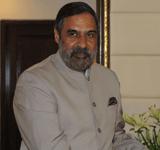
Policy making our "sovereign" right, Sharma tells Obama

July 16, 2012

policym

New Delhi, July 16: Asserting that policy decision is "sovereign" right of the country, Commerce and Industry Minister Anand Sharma today said the Barack Obama administration should itself lead the fight against protectionism and trade barriers.

In his reaction to the US President's remarks that India must carry out difficult economic reforms, Sharma said," "he (Obama) has every right to convey what his perceptions are but the policy making is a sovereign decision and India's FDI policy regime is investor-friendly".

Obamba in an interview to PTI noted that India prohibits foreign investment in too many sectors such as retail and endorsed another wave of economic reforms.

"It is still too hard to invest in India. In too many sectors, such as retail, India limits or prohibits the foreign investment...which is necessary for India to continue to grow," Obama has said.

Citing different reports, Sharma said India remains one of the attractive destinations for foreign direct investment as most of the sectors are open for FDI.

"...by all indications it is the regime, the climate that we have created in India through various policy measures, reforms, simplification, rationalisation. We have followed a calibrated approach in following the path of economic reforms," he told reporters here.

Besides, several Indian companies have made big investments abroad including in the US creating over half a million jobs in America at a time of job losses there.

"We would rather urge the US to demonstrate leadership in bringing down barriers, encouraging capital flows and trade in the world which is good for every economy. The US should be leading the fight against protectionism and taking forward the stalled Doha Development Round of the WTO to a meaningful conclusion," he added.

Indian industry and the government has been protesting against several protectionist measures in the US including hike in visa fee which has affected India's software companies like Infosys and TCS.

Sharma said when it comes to taking more decision,"the Prime Minister has said and I am also saying that we are committed to continue following our roadmap of economic reforms...we have an abiding commitment to reforms. We remain an attractive destination and we will continue to be".

However, the government takes decision after an "inclusive" process of consultations, he said.

"We have taken note of his (Obama) observations. There is always a difference between perception and reality," he said.

Economic Affairs Secretary in the Finance Ministry R Gopalan said the government, "in its wisdom will take appropriate decision at right time".

The government has been facing a criticism from a section of the industry and overseas investors for being slow in reforms, particularly with regard to allowing FDI in multi-brand retail. Facing opposition from its key ally, Trinamool Congress, it could not implement the Cabinet decision of November 2011 to allow 51 per cent FDI in multi-brand retail.

Sharma said that UNCTAD in its report has ranked India as the third important destination to attract FDI.

"JBIC (Japan Bank for International Cooperation) has also placed India at number two, and in the long term they have put India on number one. E&Y has said that over four-fifth of FDI in South Asia has come into India," he said.

He also said that Obama has paid rich tributes to India and its people.

"He (Obama) has talked about about Indian innovation being engine of the global economy. He has said that despite the global gloom, Indian economy has shown a very impressive growth," he said.

On a perception that India is not attracting FDI, he said: "last year we have received FDI in excess of USD 50 billion. Why this perception, I fail to understand...I think there is something wrong in perception, the facts speak otherwise".


Comments

Add new comment

  • Coastaldigest.com reserves the right to delete or block any comments.
  • Coastaldigset.com is not responsible for its readers’ comments.
  • Comments that are abusive, incendiary or irrelevant are strictly prohibited.
  • Please use a genuine email ID and provide your name to avoid reject.
News Network
May 13,2020

New Delhi, May 13: Vice President M. Venkaiah Naidu on Wednesday said that Prime Minister Narendra Modi's announcement of Rs 20 lakh crore stimulus package "will go a long way in overcoming challenges" posed by the COVID-19 pandemic.

"Welcome the Rs. 20 lakh crore stimulus package announced by the Prime Minister, Shri Narendra Bhai Modi Ji to revive economy, boost efficiency of various sectors through reforms & make India self reliant and resilient. #AtmaNirbharBharatAbhiyan," the Vice President tweeted.

Calling the reforms as the "need of the hour", he further said: "Bold reforms are the need of the hour to realize the dream of #AtmanirbharBharat."

Expressing confidence in the five-pillar approach, he said that it would help promote local industries "while making India face global competition effectively".

"I am confident that a focused approach on the five pillars- Economy, Infrastructure, Technology driven System, Vibrant Demography & Demand--will promote local industries led growth while making India face global competition effectively. #AtmaNirbharBharatAbhiyan," he said.

"I am certain this timely economic package will go long way in overcoming challenges posed by the unprecedented COVID-19 pandemic. #AtmaNirbharBharatAbhiyan #IndiaFightsCorona," he wrote on the micro-blogging site.

The Prime Minister had on Tuesday announced Rs 20 lakh crore special economic package for the country to become 'self-reliant' and deal with COVID-19.

Comments

Add new comment

  • Coastaldigest.com reserves the right to delete or block any comments.
  • Coastaldigset.com is not responsible for its readers’ comments.
  • Comments that are abusive, incendiary or irrelevant are strictly prohibited.
  • Please use a genuine email ID and provide your name to avoid reject.
Agencies
January 9,2020

The World Bank says that a lack of credit and drop in private consumption have led to a gloomy growth outlook for India with a steep cut in growth rate for the current fiscal year and only a modest gain projected for the next year.

India's growth rate is forecast to be only 5 per cent for the current fiscal year, weighed down by a growth of only 4.5 per cent in the July-September quarter, according to the 2020 Global Economic Prospects report released on Wednesday.

"In India, [economic] activity was constrained by insufficient credit availability, as well as by subdued private consumption," the Bank said.

The growth rate is forecast by the Bank to pick up to 5.8 per cent in the next fiscal year and to 6.1 per cent in 2021-22.

India's growth rate was 6.8 per cent in 2018-19.

The 5 per cent growth rate projection for the current financial year is a sharp cut of 2.5 per cent from the 7.5 per cent forecast made by the Bank in January last year, toppling it from the rank of the world's fastest growing economy.

India's performance follows a global trend of lowered growth weighed down by developed economies.

The report estimated world economic growth rate to be only 2.4 per cent last year and forecast it to edge up 0.1 per cent to 2.5 per cent in the current year.

Even with the lower growth rate of 5 per cent in the current fiscal year and 5.8 per cent forecast for the next, India holds the second rank among large economies, behind only China with an estimated growth rate of 6.1 per cent for 2019 and 5.9 per cent this year.

The report blamed "weak confidence, liquidity issues in the financial sector" and "weakness in credit from non-bank financial companies" for India's slowdown.

The Bank predicated India's recovery to 5.8 per cent in the coming financial year for India but "on the monetary policy stance remaining accommodative" and the assumption that "the stimulative fiscal and structural measures already taken will begin to pay off."

It also warned that sharper-than-expected slowdown in major external markets such as United States and Europe, would affect South Asia through trade, financial, and confidence channels, especially for countries with strong trade links to these economies."

The Bank said that the growth of advanced economies was 1.6 per cent last year and "is anticipated to slip to 1.4 per cent in 2020 in part due to continued softness in manufacturing."

In contrast the growth of emerging market and developing countries is expected to accelerate from 3.5 per cent last year to 4.1 per cent this year, the report said.

In South Asia, Bangladesh is estimated to have the highest growth rate of 7.2 per cent in the current fiscal year, although down from 8.1 per cent last fiscal year.

But its higher regional growth rates are coming off a lower base with a per capital gross domestic product of $1,698 compared to $2,010 for India.

Bangladesh is expected to grow by 7.3 per cent in the next financial year.

Pakistan's growth rate is estimated at only 2.4 per cent in the current fiscal year and is projected to rise to 3 per cent in the next, according to the Bank.

The Bank blamed monetary tightening in Pakistan for a sharp deceleration in fixed investment and a considerable softening in private consumption for the fall in growth rate from 3.3 per cent in the 2018-19 fiscal year.

Sri Lanka's growth rate was estimated to be 2.7 per cent last year and forecast to grow to 3.3 per cent this year.

Nepal grew by an estimated 6.4 per cent in the current fiscal year and will rise to 6.5 per cent in the next.

Comments

Add new comment

  • Coastaldigest.com reserves the right to delete or block any comments.
  • Coastaldigset.com is not responsible for its readers’ comments.
  • Comments that are abusive, incendiary or irrelevant are strictly prohibited.
  • Please use a genuine email ID and provide your name to avoid reject.
News Network
March 27,2020

Mumbai, Mar 27: Reserve Bank of India (RBI) Governor Shaktikanta Das on Friday said that Monetary Policy Committee (MPC) has taken note of the global economic activity coming to a near standstill due to the coronavirus pandemic and added that large parts of the world could slip into recession in the coming days to the coronavirus crisis.
"The MPC noted that global economic activity has come to a near stand-still as COVID-19 related lockdowns and social distancing are imposed across a widening swath of affected countries. Expectations of a shallow recovery in 2020, from 2019's decade low in global growth, have been dashed," Das said.
"The outlook is now heavily contingent upon the intensity, spread and duration of the pandemic. There is a rising probability that large parts of the world will slip into recession," he added.
The RBI Governor further added that "the implied GDP growth of 4.7 per cent in Quarter 4 of 2019-20, in the second advance estimates of the National Statistics Office which was released in February 2020, within the annual estimate of 5 per cent for the year as a whole is now at risk."
As per the outlook for the year 2020-21, Das said, "Apart from continuing resilience of agriculture and allied activities most other sectors of the economy will be adversely impacted by the pandemic depending upon, its intensity, spread and duration."
Das also announced a reduction in the repo and reverse repo rates for banks.
"The repo rate has been reduced by 75 basis points to 4.4 per cent. The reserve repo rate has been reduced by 90 basis points to 4 per cent," Das said addressing the media.
The decision for "a sizeable reduction" in the policy repo rate, according to the RBI Governor was taken to "revive growth and mitigate the impact of COVID-19 and ensure financial stability." 

Comments

Add new comment

  • Coastaldigest.com reserves the right to delete or block any comments.
  • Coastaldigset.com is not responsible for its readers’ comments.
  • Comments that are abusive, incendiary or irrelevant are strictly prohibited.
  • Please use a genuine email ID and provide your name to avoid reject.