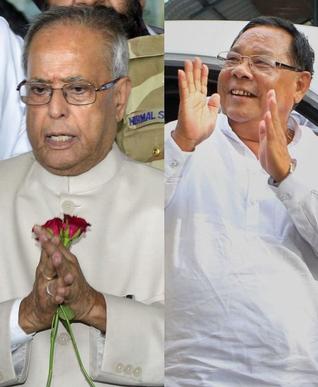
Voting begins to elect India's new president

July 19, 2012

p

New Delhi, July 19: Thousands of Indian MPs and assembly members representing Thursday began casting their votes to choose a new president. It is a direct contest between ruling United Progressive Alliance (UPA) candidate Pranab Mukherjee and opposition-backed Purno Sangma.

Voting to choose the 13th president started simultaneously at national and state capitals.

The electoral college has 4,100 assembly members and 776 members of the Lok Sabha and the Rajya Sabha.

In Delhi, polling began at 10 a.m. at Room No 63 of Parliament House. Arrangements for state legislators to vote have been made at assembly buildings in every state capital.

Polling will continue till 5 p.m.

The votes will be counted Sunday, three days before President Pratibha Patil five year tenure ends.

Comments

Add new comment

  • Coastaldigest.com reserves the right to delete or block any comments.
  • Coastaldigset.com is not responsible for its readers’ comments.
  • Comments that are abusive, incendiary or irrelevant are strictly prohibited.
  • Please use a genuine email ID and provide your name to avoid reject.
News Network
July 17,2020
New Delhi, Jul 17:  Congress leader Rahul Gandhi on Friday said that as India's COVID-19 tally has crossed 10,00,000 mark and issued a warning that by August 10, more than 20,00,000 people may be infected in the country. He called on the government to take concrete steps to control the pandemic.
 
Taking to Twitter, Gandhi marked his earlier tweet from July 14 that stated: "This week the figure will cross 10,00,000 in our country."
"The tally has crossed 10,00,000 mark. If COVID-19 continues to spread at the same speed, by August 10, more than 20,00,000 people will be infected in the country.
 
The government must take concrete, planned steps to stop the epidemic," he tweeted today.
With the highest single-day spike of 32,695 cases and 606 deaths, India's COVID-19 tally on Thursday reached 9,68,876, informed the Union Ministry of Health and Family Welfare on Thursday.
 
The total number of COVID-19 cases includes 3,31,146 active cases, 6,12,815 cured/discharged/migrated and 24,915 deaths. 

Comments

Add new comment

  • Coastaldigest.com reserves the right to delete or block any comments.
  • Coastaldigset.com is not responsible for its readers’ comments.
  • Comments that are abusive, incendiary or irrelevant are strictly prohibited.
  • Please use a genuine email ID and provide your name to avoid reject.
News Network
January 2,2020

United Nations, Jan 2: Nearly 400,000 babies were born around the world on New Year's Day with India recording the highest number of these births worldwide at 67,385, the UN children's agency said.

An estimated 392,078 babies were born around the world on New Year's Day, according to UNICEF. Of this, an estimated 67,385 babies were born in India, the most globally. China comes in second with 46,299 births.

The beginning of a new year and a new decade is an opportunity to reflect on our hopes and aspirations not only for our future, but the future of those who will come after us,” UNICEF Executive Director Henrietta Fore said.

As the calendar flips each January, we are reminded of all the possibility and potential of each child embarking on her or his life's journey—if they are just given that chance.”

Fiji in the Pacific most likely delivered 2020's first baby, while the US, the last of the New Year's Day. Globally, over half of these births were estimated to have taken place in eight countries - India (67,385), China (46,299), Nigeria (26,039), Pakistan (16,787), Indonesia (13,020), United States of America (10,452), Democratic Republic of Congo (10,247) and Ethiopia (8,493).

Each January, UNICEF celebrates babies born on New Year's Day, an auspicious day for child birth around the world, it said. However, for millions of newborns around the world, the day of their birth is far less auspicious.

In 2018, 2.5 million newborns died in just their first month of life; about a third of them on the first day of life. Among those children, most died from preventable causes such as premature birth, complications during delivery, and infections like sepsis. In addition, more than 2.5 million babies are born dead each year.

UNICEF said over the past three decades, the world has seen remarkable progress in child survival, cutting the number of children worldwide who die before their fifth birthday by more than half. But there has been slower progress for newborns. Babies dying in the first month accounted for 47 per cent of all deaths among children under five in 2018, up from 40 per cent in 1990.

UNICEF's Every Child Alive campaign calls for immediate investment in health workers with the right training, who are equipped with the right medicines to ensure every mother and newborn is cared for by a safe pair of hands to prevent and treat complications during pregnancy, delivery and birth.

Too many mothers and newborns are not being cared for by a trained and equipped midwife or nurse, and the results are devastating,” said Fore. “We can ensure that millions of babies survive their first day and live into this decade and beyond if every one of them is born into a safe pair of hands.”

India is projected to surpass China as the world's most populous country around 2027. According to UN estimates, India is expected to add nearly 273 million people between 2019 and 2050, while the population of Nigeria is projected to grow by 200 million. Together, these two countries could account for 23 per cent of the global population increase to 2050.

China, with 1.43 billion people in 2019, and India, with 1.37 billion, have long been the two most populous countries of the world, comprising 19 and 18 per cent, respectively, of the global total in 2019. Through the end of the century, India is estimated to remain the world's most populous country with nearly 1.5 billion inhabitants, followed by China with just under 1.1 billion, Nigeria with 733 million, the US with 434 million, and Pakistan with 403 million inhabitants.


Comments

Add new comment

  • Coastaldigest.com reserves the right to delete or block any comments.
  • Coastaldigset.com is not responsible for its readers’ comments.
  • Comments that are abusive, incendiary or irrelevant are strictly prohibited.
  • Please use a genuine email ID and provide your name to avoid reject.
News Network
April 2,2020

New Delhi, April 2: The Defence Research and Development Organisation (DRDO) has developed a bio suit to keep the medical, paramedical and other personnel engaged in combating COVID-19 safe from the deadly virus.

"Scientists at various DRDO laboratories have applied their technical know-how and expertise in textile, coating and nanotechnology to develop the Personal Protective Equipment (PPE) having specific type of fabric with coating," read a statement.

The suit has been prepared with the help of the industry and subjected to rigorous testing for textile parameters as well as protection against synthetic blood. The protection against synthetic blood exceeds the criteria defined for body suits by the Ministry of Health and Family Welfare.

"DRDO is making all efforts to ensure that these suits are produced in large numbers and serve as robust line of defence for the medics, paramedics and other personnel in the front line combating COVID-19," the statement said.

The industry is geared up for production of the suit in large quantities. Kusumgarh Industries is producing the raw material and coating material, with the complete suit being manufactured with the help of another vendor. The current production capacity is 7,000 suits per day.

Another vendor is being brought in with the experience in garment technology and efforts are on to ramp up the capacity to 15,000 suits per day.

The bio suit production in the country by DRDO industry partners and other industries are being hampered due to non-availability of seam sealing tapes, the statement said.

"The DRDO has prepared a special sealant as an alternative to seam sealing tape based on the sealant used in submarine applications.

Presently, bio suits prepared using this glue for seam sealing by an industry partner has cleared test at Southern India Textile Research Association (SITRA) Coimbatore," it said.

"This can be a game changer for the textile industry. The DRDO can mass produce this glue through industry to support the seam sealing activity by suit manufacturers," the statement added.

Comments

Add new comment

  • Coastaldigest.com reserves the right to delete or block any comments.
  • Coastaldigset.com is not responsible for its readers’ comments.
  • Comments that are abusive, incendiary or irrelevant are strictly prohibited.
  • Please use a genuine email ID and provide your name to avoid reject.