


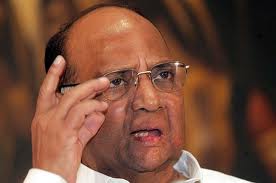
NCP-UPA trouble live: Congress in damage control after Sharad Pawar quits

July 20, 2012

congressdam

New Delhi, July 20: 11:15 am: The UPA is reportedly making all possible efforts to placate Nationalist Congress Party (NCP) chief Sharad Pawar after he and party leader Praful Patel sent their resignation letters to the Prime Minister. The Congress has said that the NCP is important to it.

"Pawar has supported Pranab Mukherjee, he is an important person. The NCP is important to us and ll our allies are intact," Congress leader Jagdambika Pal said.

10:45 am: It is being said that the UPA is not following the coalition dharma and is ignoring smaller allies. Sharad Pawar has now red-flagged the issue and has, in a way, asked the UPA to be serious about smaller allies.

10 am: The UPA is likely to accommodate some demands of Nationalist Congress Party (NCP) chief Sharad Pawar, according to sources. Sharad Pawar, in his meeting with UPA Chairperson Sonia Gandhi, conveyed his displeasure.

Sharad Pawar is reportedly angry at being superseded for the number two position in the Union Cabinet. However, Congress sources claim that the number two position in the Cabinet is not an issue and say the government will take up some of Pawar's demands like forward contracts soon.

9:30 am: Nationalist Congress Party (NCP) chief Sharad Pawar, who resigned from the Cabinet late on Thursday night, met UPA Chairperson Sonia Gandhi on Friday morning.

Nationalist Congress Party (NCP) chief Sharad Pawar and party member Praful Patel on Friday sent in their resignations to Prime Minister Manmohan Singh, sources said. The duo were said to be upset over the NCP chief not being made the number two within the UPA government.

The duo had said they will not attend their offices on Friday. Pawar and Patel sent their resignation letters to Prime Minister Manmohan Singh late on Thursday night. However, the letters have been written in a manner that leaves a window of opportunity open for the UPA as it provides a scope for negotiations.

This may be seen as a trouble for the UPA as the NCP has been one of the most reliable allies of the UPA as it has supported the UPA in important situations. The NCP was among one of the first parties to support UPA candidate Pranab Mukherjee in the Presidential poll. Therefore, the UPA is likely to make efforts to placate Pawar.

The UPA has two options. They can either give the number two position to Pawar, as he desires, or they can make him the Leader of the Lok Sabha. The UPA core committee will meet later on Friday and may chalk out a plan to placate Pawar and Patel.

In fact, for a second time on Thursday, Pawar and Patel had skipped the Cabinet meeting despite the fact that on agenda was a matter relating to Pawar's ministry.

Sources said the rift was over the number two slot. With Pranab Mukherjee gone, Pawar, as per seniority, should have been made number two.

Congress, however, argued that the NCP had only nine MPs while Congress was the largest constituent of the UPA and hence could choose the number two. It's Defence Minister AK Antony who got the slot. This upset the NCP.

NCP sources also said Pawar was upset by the Congress's witch-hunting and lack of gratitude.

Pawar is believed to have been angry that some of his nominees for the Governor's post and for chairmanship of NABARD and NAFED were rejected. Certain projects with which Sharad Pawar was involved were not cleared by government. Also, he accused the Cabinet of dragging its feet over forward trading.

Comments

Add new comment

  • Coastaldigest.com reserves the right to delete or block any comments.
  • Coastaldigset.com is not responsible for its readers’ comments.
  • Comments that are abusive, incendiary or irrelevant are strictly prohibited.
  • Please use a genuine email ID and provide your name to avoid reject.
News Network
January 18,2020

Jan 18: To mark the 30th anniversary of the mass exodus of Kashmiri Pandits from the Valley, members of the community took to social media to post videos of themselves by narrating the "Hum Aayenge Apne Watan" dialogue from an upcoming flick, 'Shikara', with the hope that they would return to their homeland one day.

On January 19, 1990, lakhs of Kashmiri Pandits were forced to leave their homes in the Valley following a genocidal campaign launched by the terrorists.

Theatre actor Chandan Sadhu participated in the campaign and said that Kashmiri Pandits have shown "unimaginable resilience" and hope to return to the Valley soon.

"As Kashmiri Pandits complete 30 years in exile this weekend, let our cry for justice be finally noticed. We have shown unimaginable resilience, and today we resolve to return home. Kashmiri Pandit friends: please record this video statement and put it up with #HumWapasAayenge," Sadhu tweeted.

The #HumWapasAayenge is trending on Twitter as more and more Kashmiri Pandits joined in the campaign to narrate the "Hum Aayenge Apne Watan" dialogue and a pledge to return to their homes.

Noted political commentator Sunanda Vashisht tweeted a throwback image of herself and said that resolve to go back home has strengthened more.

"I don't have many pictures left of my childhood. Choosing between life and family albums is really no choice at all. When lives were rescued, family albums got left behind. 30 years have passed. Resolve to go back home has only strengthened. #HumWapasAayenge," she tweeted.

Radio personality Khushboo Mattoo tweeted a video repeating the dialogue from Shikara and tweeted, "Said this in a BBC interview three years back. And I am saying it again #HumWapasAayenge #Shikara."

Journalist Rahul Pandita also took to his Twitter and captioned his post saying, "30 years of exile from Kashmir. Let us now pledge that we will return home."

'Shikara' chronicles the exodus of Kashmiri Pandits from the Valley on the night of January 19, 1990. Helmed by Vidhu Vinod Chopra, the movie is slated to release on February 7.

Netizens have supported the initiative and have expressed solidarity with the Kashmiri Pandits.

In July last year, Home Minister Amit Shah said in the Rajya Sabha that the central government is committed to bringing Kashmiri Pandits and Sufis back to the Valley saying a time will come when they will offer prayers at the famous Kheer Bhawani temple.

"Kashmiri Pandits were forced to leave Kashmir. Many of their shrines were demolished. Sufism was targeted in Jammu and Kashmir. Sufism used to talk about unity and harmony but they were attacked. No voice was raised in favour of Kashmiri Pandits and Sufis when they were brutally attacked. Sufis used to talk about the unity among Hindus and Muslims but they were forced to leave the Valley. Narendra Modi-led government is committed to bringing back Kashmiri Pandits, he had said.

The Mata Kheer Bhawani temple is one of the holiest shrines of Kashmiri Pandits, located about 14 kilometres east of Srinagar.

Last September, a delegation of the Kashmiri Pandit community met the Prime Minister in Houston and thanked him for the historic decision to abrogate Article 370 that gave special status to Jammu and Kashmir.

Modi acknowledged the hardships endured by the community following their exodus from their ancestral homeland back in 1989-1990 due to militancy.

"You have suffered a lot, but the world is changing. We have to move ahead together and build a new Kashmir," the Prime Minister had told the delegation.

"I had a special interaction with Kashmiri Pandits in Houston," Modi had tweeted following the interaction.

In October, Union Minister Prakash Javadekar announced that the Centre has decided to provide compensation of Rs 5.5 lakh each to 5,300 displaced families from Pakistan-occupied Kashmir (PoK), who initially opted to move outside Jammu and Kashmir but later on returned.

These families were earlier left out in the rehabilitation package that was approved by the Cabinet on November 30, 2016.

The Prime Minister had announced a reconstruction plan for Jammu and Kashmir in November 2016. His plan included a rehabilitation package for a one-time settlement of 36,384 displaced persons' (DPs) families of PoK-1947 and Chhamb.

Comments

Add new comment

  • Coastaldigest.com reserves the right to delete or block any comments.
  • Coastaldigset.com is not responsible for its readers’ comments.
  • Comments that are abusive, incendiary or irrelevant are strictly prohibited.
  • Please use a genuine email ID and provide your name to avoid reject.
Agencies
August 8,2020

New Delhi, Aug 8: Former Union Minister Rajiv Pratap Rudy on Saturday said that it is unfair and unfortunate to blame the pilots or the Airports Authority of India (AAI) for the Kerala place crash which took place on Friday evening.

"It is very unfortunate and unfair when experts come under television channel and they try to put blame on the Airports Authority of India or the pilots. Airport authority in an institution which has had survived various tests of time for the last 65 to 70 years, or pre-independence, so it is unfair to blame them," he said.

While speaking to news agency, Rajiv Pratap Rudy said that the 737 Boeing aircraft is reliable and the pilots were experienced, and it was wrong to blame them.

He further said that there are many possibilities on what could have happened, and said, "It is an accident and we need to find the facts."
Rajiv Pratap Rudy also expressed his deepest condolences to the family members of those who lost their lives in the plane crash. "This accident is terrible and heart-rending. 

I offer my deepest condolences to the family members of the captain and first officer, and the families of passengers who died and were injured," he said.

At least 18 people died when a plane carrying 190 passengers came from Dubai met with an accident at Karipur airport in Kozhikode on Friday evening, as per the Directorate General of Civil Aviation (DGCA).

"Eighteen people, including two pilots, have lost their lives. It is unfortunate. 127 people are at hospitals, others have been released," said Puri on the Air India Express flight that crash-landed on Friday evening.

Air India Express Dubai-Kozhikode IX-1344 flight, carrying 190 people on board from Dubai under the Vande Bharat Mission, skidded off the runway at Karipur Airport in Kozhikode at 7.41 pm on Friday in which several people sustained injuries.

Comments

Add new comment

  • Coastaldigest.com reserves the right to delete or block any comments.
  • Coastaldigset.com is not responsible for its readers’ comments.
  • Comments that are abusive, incendiary or irrelevant are strictly prohibited.
  • Please use a genuine email ID and provide your name to avoid reject.
News Network
January 24,2020

Jan 24: India’s economy appears to be shaking off a slump, as activity in the services and manufacturing sectors expanded for a second straight month in December.

The needle on a gauge measuring so-called animal spirits signaled the economy may be taking a turn for the better, as five of the eight high-frequency indicators tracked by Bloomberg News came in stronger last month. The dial was last at the current position in August.

“Animal spirits” is a term coined by British economist John Maynard Keynes to refer to investors’ confidence in taking action, and the gauge uses the three-month weighted average to smooth out volatility in the single-month numbers.

The nascent recovery would need a helping hand, with expectations building that Finance Minister Nirmala Sitharaman will provide some stimulus when she presents the budget Feb. 1. Official forecasts show the economy is set to expand at 5% in the year ending March 2020 -- the weakest pace in more than a decade.

Here are the details of the dashboard:

Business Activity

The dominant services index rose to the highest level in five months in December as improving new work orders helped boost activity. The seasonally adjusted Markit India Services PMI index climbed to 53.3 from 52.7 in November, helping post a strong end to the calendar year.

India’s manufacturing PMI also rose -- to 52.7 from 51.2 a month ago -- boosted by the fastest increase in new orders since July. A reading above 50 means expansion while anything below that signals contraction.

The uptick in business confidence was accompanied by a rise in inflationary pressures, the survey showed. That trend may keep monetary policy makers from resuming interest-rate cuts anytime soon, leaving most of the heavy-lifting to boost growth with the government.

“The relative stability in macro indicators over the past two months suggests that the worst is behind, but the recovery is likely to be prolonged,” said Teresa John, an economist at Nirmal Bang Equities Pvt. in Mumbai. “Still, sluggish growth and rising inflation indicate that India may well remain in stagflation for most of 2020.”

Exports

Exports remained a laggard, falling 1.8% in December from a year ago. The drag was mainly because of a fall in export of engineering goods, which constitute a third of India’s non-oil exports.

Capital goods imports continued to contract and was lower by 16.5% year-on-year in December after a 22% drop in November. This was the seventh consecutive month of continuous decline, underscoring the weakness in the capex cycle, according to IDFC First Bank.

Consumer Activity

Weakness in demand for passenger vehicles persisted, with local sales falling 1.2% in December from a year ago, according to the Society of Indian Automobile Manufacturers. That capped the worst yearly passenger vehicle sales on record. A Nielsen study on demand for fast-moving consumer goods showed volume growth dropped to 3.5% in the last quarter of 2019 from 3.9% in the same period of 2018.

Funding conditions held out hope, showing considerable improvement in December, according to the Citi India Financial Conditions Index. Credit growth remained tardy though, with demand for loans rising at a slower 7.1% pace from a year ago compared with a nearly 8% growth in November.

Industrial Activity

Industrial output rose for the first time in four months in November. The pick up was broad-based, led by mining, manufacturing and electricity. Mining and manufacturing, in particular, posted a second month of sequential growth. Production of consumer goods also rose after a few months of contraction.

The index of eight core infrastructure industries, which feeds into the index of industrial production, however, declined 1.5% in November from a year ago -- the fourth straight month of contraction. That was on account of shrinking production of electricity, steel, coal, natural gas and crude oil. Both the core sector and industrial output numbers are reported with a one-month lag.

Comments

Add new comment

  • Coastaldigest.com reserves the right to delete or block any comments.
  • Coastaldigset.com is not responsible for its readers’ comments.
  • Comments that are abusive, incendiary or irrelevant are strictly prohibited.
  • Please use a genuine email ID and provide your name to avoid reject.