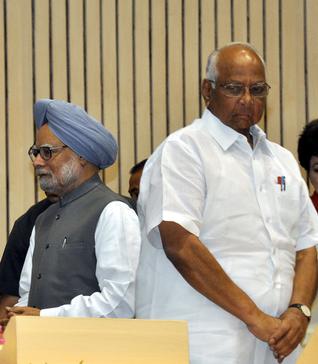
Pawar a “very valued colleague”: Manmohan

July 20, 2012

mnpwr

New Delhi, July 20: Reaching out to sulking NCP chief Sharad Pawar, Prime Minister Manmohan Singh on Friday hailed him as a “very valued colleague” and said his knowledge, wisdom and experience are a “great asset” to his government.

Dr. Singh spoke to Mr. Pawar on Thursday night after he, along with party colleague Praful Patel, skipped the Cabinet meeting, apparently unhappy over denial of number two status in the government.

“Mr Sharad Pawar is a very valued colleague of mine whose knowledge, wisdom and experience are a great asset to our government,” Dr. Singh said in a statement to PTI.

The Prime Minister’s statement came after Mr. Pawar met Congress president Sonia Gandhi and his party stated that it had “serious issues” over the functioning of the government and the coalition.

“We are unhappy with some aspects which have been raised by Pawar in personal meetings with Prime Minister Manmohan Singh and Sonia Gandhi,” Mr. Praful Patel, NCP leader and Heavy Industries Minister, said after the party’s confabulations.

Mr. Patel, however, said NCP continues to be an “integral” part of the UPA.

Congress General Secretary Digvijay Singh sought to mollify Mr. Pawar. “In a Parliamentary democracy, all are equal in Cabinet. The Prime Minister is first among equals and there is no number two or number three.”


Comments

Add new comment

  • Coastaldigest.com reserves the right to delete or block any comments.
  • Coastaldigset.com is not responsible for its readers’ comments.
  • Comments that are abusive, incendiary or irrelevant are strictly prohibited.
  • Please use a genuine email ID and provide your name to avoid reject.
News Network
March 4,2020

New Delhi, Mar 4: The government on Wednesday permitted NRIs to own up to 100 per cent stake in disinvestment-bound Air India.

The decision comes at a time when the government is looking to sell 100 per cent stake sale in the national carrier.

Union minister Prakash Javadekar said the Cabinet has approved allowing Non-Residents Indians (NRIs) to hold up to 100 per cent stake in Air India.

Allowing 100 per cent investment by Non-Resident Indians (NRIs) in the carrier would also not be in violation of SOEC norms. NRI investments would be treated as domestic investments.

Under the Substantial Ownership and Effective Control (SOEC) framework, which is followed in the airline industry globally, a carrier that flies overseas from a particular country should be substantially owned by that country's government or its nationals.

Currently, NRIs can acquire only 49 per cent in Air India. Foreign Direct Investment (FDI) in the airline is also 49 per cent through the government approval route.

As per the existing norms, 100 per cent FDI is permitted in scheduled domestic carriers, subject to certain conditions, including that it would not be applicable for overseas airlines.

In the case of scheduled airlines, 49 per cent FDI is permitted through automatic approval route and any such investment beyond that level requires government nod.

On January 27, the government came out witha Preliminary Information Memorandum (PIM) for Air India disinvestment. It has proposed selling 100 per cent stake in Air India along with budget airline Air India Express and the national carrier's 50 per cent stake in AISATS, an equal joint venture with Singapore Airlines.

Under the latest disinvestment plan, the successful bidder would have to take over only debt worth Rs 23,286.5 crore while the liabilities would be decided depending on current assets at the time of closing of the transaction.

This is the second attempt by the government in as many years to divest Air India, which has been in the red for long.

Comments

Add new comment

  • Coastaldigest.com reserves the right to delete or block any comments.
  • Coastaldigset.com is not responsible for its readers’ comments.
  • Comments that are abusive, incendiary or irrelevant are strictly prohibited.
  • Please use a genuine email ID and provide your name to avoid reject.
News Network
May 24,2020

New Delhi, May 24: New rules for domestic travel during the lockdown were released by the government today, including advising passengers to download the Aarogya Setu application on their mobile devices and asking states to ensure thermal screening at departure point of airports, railway stations and bus terminals. The guidelines were shared by Civil Aviation Minister Hardeep Singh Puri, who also shared new rules for international travel.

The minister had recently said that international flight operations may start by mid-June or end-July if the COVID-19 virus "behaves in a predictable manner".

"Prescribed clinical protocol will be followed in case any domestic or international traveller shows symptoms of COVID-19. States can also develop their own protocol for quarantine and isolation as per their own assessment," Mr Puri said.

The guidelines come a day before the resumption of air travel after nearly two-months hiatus following lockdown to prevent the spread of coronavirus.

The Indian Railways has also issued a list of 100 pairs of trains that it will operate from June 1, putting in operation popular trains such as Durontos, Sampark Krantis, Jan Shatabdis and Poorva Express.

Dos and Don'ts shall be provided along with tickets to travellers by agencies concerned, said the Health Ministry's guidelines for domestic travel (air/train/inter-state bus travel).

Latest guidelines on domestic & international travel have been issued by @MoHFW_INDIA.

I hope travellers strictly follow these self-regulatory norms & strengthen India's hands in this fight against COVID19. Remember, each one of us is a soldier against the pandemic.@MoCA_GoIpic.twitter.com/xVbTG1K44n

— Hardeep Singh Puri (@HardeepSPuri) May 24, 2020
Travellers shall give 14-day quarantine undertaking before boarding

The states and Union Territories shall ensure that all passengers undergo thermal screening at the point of departure and only asymptomatic passengers are allowed to board the flight, train or bus. Asymptomatic passengers, however, will be permitted to travel after they give an undertaking to self-monitor for 14 days, the ministry said.

Those having moderate or severe symptoms will be admitted to dedicated COVID health facilities and managed accordingly, the guidelines said.

Those having mild symptoms will be given the option of home isolation or isolated in the COVID Care Centre (both public and private facilities) as appropriate and tested as per ICMR protocol, they said.

"If positive, they will continue in COVID Care Centre and will be managed as per clinical protocol. If negative, the passenger may be allowed to go home, isolate himself/herself and self-monitor his/her health for further 7 days," the health ministry said.

In case, any symptoms develop they shall inform the district surveillance officer or the state or the national call centre (1075), it said.

Use of face covers, following respiratory hygine during travel

During boarding and travel, all passengers shall use face covers or masks and will also follow hand hygiene, respiratory hygiene and maintain environmental hygiene, the ministry said in its guidelines.

At airports, railway stations and bus terminals, required measures to ensure social distancing shall be taken, the guidelines said.

Airports, railway stations and bus terminals to be regularly sanitised

Airports, railway stations and bus terminals should be regularly sanitised or disinfected and the availability of soaps and sanitisers shall be ensured, the health ministry said.

The ministry said that states can also develop their own protocol with regards to quarantine and isolation as per their assessment.

Guidelines for International Travel

The guidelines for international travel include mandatory undertaking for quarrantine for 14 days. "Only for exceptional and compelling reasons such as cases of human distress, pregnancy, death in family, serious illness and parent(s) accompanied by children below 10 yrs, as assessed by the receiving states, home quarantine may be permitted for international travellers for 14 days," the Civil Aviation minister said.

Asymptomatic travelers will be allowed to board flight/ship

At the time of boarding the flight or ship, only asymptomatic travellers will be allowed to board after thermal screening, the health ministry said.. Passengers arriving through land borders will also have to undergo the same procedure, it said.

"Self-declaration form in duplicate shall be filled by the person in the flight/ship and a copy of the same will be given to Health and immigration officials present at the airport/seaport/landport. The form will be made available through the Aarogya Setu app," the new order said.

Passengers found to be symtomatic during screening shall be immediately isolated and taken to medical facility as per health protocol. "These passengers will be kept under institutional quarrantine for a minimum period of 7 days and should undergo necessary tests as per ICMR protocol," the guidelines said.

Sanitisation and disinfection must inside flights

Authorities must take adequate measures to such as environmental sanitation and disinfection at the airports as well as within the flights, the guideline said.Suitable announcement about COVID-19 including precautionary measures to be followed shall be made at airports/ports, it added.

While on board flight, ships, passengers and crew required precautions such as wearing of masks, environmental hygiene, respiratory hygiene, hand hygiene, the ministry said.

This morning, India registered the biggest-single day jump in the number of coronavirus cases as 6,767 new patients were reported in the last 24 hours. This is the third consecutive day that India has reported more than 6,000 COVID-19 cases with a record number of new patients each day. The county has officially logged 1,31,868 cases, 3,867 deaths linked to the highly infectious illness since the pandemic began. Of these, 147 patients died in the last 24 hours. The global number of novel coronavirus cases has passed 5.25 million with more than 339,000 deaths. Since the outbreak first emerged in China in December, 5,260,970 cases have been recorded across 196 countries and territories, with 339,758 deaths attributed to the virus.


Comments

Add new comment

  • Coastaldigest.com reserves the right to delete or block any comments.
  • Coastaldigset.com is not responsible for its readers’ comments.
  • Comments that are abusive, incendiary or irrelevant are strictly prohibited.
  • Please use a genuine email ID and provide your name to avoid reject.
News Network
June 12,2020

Jun 12: There have been complaints of non-availability of beds or denial of treatment to coronavirus patients in the national capital despite nearly 70 per cent of beds in five designated hospitals run by the Delhi government lying vacant, with experts attributing it to people''s aversion towards state-run facilities.

As per the latest information shared on the Delhi Corona app on Thursday afternoon, more than 3,000 beds are lying vacant in these five dedicated COVID-19 hospitals that have a total capacity of 4,344 beds.

However, almost all beds at several big private hospitals are shown to be occupied.

Families of many COVID-19 patients, confirmed or suspected, have alleged in the past few weeks that they have been denied admission at many facilities or have not been able to get a bed for their kin.

Medical and public health experts feel it may be because of the image associated with government hospitals, related to infrastructure and hygiene conditions, and perhaps shortage of staff.

According to the latest data available on Delhi Corona app on Thursday afternoon, a total of 9,444 beds are available in private facilities and hospitals run by the central and Delhi governments. Out of these, 4,371 are vacant.

The app shows that beds are available at Delhi government-run hospitals dedicated for COVID-19 treatment such as LNJP Hospital (1,219), GTB Hospital (1,314), Rajiv Gandhi Super Speciality Hospital or RGSSH (242).

However, almost all beds at several big private hospitals are shown to be occupied.

At LNJP Hospital, there are a total of 2,000 beds, out of these 781 are occupied. GTB Hospital has total 1,500 beds, only 186 of which are occupied. Even at RGSSH, 258 of the 500 beds are occupied.

Beds are available at other dedicated COVID-19 facilities in the national capital too, according to the app. Deep Chand Bandhu Hospital has 94 unoccupied beds out of a total 176 and Satyawadi Raja Harishchandra Hospital has 145 vacant beds out of a total 168.

This makes a total of 4,344 COVID-19 beds at these five dedicated Delhi government hospitals, out of which 3,014 or 69.38 per cent are vacant.

A senior doctor at the RGSSH said, "We are only admitting very serious COVID-19 patients in the hospital. Those with mild symptoms, or asymptomatic ones, are either being home quarantined or being sent to COVID Care Centres. Our beds are on stand-by also to accommodate serious patients in case there is a sudden rush."

Delhi Heath Minster Satyendar Jain had recently said that some private hospitals could have been denying admission, but the Delhi government-run hospitals have not denied beds to any needy COVID-19 patient.

He had also said that main private hospitals are almost full to their capacity in terms of number of COVID-19 beds.

According to the app, at prominent private hospitals like Indraprastha Apollo, Max Hospital in Shalimar Bagh, Fortis Hospital in Shalimar Bagh, BL Kapur Hospital are fully occupied.

Max Hospital in Saket has a total of 200 beds for COVID-19 patients, and only one is vacant.

On June 9, the Delhi government had directed 22 private hospitals in the national capital to dedicate a total of 2,015 extra beds for treatment of coronavirus patients, revising its earlier allocation limit of 20 per cent.

Lawyer and public heath activist Ashok Agarwal said infrastructure and hygiene are two main factors, and people still want to "avoid government facilities".

"I know of cases, where people were willing to be on waiting list of private hospitals but did not go to a government hospital, even though beds were available," he said.

Even those who went to a government hospital for COVID-19 treatment, complained of "dirty toilets, and these being used by multiple patients", Agarwal said.

"Also, as the cases erupted successively over the months, many people got scared and were in two minds to go to a government hospital, as admitted patients were making allegations in videos and on social media about lack of proper services. Besides, there is shortage of medical staff at various facilities, and each patient needs to be attended to," he argued.

Delhi government hospitals and private facilities were directed to prominently display information about the availability of beds on a flex board at their main gates.

Delhi Lt Governor Anil Baijal on Wednesday ordered Delhi hospitals to display the availability of COVID and non-COVID beds, charges for rooms or beds along with contact details on a LED board outside the hospital.

Max Hospital sources said they were already displaying the status of beds on LED screens near their reception area even before the government order.

A spokesperson from Fortis Hospital said, "We are in the process of arranging to put up the displays as per the prescribed format."

Delhi recorded 1,501 fresh coronavirus cases on Wednesday, taking the COVID-19 tally in the city to over 32,000, and the death toll due to the disease mounted to 984, authorities said.

Comments

Add new comment

  • Coastaldigest.com reserves the right to delete or block any comments.
  • Coastaldigset.com is not responsible for its readers’ comments.
  • Comments that are abusive, incendiary or irrelevant are strictly prohibited.
  • Please use a genuine email ID and provide your name to avoid reject.