



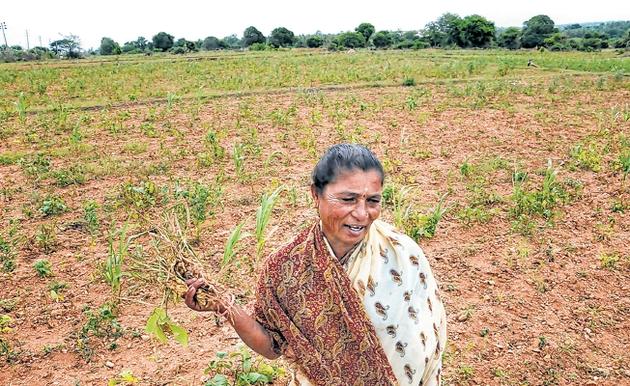
Drought looms large over more States

July 22, 2012

draught_copy

New Delhi, July 22: Drought conditions loom over south Karnataka and central Maharashtra adding to concern at the severely deficient southwest monsoon in parts of Rajasthan and Gujarat.

These States have been advised to go for early rabi (winter) plantation to make up for the shortfall in kharif sowing. Much will depend on the progress of the monsoon in the last week of July.

With an average 40 per cent deficiency in monsoon rain in the northwest so far, farmers in paddy-growing Punjab and Haryana are stressed due to the higher cost of cultivation. As water levels in the Pong and Bhakra dams are below normal, farmers in these States are using excessive power and diesel to draw groundwater to save kharif paddy.

Alarmed at the situation, the Centre on Saturday convened a meeting of the affected States, including Karnataka, Maharashtra, Rajasthan, Punjab, Haryana and Gujarat. What triggered the move was the grim situation. Two-thirds of the kharif sowing period are already over.

Now only late varieties or short-duration crops or fodder can be sowed to save farmers in the affected States. What hits them most is that the credit/loan they take for normal sowing cannot be returned if they fail to sow. If they go for renewed sowing of contingency crops, they will have to seek a fresh loan.

Agriculture Secretary Ashish Bahuguna, who convened the meeting with the Principal Secretaries of the six States on a non-working day, said he reviewed the situation with the States that faced “contingency.” The situation is worst in Karnataka, where sowing of coarse cereals, pulses and oilseeds has been hit. The monsoon has bypassed large tracts of the State where these crops are raised. Kharif sowing is short by 10 lakh hectares, mostly in coarse cereals and groundnut, in the State.

In the Pune-Sholapur-Sangli-Satara belt of Maharashtra, rainfall deficiency has severely hit the sowing of pulses and coarse cereals. About 8.5 lakh hectares remained unsown. These districts have been advised to go for early rabi sowing of guar, gram and maize to make up for the shortfall.

In Rajasthan, monsoon has been delayed in the western districts and jowar and bajra sowing on nearly 15 lakh hectares has been affected.

Comments

Add new comment

  • Coastaldigest.com reserves the right to delete or block any comments.
  • Coastaldigset.com is not responsible for its readers’ comments.
  • Comments that are abusive, incendiary or irrelevant are strictly prohibited.
  • Please use a genuine email ID and provide your name to avoid reject.
News Network
January 10,2020

Mumbai, Jan 10: India’s oil demand growth is set to overtake China by mid-2020s, priming the country for more refinery investment but making it more vulnerable to supply disruption in the Middle East, the International Energy Agency (IEA) said on Friday.

India’s oil demand is expected to reach 6 million barrels per day (bpd) by 2024 from 4.4 million bpd in 2017, but its domestic production is expected to rise only marginally, making the country more reliant on crude imports and more vulnerable to supply disruption in the Middle East, the agency said.

China’s demand growth is likely to be slightly lower than that of India by the mid-2020s, as per IEA’s China estimates given in November, but the gap would slowly become bigger thereafter.

“Indian economy is and will become even more exposed to risks of supply disruptions, geopolitical uncertainties and the volatility of oil prices,” the IEA said in a report on India’s energy policies.

Brent crude prices topped USD 70 a barrel on rising geopolitical tensions in the Middle East, putting pressure on emerging markets such as India. Like the rest of Asia, India is highly dependent on Middle East oil supplies with Iraq being its largest crude supplier.

India, which ranks No 3 in terms of global oil consumption after China and the United States, ships in over 80 per cent of its oil needs, of which 65 per cent is from the Middle East through the Strait of Hormuz, the IEA said.

The IEA, which coordinates release of strategic petroleum reserves (SPR) among developed countries in times of emergency, said it is important for India to expand its reserves.

REFINERY INVESTMENTS

India is the world’s fourth largest oil refiner and a net exporter of refined fuel, mainly gasoline and diesel.

India has drawn plans to lift its refining capacity to about 8 million bpd by 2025 from the current about 5 million bpd.

The IEA, however, forecasts India’s refining capacity to rise to 5.7 million bpd by 2024.

This would make “India a very attractive market for refinery investment,” IEA said.

Drawn to India’s higher fuel demand potential, global oil majors like Saudi Aramco, BP, Abu Dhabi National Oil Co and Total are looking at investing in India’s oil sector.

Saudi Aramco and ADNOC aim to own a 50 per cent stake in a planned 1.2-million bpd refinery in western Maharashtra state, for which land is yet to be acquired.

Comments

Add new comment

  • Coastaldigest.com reserves the right to delete or block any comments.
  • Coastaldigset.com is not responsible for its readers’ comments.
  • Comments that are abusive, incendiary or irrelevant are strictly prohibited.
  • Please use a genuine email ID and provide your name to avoid reject.
Agencies
July 11,2020

New Delhi, Jul 11: A notice which claims that a COVID-19 Monitoring Committee has been formed is fake, and no such committee has been set up by the Union Home Ministry, as per Spokesperson, Ministry of Home Affairs (MHA).

The "Fake" MHA order stated, "Pursuant to the official orders received dated: Monday, May 18, 2020, of the Honourable Minister of Home Affairs, passed in the approval of Special Status Advisory Committee for COVID-19, a COVID-19 Monitoring Committee has been constituted in the MHA vide order dated: Friday, June 12, 2020."

MHA Spokesperson also cautioned people to beware of fake news and rumours.

India's COVID-19 case count crossed the eight lakh-mark on Saturday with yet another highest single-day spike of 27,114 new cases in the last 24 hours.

Comments

Add new comment

  • Coastaldigest.com reserves the right to delete or block any comments.
  • Coastaldigset.com is not responsible for its readers’ comments.
  • Comments that are abusive, incendiary or irrelevant are strictly prohibited.
  • Please use a genuine email ID and provide your name to avoid reject.
Agencies
January 11,2020

New Delhi, Jan 11: The Supreme Court is scheduled to hear the curative petition of two death row convicts in 2012 Nirbhaya gang-rape case on January 14.

A five-judge Bench of Justices N V Ramana, Arun Mishra, R F Nariman, R Banumathi and Ashok Bhushan will hear the petition filed by Vinay Sharma and Mukesh.

The duo had moved a curative petition in the top court after a Delhi court issued a death warrant in their name and announced January 22 as the date of their execution.

Besides them, two other convicts named Pawan and Akshay are also slated to be executed on the same day at 7 am in Delhi's Tihar Jail premises.

They were convicted and sentenced to death for raping a 23-year-old woman on a moving bus in the national capital on the night of December 16, 2012.

The victim, who was later given the name Nirbhaya, died at a hospital in Singapore where she had been airlifted for medical treatment.

A curative petition is the last judicial resort available for redressal of grievances. It is decided by the judges in-chamber.

If it is rejected, they are legally bound to move a mercy petition. It is filed before the President who has the power to commute it to life imprisonment.

The court after issuing a black warrant in their name gave them two weeks' time to file both the curative and mercy petition.

Comments

Add new comment

  • Coastaldigest.com reserves the right to delete or block any comments.
  • Coastaldigset.com is not responsible for its readers’ comments.
  • Comments that are abusive, incendiary or irrelevant are strictly prohibited.
  • Please use a genuine email ID and provide your name to avoid reject.