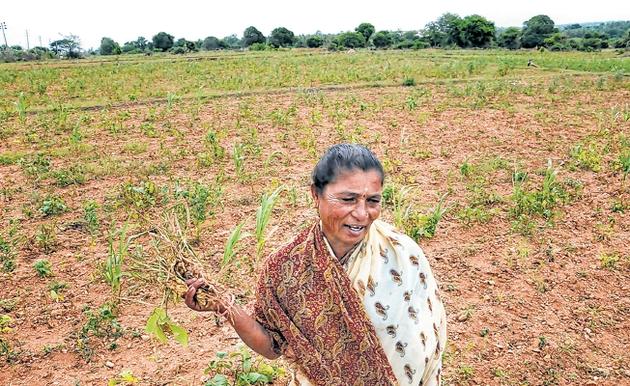
Drought looms large over more States

July 22, 2012

draught_copy

New Delhi, July 22: Drought conditions loom over south Karnataka and central Maharashtra adding to concern at the severely deficient southwest monsoon in parts of Rajasthan and Gujarat.

These States have been advised to go for early rabi (winter) plantation to make up for the shortfall in kharif sowing. Much will depend on the progress of the monsoon in the last week of July.

With an average 40 per cent deficiency in monsoon rain in the northwest so far, farmers in paddy-growing Punjab and Haryana are stressed due to the higher cost of cultivation. As water levels in the Pong and Bhakra dams are below normal, farmers in these States are using excessive power and diesel to draw groundwater to save kharif paddy.

Alarmed at the situation, the Centre on Saturday convened a meeting of the affected States, including Karnataka, Maharashtra, Rajasthan, Punjab, Haryana and Gujarat. What triggered the move was the grim situation. Two-thirds of the kharif sowing period are already over.

Now only late varieties or short-duration crops or fodder can be sowed to save farmers in the affected States. What hits them most is that the credit/loan they take for normal sowing cannot be returned if they fail to sow. If they go for renewed sowing of contingency crops, they will have to seek a fresh loan.

Agriculture Secretary Ashish Bahuguna, who convened the meeting with the Principal Secretaries of the six States on a non-working day, said he reviewed the situation with the States that faced “contingency.” The situation is worst in Karnataka, where sowing of coarse cereals, pulses and oilseeds has been hit. The monsoon has bypassed large tracts of the State where these crops are raised. Kharif sowing is short by 10 lakh hectares, mostly in coarse cereals and groundnut, in the State.

In the Pune-Sholapur-Sangli-Satara belt of Maharashtra, rainfall deficiency has severely hit the sowing of pulses and coarse cereals. About 8.5 lakh hectares remained unsown. These districts have been advised to go for early rabi sowing of guar, gram and maize to make up for the shortfall.

In Rajasthan, monsoon has been delayed in the western districts and jowar and bajra sowing on nearly 15 lakh hectares has been affected.

Comments

Add new comment

  • Coastaldigest.com reserves the right to delete or block any comments.
  • Coastaldigset.com is not responsible for its readers’ comments.
  • Comments that are abusive, incendiary or irrelevant are strictly prohibited.
  • Please use a genuine email ID and provide your name to avoid reject.
News Network
July 3,2020

Leh, Jul 3: Taking an apparent dig at China, Prime Minister Narendra Modi on Friday said the age of expansionism is over and added that the new age of development is here.

"Age of expansionism is over, this is the age of development. History is witness that expansionist forces have either lost or were forced to turn back," Modi said addressing soldiers in Ladakh's Nimmoo. However, the Prime Minister did not mention China at all in his address to the soldiers.

The remark comes amidst the ongoing tension between India and China at Line of Actual Control in the eastern Ladakh. In a violent face-off 20 Indian soldiers were killed in the Galwan Valley on June 15-16 when Chinese troops attempted to unilaterally change the status quo during the de-escalation.

The Prime Minister also said that the people of Ladakh have rejected every attempt to create separatism in the region.

"Ladakh is the head of the country. This is the symbol of pride for the 130 crore citizens of India. This land belongs to the people who are willing to make the ultimate sacrifice for the country... Every attempt to create separatism in the region was rejected by the nationalist people of Ladakh," Modi said.

He also said: "We are the same people who pray to the flute playing Lord Krishna, but we are also the same people who idealise and following the same Lord Krishna who carries the Sudarshan Chakra."

The two countries -- India and China -- have been involved in talks to ease the ongoing border tensions since last month.

Lauding the bravery displayed by the soldiers, the Prime Minister said: "The bravery that you and your compatriots showed, a message has gone to the world about India's strength."

"Your courage is higher than the heights where you are posted today," he added.

"Atmanirbhar Bharat ka sankalp aapke tyag, balidan, pursharth ke karan aur bhi mazbut hai,"(The determination of self-reliant India gets strengthened from your sacrifice and courage)," the Prime Minister said.

The soldiers were observed maintaining social distancing while PM Modi's address here.

PM Modi on Friday made a surprise visit to Ladakh and was briefed by senior officers at Nimmoo amid ongoing tension with China. The Prime Minister was accompanied by Chief of Defence Staff (CDS) General Bipin Rawat and Army Chief General Manoj Mukund Naravane.

He reached Nimmoo, early morning today and interacted with Army, Air Force and ITBP personnel.

Located at 11,000 feet, this is among the tough terrains, surrounded by Zanskar range and on the banks of the Indus.

Sources had earlier informed about CDS Rawat's visit to Leh today. General Rawat's visit holds importance since it comes in the wake of Defence Minister Rajnath Singh's visit to Ladakh being rescheduled.

Earlier, the Defence Minister was scheduled to visit Ladakh today to review the preparedness of the army amid the ongoing standoff with China.

The situation at the India-China border remains tense after 20 Indian soldiers lost their lives in a violent face-off in the Galwan valley on June 15-16 when Chinese troops attempted to unilaterally change the status quo during the de-escalation. India and China have been involved in talks to ease the ongoing border tensions since last month.

Comments

Add new comment

  • Coastaldigest.com reserves the right to delete or block any comments.
  • Coastaldigset.com is not responsible for its readers’ comments.
  • Comments that are abusive, incendiary or irrelevant are strictly prohibited.
  • Please use a genuine email ID and provide your name to avoid reject.
News Network
May 28,2020

May 28: Abdul Kareem was forced out of school and into a life of odd jobs like repairing bicycles before he finally managed to pull his family out of abject poverty transporting goods across Delhi in a mini truck.

The job, and the slim financial security that came with it, was the first stepping stone to a better life.

All that is now gone as India reels under the economic impact of its protracted coronavirus lockdown. Mr Kareem's out of a job and stranded in his village in Uttar Pradesh with his wife and two children. Their minuscule savings from his Rs 9,000 a month job have been exhausted, and the money he saved for books and school uniforms is spent.

"I don't know what the job situation will be in Delhi once we go back," Mr Kareem said. "We can't stay hungry so I will do whatever I find."

At least 49 million people across the world are expected to plunge into "extreme poverty" -- those living on less than $1.90 per day -- as a direct result of the pandemic's economic destruction and India leads that projection, with the World Bank estimating some 12 million of its citizens will be pushed to the very margins this year.

Some 122 million Indians were forced out of jobs last month alone, according to estimates from the Center for Monitoring Indian Economy, a private sector think tank. Daily wage workers and those employed by small businesses have taken the worst hit. These include hawkers, roadside vendors, workers employed in the construction industry and many who eke out a living by pushing handcarts and rickshaws.

For Prime Minister Narendra Modi, who came to power in 2014 promising to lift the poorest citizens out of poverty, the fallout from the lockdown brings with it significant political risk. He won an even larger second term majority last year on the strength of his government's popular social programs that directly targeted the poor, such as the provision of cooking gas cylinders, power and public housing. The breadth and depth of this renewed economic pain will only increase the pressure on his government as it works to steer the country's economy back on track.

"Much of the Indian government's efforts to mitigate poverty over the years could be negated in a matter of just a few months," said Ashwajit Singh, managing director of IPE Global, a development sector consultancy that advises several multinational aid agencies. Noting that he did not expect unemployment rates to improve this year, Singh said: "More people could die from hunger than the virus."

Desperate Times

Mr Singh points to a United Nations University study estimating 104 million Indians could fall below the World Bank-determined poverty line of $3.2 a day for lower-middle-income countries. This will take the proportion of people living in poverty from 60% -- or 812 million currently, to 68% or 920 million -- a situation last seen in the country more than a decade ago, he said.

A World Bank report found the country had been making significant progress and was close to losing its status as the country with the most poor citizens. The impact of PM Modi's lockdown risks reversing those gains.

The World Bank and the CMIE estimates were published in late April and early May respectively. Since then the situation has only become grimmer, with harrowing images of people making desperate attempts to reach their villages, on crowded buses, the flatbeds of trucks and even on foot or on bicycles dominating media coverage.

The Rustandy Center for Social Sector Innovation at the University of Chicago Booth School of Business analyzed the unemployment data from the CMIE, collected through surveys covering about 5,800 homes across 27 states in April.

Researchers found rural areas were the hardest hit, and the economic misery was the result of the lockdown, rather than the spread of infections in the hinterland. More than 80% of households had experienced a drop income and many won't survive much longer without aid, they wrote in a report.

The government has promised cheap credit to farmers, direct transfer of money to the poor and eased access to food security programs -- but these help people who have some documentation, which many of the poorest don't. With millions of impoverished people now in transit across the country, the food security situation is dire -- news reports are emerging of people foraging through piles of rotting fruit or eating leaves.

Shattered Economy

The economy was already growing at its slowest pace in over a decade when the virus struck. The lockdown, which came into effect on March 25, has hammered it, stalling business activity and putting a lid on consumption, pushing the economy to what may be its first full-year contraction in more than four decades.

It's dire enough to warrant the country exiting its lockdown, as it has been doing incrementally since May 4, even as its infections are surging. India is now Asia's virus hotspot with infections crossing 151,000 according to data from Johns Hopkins University.

PM Modi, who has come under criticism for the pain inflicted on the poor, has said his government will spend $265 billion or about 10% of its GDP to help Asia's third-largest economy weather the pandemic's fallout. But experts say only a part of it is direct fiscal stimulus, and probably smaller than the total damage done to the economy during the lockdown period.

"What is especially worrying is the government's response," said Reetika Khera, an economics professor at the Indian Institute of Technology in Delhi. "The epidemic will magnify existing -- and already high -- inequalities in India."

Still, the economic measures aren't going to kick in for some time and industry will likely struggle to restart because of the flight of labour from industrial hubs.

And as the harsh summer unfolds more pain lies in store in the villages now dealing with returning migrant workers.

"There are no factories or industries here, there are just hills," said Surendra Hadia Damor, who had walked nearly 100 km from Ahmedabad, Gujarat, before a voluntary organisation drove him to his village in the neighboring state of Rajasthan. "We can survive for a month or two and then try and find a job nearby -- we will see what happens."


Comments

Add new comment

  • Coastaldigest.com reserves the right to delete or block any comments.
  • Coastaldigset.com is not responsible for its readers’ comments.
  • Comments that are abusive, incendiary or irrelevant are strictly prohibited.
  • Please use a genuine email ID and provide your name to avoid reject.
News Network
July 16,2020

New Delhi, Jul 16: With India's economic growth sputtering, the Reserve Bank of India was expected to maintain a rate-cutting cycle, but an uptick in near-term inflation could give the central bank's Monetary Policy Committee reason to pause for now.

Having cut its key lending rate by an aggressive 115 basis points (bps) in 2020, on top of 135 bps cuts in 2019, the RBI so far has had little success in spurring credit growth amid varying degrees of lockdowns across India.

Some economists and market insiders argue it may be prudent for the MPC, the policy committee, to hold its fire when it meets early next month.

"It's probably too early to administer a demand stimulus. The RBI still has room to cut rates, but we probably want to be more cautious of the timing," said Venkat Pasupuleti, portfolio manager at Dalton Investments.

"Maybe they should wait a quarter to see how things pan out once the lockdown situation is eased further."

Market participants have factored in at least a 25 bps rate cut by the MPC on August 6 while analysts are predicting a total 50-75 bps cuts over the rest of the fiscal year that runs to March 31.

The spike in the retail inflation rate above the RBI's mandated 2%-4% target range is another reason for the central bank to take a breather, analysts say.

Annual retail inflation rose to 6.09% in June, compared to 5.84% in March and sharply above a 5.30% median forecast in a Reuters poll of economists.

Rahul Bajoria, an economist at Barclays, said the spike in both consumer and wholesale prices "could lead to a tempering in enthusiasm for material front-loaded policy support from here on."

Almost all economists however agreed the RBI cannot move away from its accommodative stance or call an end to the rate cutting cycle just yet.

India's economy grew at 3.1% in the March quarter - an eight year low - and some economists have predicted a contraction of more than 20% in the June quarter and a contraction of up to 5% in the fiscal year.

"Even in the event of a pause, we think the RBI and MPC would want to hold out the promise of more cuts," said A. Prasanna, economist with ICICI Securities.

RBI Governor Shaktikanta Das said in a recent speech the need of the hour is to restore confidence, preserve financial stability, revive growth and recover stronger, suggesting inflation concerns are unlikely to deter the downward trajectory for rates too soon.

"The August policy decision would boil down to a judgment call over whether RBI can maintain easy monetary and financial conditions without the aid of a token rate cut," Prasanna said. 

Comments

Add new comment

  • Coastaldigest.com reserves the right to delete or block any comments.
  • Coastaldigset.com is not responsible for its readers’ comments.
  • Comments that are abusive, incendiary or irrelevant are strictly prohibited.
  • Please use a genuine email ID and provide your name to avoid reject.