


Pranab Mukherjee elected as 13th President, P A Sangma cries foul

July 23, 2012

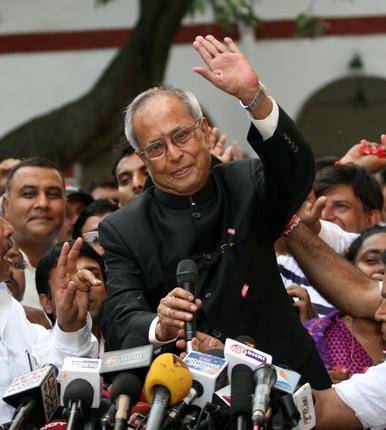
pranab13thNew Delhi, July 23: Pranab Mukherjee on Sunday scripted history by becoming the first person from West Bengal to be elected as the President of India. He defeated his opponent, former Lok Sabha speaker P A Sangma, with a huge margin to be elected as the 13th President of the country.

Following the declaration of the results, Mukherjee thanked the people of the "great country" for his win with a record margin of sorts bagging 69 per cent of the votes.

"I express deep gratitude for electing me to high office," said Mukherjee.

Addressing mediapersons, he further said, "I thank all those who supported me…I thank Sangma for congratulating me." He said he would try to justify the trust of people, adding, "I have received much more than I have given".

Meanwhile, though Sangma congratulated Mukherjee on the win, he lashed out at his opponent saying the poll was not fair. Sangma did not even rule out moving court on the election, saying its process was "exceptionally partisan".

Not ruling out moving the Supreme Court on the election, he said, "We are meeting a day after tomorrow to review the whole situation where this matter will come up for discussion."

Addressing mediapersons, the former Lok Sabha speaker said the presidential and the vice presidential elections must have a code of conduct to make the elections fair.

When asked to clarify on his statement that the elections needed to be made fair, Sangma said that several states were given financial packages.

Sangma accused the UPA of indulging in unfair practices saying the election was not fair and the country had lost a great opportunity to elect a tribal President. "Election process was exceptionally partisan and political through economic and other packages, inducements and threats," he said.

"I might have lost the elections but nation also lost an opportunity to project a tribal as President. I thank Pranab Mukherjee for winning the Presidential poll," he told reporters.

"There is compelling need for establishing an election code of conduct in Presidential elections. Presidential and Vice-Presidential elections should have a code of conduct," he said, when asked to clarify on his statement that the elections needed to be made fair. He said that several states were given financial packages.

On asked if he will go to the court, he said, "We are meeting in a few days to discuss all these issues. We knew that there was a problem in Karnataka. Results also show in many places there was cross voting."

However, even before the election commission declared the final results, there was a steady stream of visitors at the residence of the former finance minister to congratulate him on the massive victory.

Among the early callers at his Talkatora Road residence, located not far from Parliament House, were Prime Minister Manmohan Singh, UPA chairperson Sonia Gandhi, Congress general secretary Rahul Gandhi and ministers from the UPA Cabinet.

Sonia Gandhi and party general secretary Rahul Gandhi came together ahead of the Prime Minister's visit to greet the 76-year-old veteran. They were soon joined by Singh and his wife Gursharan Kaur.

Lok Sabha Speaker Meira Kumar, Union ministers A K Anthony, P Chidambaram, Sushil Kumar Shinde, Subodh Kant Sahai, Farooq Abdullah and E Ahamed visited Mukherjee's residence to greet him for becoming the 13th President of India.

"We thank our all our allies for the victory of Pranab Mukherjee as the President of India. This is an emphatic victory," Chidambaram said after meeting Mukherjee.

DMK leaders T R Baalu and Murasoli Maran also met Mukherjee to greet him.

West Bengal Chief Minister Mamata Banerjee, who had earlier opposed the candidature of Mukherjee for the presidential elections but decided to back him two days before the voting, also congratulated Mukherjee. She also accepted the invitation by the President-elect to attend his swearing-in ceremony. The Trinamool Congress chief also invited Mukherjee to visit West Bengal first after the win.

Later, leaders from Opposition Bharatiya Janata Party (BJP) and Left parties also congratulated the man of the moment.

However, the BJP in Karnataka suffered a humiliation when Mukherjee secured a backing of 117 MLAs as against Sangma's 103, with some party members cross-voting in favour of the UPA nominee.

Mukherjee had a pledged support from only 98 MLAs – 71 from Congress and 27 from JD(S) – but he managed to secure the support of 19 more legislators.

Sangma could only garner 103 votes, even though the BJP has 119 members in the Assembly.

The counting of votes for the Presidential election was done in Room number 63 of Parliament. Six groups were formed for the counting of votes.

The six groups were:

Group 1: Andhra Pradesh, Gujarat, Kerala, Nagaland, Tripura and Parliament

Group 2: Arunachal Pradesh, Haryana, Madhya Pradesh, Odisha, Uttarakhand

Group 3: Assam, Himachal Pradesh, Maharashtra, Punjab, Uttar Pradesh

Group 4: Bihar, Jammu and Kashmir, Manipur, Rajasthan, West Bengal

Group 5: Chhattisgarh, Jharkhand, Meghalaya, Sikkim, Delhi

Group 6: Goa, Karnataka, Mizoram, Tamil Nadu, Puducherry

Following the counting, Rajya Sabha Secretary General V K Agnihotri officially declared Pranab Mukherjee elected as the 13th President of the country with 3095 votes valued at 7, 13, 763. His opponent P A Sangma secured 1483 votes valued at 3, 15, 987.

The total number of votes cast in the presidential elections was 4659, valued at 10, 47, 971, of which 4578 votes, at a value of 10, 29, 750, were valid. There were 81 invalid votes valued at 18, 221.

Agnihotri presented the certificate to Pranab Mukherjee on winning the presidential elections.


Comments

Add new comment

  • Coastaldigest.com reserves the right to delete or block any comments.
  • Coastaldigset.com is not responsible for its readers’ comments.
  • Comments that are abusive, incendiary or irrelevant are strictly prohibited.
  • Please use a genuine email ID and provide your name to avoid reject.
News Network
February 28,2020

Feb 28: National oil marketer Indian Oil Corporation (IOC) on Friday said it is ready to supply low emission BS-VI fuels from April 1 and that there will be a marginal increase in retail prices.

The largest oil supplier has spent over Rs 17,000 crore to upgrade its refineries to produce the low-sulfur diesel and petrol, the company's chairman Sanjiv Singh told reporters here.

Without disclosing the quantum of price increase, Singh said, “there will definitely be a marginal increase in retail prices of the fuels from April 1 when the whole country will be run on new fuels, which will have a sulphur content of only 10 parts per million (ppm) as against the present 50 ppm.

“But let me assure you, we will not be burdening the consumers with a steep hike,” Singh said.

He said, state-run oil marketing companies (OMCs) have invested Rs 35,000 crore to upgrade their refineries, of which Rs 17,000 crore have been spent by IOC alone.

Earlier this week, the sell-off bound BPCL said it had invested around Rs 7,000 crore for the same. ONGC-run HPCL has not so far disclosed its readiness for BS-VI supplies or its capex on the same.

HPCL had said from February 26-27 it was ready with BS-VI fuels and that it would sell only the new fuels from March 1.

IOC switched to BS-VI fuel production a fortnight ago and all its depots and containers are ready now, Singh said.

However, he said some remote locations, where the intake is very low, will take some more time to switch. But the company is planning to drain out the entire BS-IV stock and replenish the new fuels at such locations, he added.

Further, it has been reported that the companies will have to increase prices by 70-120 paise a litre, but Singh said, to arrive such a weighted average is not possible given the complexities of each refinery.

He, however, asserted that the price hike will not be a burden on consumers.

We are not looking at this investment from a pure return on investment basis, but this is a national mandate and we have done it.

Having said that, all those countries that moved to low emission fuels are charging higher prices; and from April 1, our prices will also be benchmarked against Euro VI prices as against the present practice of the cost-plus model, Singh concluded.

Comments

Add new comment

  • Coastaldigest.com reserves the right to delete or block any comments.
  • Coastaldigset.com is not responsible for its readers’ comments.
  • Comments that are abusive, incendiary or irrelevant are strictly prohibited.
  • Please use a genuine email ID and provide your name to avoid reject.
News Network
April 23,2020

Washington, Apr 23: Air pollution over northern India has plummeted to a 20-year-low for this time of the year, according to satellite data published by US space agency National Aeronautics and Space Administration (NASA).
The US space agency's satellite sensors observed aerosol levels at a 20-year low post the countrywide lockdown, implemented to slow the spread of the novel coronavirus.

"We knew we would see changes in atmospheric composition in many places during the lockdown," said Pawan Gupta, a Universities Space Research Association (USRA) scientist at NASA''s Marshall Space Flight Center. "But I have never seen aerosol values so low in the Indo-Gangetic Plain at this time of year," added Mr Gupta.

Acting Assistant Secretary of State for South and Central Asia Alice G Wells tweeted, "These images from NASA were taken each spring starting in 2016 and show a 20-year low in airborne particle levels over India. When India and the world are ready to work and travel again, let's not forget that collaborative action can result in cleaner air."

The data published with maps show aerosol optical depth (AOD) in 2020 compared to the average for 2016-2019. Aerosol optical depth is a measure of how light is absorbed or reflected by airborne particles as it travels through the atmosphere.

If aerosols are concentrated near the surface, an optical depth of 1 or above indicates very hazy conditions. An optical depth, or thickness, of less than 0.1 over the entire atmospheric vertical column is considered "clean." The data were retrieved by the Moderate Resolution Imaging Spectroradiometer (MODIS) on NASA's Terra satellite.

In the first few days of the lockdown, it was difficult to observe a change in the pollution signature. "We saw an aerosol decrease in the first week of the shutdown, but that was due to a combination of rain and the lockdown," said Mr Gupta.

Around March 27, heavy rain poured over vast areas of northern India and helped clear the air of aerosols. Aerosol concentrations usually increase again after such heavy precipitation.

"After the rainfall, I was really impressed that aerosol levels did not go up and return to normal. We saw a gradual decrease and things have been staying at the level we might expect without anthropogenic emissions," Mr Gupta said.

On March 25, the Indian government placed its 1.3 billion citizens under a strict lockdown to reduce the spread of COVID-19. The countrywide mandate decreased activity at factories and severely reduced car, bus, truck and airplane traffic. Every year, aerosols from anthropogenic (human-made) sources contribute to unhealthy levels of air pollution in many Indian cities.

Aerosols are tiny solid and liquid particles suspended in the air that reduce visibility and can damage the human lungs and heart.

In southern India though, the story is a little hazier. Satellite data show aerosol levels have not yet decreased to the same extent. In fact, levels seem to be slightly higher than in the past four years. The reasons are unclear but could be related to recent weather patterns, agricultural fires, winds or other factors.

"This a model scientific experiment," Robert Levy, program leader for NASA's MODIS aerosol products, said about the lockdown and its effects on pollution.

"We have a unique opportunity to learn how the atmosphere reacts to sharp and sudden reductions in emissions from certain sectors. This can help us separate how natural and human sources of aerosols affect the atmosphere," Mr Levy added.

Comments

Add new comment

  • Coastaldigest.com reserves the right to delete or block any comments.
  • Coastaldigset.com is not responsible for its readers’ comments.
  • Comments that are abusive, incendiary or irrelevant are strictly prohibited.
  • Please use a genuine email ID and provide your name to avoid reject.
News Network
March 12,2020

Bhopal, Mar 12: The Madhya Pradesh Congress on Thursday took a dig at Jyotiraditya Scindia, who broke ranks with the party and joined BJP on Wednesday, by pointing out that neither Prime Minister Narendra Modi nor Amit Shah had not even put out as much a tweet to welcome him in the party, and construed it as "humiliation" for the "maharaja".

"Not even a tweet by Narendra Modi-ji or Amit Shah-ji to welcome Scindia-ji! Modi-ji, Shah-ji, at least do not do it so soon. It has not even been 24 hours yet and you guys have already started humiliating him...!" Madya Pradesh Congress tweeted in Hindi.

Taking a jibe at Mr Scindia, a member of the erstwhile royal family of Gwalior who ended his 18-year-long association with the Congress party on a bitter note, the state Congress said: "He is a maharaja, the one whose history is often mentioned by Shivraj-ji (former Madhya Pradesh Chief Minister Shivraj Singh Chouhan)."

On Wednesday, Jyotiraditya  Scindia joined BJP in New Delhi in the presence of party president JP Nadda. He had resigned from Congress a day earlier after meeting Amit Shah and Prime Minister Narendra Modi.

Mr Scindia will file his nomination for the Rajya Sabha elections on March 13. He is expected to go to Bhopal today.

Comments

Add new comment

  • Coastaldigest.com reserves the right to delete or block any comments.
  • Coastaldigset.com is not responsible for its readers’ comments.
  • Comments that are abusive, incendiary or irrelevant are strictly prohibited.
  • Please use a genuine email ID and provide your name to avoid reject.