Oil firms go for petrol price hike again

July 24, 2012

oil

New Delhi, July 24: The state-owned oil companies on Monday announced another hike in petrol prices, by a minimum of 70 paise per litre, excluding state levies, citing surge in international oil prices and depreciation of the Indian rupee against the US dollar.

The hike will come into effect from Monday midnight. “As a consequence of the said revision, increase in selling price shall vary from Rs 0.70 per litre to Rs 0.91 per litre depending upon the state taxes,” the oil companies said.

Petrol will now cost Rs 68.48 per litre in Delhi, Rs 77.30 in Bangalore, Rs 74.23 in Mumbai, Rs 73.16 in Chennai, Rs 75.80 in Hyderabad and Rs 73.61 in Kolkata. The price in Delhi will go up by 70 paise, while in Bangalore and Hyderabad, the hike will be 91 paise.

In Mumbai, petrol will cost 88 paise more, while in Chennai and Kolkata, the prices will go up by 89 paise and 87 paise respectively. Until now, a litre of petrol cost Rs 67.78 in Delhi, Rs 76.39 in Bangalore, Rs 74.89 in Hyderabad, Rs 72.27 in Chennai, Rs 73.35 in Mumbai and Rs 72.74 in Kolkata.

“The price revision in other states will vary depending upon the respective rates of state VAT or sales tax,” Indian Oil said. The hike follows two rounds of reductions in the last one month. The prices were reduced by Rs 2.02 per litre on June 3 and Rs 2.46 a litre on June 29.

Fresh revision

“The (fresh) revision (in petrol prices) has been necessitated due to increasing international oil prices and movement in INR-USD exchange rate,” the oil companies said.

Average price of Indian basket of crude is $ 101.28 per barrel while international MS price is $ 111.59 a barrel. The value of rupee is 55.36 against a USD. “At these levels, IOC is incurring losses of about Rs 1.41 per litre on MS sales in the domestic market.

However, as the price movement is quite volatile, it has been decided that an increase of Rs. 0.70/ litre (excluding state levies) may be effected at this juncture and the situation watched for some time depending upon which a further view will be taken at an appropriate time,” the Indian Oil said.

State-owned oil firms have now abandoned the practice of revising petrol prices on the 1st and 16th of every month. Price is now revised on a random date.

Comments

Add new comment

  • Coastaldigest.com reserves the right to delete or block any comments.
  • Coastaldigset.com is not responsible for its readers’ comments.
  • Comments that are abusive, incendiary or irrelevant are strictly prohibited.
  • Please use a genuine email ID and provide your name to avoid reject.
News Network
January 10,2020

Mumbai, Jan 10: India’s oil demand growth is set to overtake China by mid-2020s, priming the country for more refinery investment but making it more vulnerable to supply disruption in the Middle East, the International Energy Agency (IEA) said on Friday.

India’s oil demand is expected to reach 6 million barrels per day (bpd) by 2024 from 4.4 million bpd in 2017, but its domestic production is expected to rise only marginally, making the country more reliant on crude imports and more vulnerable to supply disruption in the Middle East, the agency said.

China’s demand growth is likely to be slightly lower than that of India by the mid-2020s, as per IEA’s China estimates given in November, but the gap would slowly become bigger thereafter.

“Indian economy is and will become even more exposed to risks of supply disruptions, geopolitical uncertainties and the volatility of oil prices,” the IEA said in a report on India’s energy policies.

Brent crude prices topped USD 70 a barrel on rising geopolitical tensions in the Middle East, putting pressure on emerging markets such as India. Like the rest of Asia, India is highly dependent on Middle East oil supplies with Iraq being its largest crude supplier.

India, which ranks No 3 in terms of global oil consumption after China and the United States, ships in over 80 per cent of its oil needs, of which 65 per cent is from the Middle East through the Strait of Hormuz, the IEA said.

The IEA, which coordinates release of strategic petroleum reserves (SPR) among developed countries in times of emergency, said it is important for India to expand its reserves.

REFINERY INVESTMENTS

India is the world’s fourth largest oil refiner and a net exporter of refined fuel, mainly gasoline and diesel.

India has drawn plans to lift its refining capacity to about 8 million bpd by 2025 from the current about 5 million bpd.

The IEA, however, forecasts India’s refining capacity to rise to 5.7 million bpd by 2024.

This would make “India a very attractive market for refinery investment,” IEA said.

Drawn to India’s higher fuel demand potential, global oil majors like Saudi Aramco, BP, Abu Dhabi National Oil Co and Total are looking at investing in India’s oil sector.

Saudi Aramco and ADNOC aim to own a 50 per cent stake in a planned 1.2-million bpd refinery in western Maharashtra state, for which land is yet to be acquired.

Comments

Add new comment

  • Coastaldigest.com reserves the right to delete or block any comments.
  • Coastaldigset.com is not responsible for its readers’ comments.
  • Comments that are abusive, incendiary or irrelevant are strictly prohibited.
  • Please use a genuine email ID and provide your name to avoid reject.
News Network
January 7,2020

New Delhi, Jan 7: The Delhi Police has filed an FIR against JNUSU president Aishe Ghosh and 19 others for allegedly attacking security guards and vandalising the server room of the Jawaharlal Nehru University (JNU) on January 4.

The police registered the FIR on January 5.

In the complaint filed by the JNU administration, the University alleged that the accused were involved in physical violence and pushed the women guards, verbally abused them and threatened them of dire consequences if they opened the lock of university's communication and information (CIS) office.

"They illegally trespassed the University property with the criminal intention to damage the public property. They damaged servers and made it dysfunctional. They also damaged fiber optic power supplies and broke the biometric systems inside the room," the University officials alleged.

This incident allegedly occurred a day before Aishe Ghosh, other JNU students and teachers were attacked by a masked mob inside the campus.

Comments

Add new comment

  • Coastaldigest.com reserves the right to delete or block any comments.
  • Coastaldigset.com is not responsible for its readers’ comments.
  • Comments that are abusive, incendiary or irrelevant are strictly prohibited.
  • Please use a genuine email ID and provide your name to avoid reject.
Agencies
August 3,2020

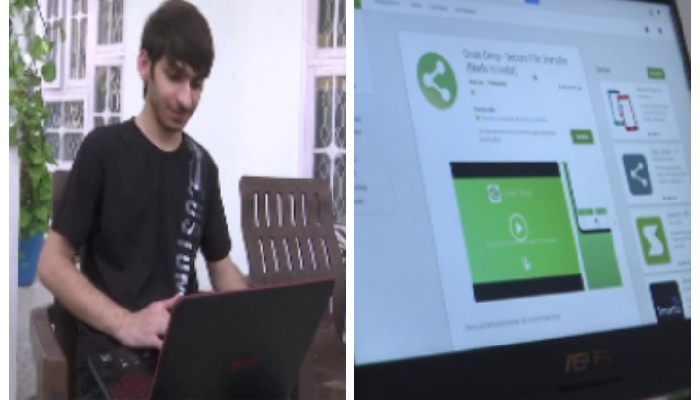
Rajouri, Aug 3: Ashfaq Mehmood Choudhary, a 17-year-old boy from Chattyear of Jammu and Kashmir's Rajouri district, has developed a file-sharing app 'Dodo Drop' which would enable users to share audios, videos, images, and texts between two devices without Internet access.

While speaking to media persons, Ashfaq Mehmood said that the 'Dodo Drop' application is an alternative to the Chinese 'SHAREit' app. "The Indian government has banned several Chinese apps due to data breaching, and among those apps was SHAREit which was used for sharing files.

Users faced a lot of problems due to the ban, and so I decided to make this file-sharing app. With 'Dodo Drop', users can share audios, videos, images, and even texts," he said.

Ashfaq said that it took him four weeks to develop the application, and it was launched on August 1 this year. The 'Dodo Drop' application has a transfer rate of up to 480 mbps, which is faster than the SHAREit app and is "quite easy" to use.

"Users can transfer data comprising photos, videos, audios, apps, texts, etc. between two devices with no Internet access. The transfers are fully encrypted and secure," he added.

"Our Prime Minister has always asserted the need for decreasing the dependency on foreign products and apps and to focus on the development of India-based apps. I tried to be part of the initiative of 'Aatmanirbhar Bharat' by developing an India-based file-sharing app. I want to develop global-standard apps for India," he added.

"We support and cooperate with him. He generates his own income by working on some projects and utilises it. We will continue to support him," said Parvez Ahmed Choudhary, Ashfaq's father.

In July, the Ministry of Electronics and Information Technology (MEITY) banned 47 apps, which were variants and cloned copies of the 59 apps banned earlier in June. These banned clones included SHAREit Lite, Tiktok Lite, Helo Lite, BIGO LIVE Lite, and VFY Lite.

The 59 apps had been banned by the Centre in June in view of the information available that they were engaged in activities which were "prejudicial to sovereignty and integrity and defence" of the country.

Almost all the apps banned had some preferential Chinese interest and the majority had parent Chinese companies.

The ban came amid border tensions with China in the Eastern Ladakh region.

Comments

Add new comment

  • Coastaldigest.com reserves the right to delete or block any comments.
  • Coastaldigset.com is not responsible for its readers’ comments.
  • Comments that are abusive, incendiary or irrelevant are strictly prohibited.
  • Please use a genuine email ID and provide your name to avoid reject.