


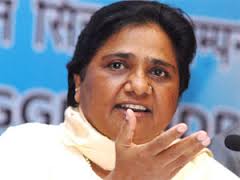
Akhilesh renames UP districts named after dalits by Mayawati

July 24, 2012
mayavathiLucknow, July 24: The Uttar Pradesh Cabinet on Monday approved a proposal to rename eight districts whose names were changed during former chief minister Mayawati's tenure. At a meeting chaired by chief minister Akhilesh Yadav, the state cabinet said Chhatrapati Shahuji Maharaj Nagar and Ramabai Nagar will revert to their original names, Amethi and Kanpur Dehat. The decision, the government said, was taken following requests from residents and people's representatives who said they were facing difficulties in identifying their districts both within and outside the state.

Restoring the original names of existing districts, in Monday's cabinet, the government also approved new names for the districts that were created during the BSP regime. Bheem Nagar, Prabudh Nagar and Pancheel Nagar, three districts that were created in September 2011, the cabinet said, would now be renamed as Sambhal, Shamli and Hapur, respectively. In a similar vein, while Kanshiram Nagar will now be Kasganj, Mahamaya Nagar and J P Nagar have also been restored to their original names -- Hathras and Amroha, respectively.

This is the third time the Samajwadi Party government has revoked BSP decisions. Earlier, the SP government also scrapped social welfare schemes named after Dalit icons, revoked quota system in promotions and renamed public utility services and environment awards that were constituted in the name of BSP founder Kanshi Ram.

Reacting sharply to the state government's decision, former CM Mayawati said "the act of naming districts after Dalit icons was meant to inspire people and usher the state towards social change". Down, but hardly out, the BSP supremo also warned the SP that it would have to pay, eventually, for resorting to "cheap popularity'' tactics.

In a landmark decision, the state cabinet also decided to allot up to 250 sq meters of free land to all persons displaced by floods in the state. Saying that land would be allotted on priority basis -- to persons of Scheduled Castes and tribes, other backward castes, farmers and rural craftspeople from the general category but living below the poverty line -- the government also added that the possession of land would be revoked if beneficiaries failed to construct houses on the land, or maintain it in keeping with the state government's directions.

Times View

In itself, restoring names by which different places have been known for a long time might seem like a good idea. However, in this particular case it is difficult to escape the conclusion that the move is driven more by a desire to undo all the previous regime did than by any considerations of public convenience. In general, the practice of repeatedly changing names of cities, districts, streets and so on is best avoided. Not only does it trigger a chain reaction of constant renaming, as in this case, it is a nuisance to the public at large which is suddenly confronted with a name it cannot associate with.


Comments

Add new comment

  • Coastaldigest.com reserves the right to delete or block any comments.
  • Coastaldigset.com is not responsible for its readers’ comments.
  • Comments that are abusive, incendiary or irrelevant are strictly prohibited.
  • Please use a genuine email ID and provide your name to avoid reject.
News Network
January 20,2020

Davos, Jan 20: India's richest 1 per cent hold more than four-times the wealth held by 953 million people who make up for the bottom 70 per cent of the country's population, while the total wealth of all Indian billionaires is more than the full-year budget, a new study said on Monday.

Releasing the study 'Time to Care' here ahead of the 50th annual meeting of the World Economic Forum (WEF), rights group Oxfam also said the world's 2,153 billionaires have more wealth than the 4.6 billion people who make up 60 per cent of the planet's population.

The report flagged that global inequality is shockingly entrenched and vast and the number of billionaires has doubled in the last decade, despite their combined wealth having declined in the last year.

"The gap between rich and poor can't be resolved without deliberate inequality-busting policies, and too few governments are committed to these," said Oxfam India CEO Amitabh Behar, who is here to represent the Oxfam confederation this year.

The issues of income and gender inequality are expected to figure prominently in discussions at the five-day summit of the WEF, starting Monday. The WEF's annual global risks Report has also warned that the downward pressure on the global economy from macroeconomic fragilities and financial inequality continued to intensify in 2019.

Concern about inequality underlies recent social unrest in almost every continent, although it may be sparked by different tipping points such as corruption, constitutional breaches, or the rise in prices for basic goods and services, as per the WEF report.

Although global inequality has declined over the past three decades, domestic income inequality has risen in many countries, particularly in advanced economies and reached historic highs in some, the Global Risks Report flagged last week.

The Oxfam report further said "sexist" economies are fuelling the inequality crisis by enabling a wealthy elite to accumulate vast fortunes at the expense of ordinary people and particularly poor women and girls.

Regarding India, Oxfam said the combined total wealth of 63 Indian billionaires is higher than the total Union Budget of India for the fiscal year 2018-19 which was at Rs 24,42,200 crore.

"Our broken economies are lining the pockets of billionaires and big business at the expense of ordinary men and women. No wonder people are starting to question whether billionaires should even exist," Behar said.

As per the report, it would take a female domestic worker 22,277 years to earn what a top CEO of a technology company makes in one year.

With earnings pegged at Rs 106 per second, a tech CEO would make more in 10 minutes than what a domestic worker would make in one year.

It further said women and girls put in 3.26 billion hours of unpaid care work each and every day -- a contribution to the Indian economy of at least Rs 19 lakh crore a year, which is 20 times the entire education budget of India in 2019 (Rs 93,000 crore).

Besides, direct public investments in the care economy of 2 per cent of GDP would potentially create 11 million new jobs and make up for the 11 million jobs lost in 2018, the report said.

Behar said the gap between rich and poor cannot be resolved without deliberate inequality-busting policies, and too few governments are committed to these.

He said women and girls are among those who benefit the least from today's economic system.

"They spend billions of hours cooking, cleaning and caring for children and the elderly. Unpaid care work is the 'hidden engine' that keeps the wheels of our economies, businesses and societies moving.

"It is driven by women who often have little time to get an education, earn a decent living or have a say in how our societies are run, and who are therefore trapped at the bottom of the economy,” Behar added.

Oxfam said governments are massively under-taxing the wealthiest individuals and corporations and failing to collect revenues that could help lift the responsibility of care from women and tackle poverty and inequality.

Besides, the governments are also underfunding vital public services and infrastructure that could help reduce women and girls' workload, the report said.

As per the global survey, the 22 richest men in the world have more wealth than all the women in Africa.

Besides, women and girls put in 12.5 billion hours of unpaid care work each and every day -- a contribution to the global economy of at least USD 10.8 trillion a year, more than three times the size of the global tech industry.

Getting the richest one per cent to pay just 0.5 per cent extra tax on their wealth over the next 10 years would equal the investment needed to create 117 million jobs in sectors such as elderly and childcare, education and health.

Governments must prioritise care as being as important as all other sectors in order to build more human economies that work for everyone, not just a fortunate few, Behar said.

Oxfam said its calculations are based on the latest data sources available, including from the Credit Suisse Research Institute's Global Wealth Databook 2019 and Forbes' 2019 billionaires list.

Comments

Add new comment

  • Coastaldigest.com reserves the right to delete or block any comments.
  • Coastaldigset.com is not responsible for its readers’ comments.
  • Comments that are abusive, incendiary or irrelevant are strictly prohibited.
  • Please use a genuine email ID and provide your name to avoid reject.
News Network
March 5,2020

Mar 5: The fourteen Italians, who have tested positive for coronavirus, have been shifted to the Medanta Hospital in Gurgaon from an ITBP quarantine centre.

The hospital issued a statement on Thursday morning, saying these patients are housed on a completely separate floor, which has been quarantined and has no contact with the rest of the hospital.

There is a dedicated medical team wearing protective gear looking after these patients.All items used on the floor are isolated to that floor.

The isolated floor will completely contain the disease even with these asymptomatic persons. All other hospital operations are operating as normal, and there is no increased risk to patients, visitors or staff, the statement said.

Twenty-one Italian tourists and their three Indian tour operators were shifted out from an ITBP quarantine centre here on Wednesday as they were exposed to novel coronavirus.

An affected Italian couple is being treated at Jaipur's SMS medical college.

Officials on Tuesday said the foreigners have been sent to a private hospital in Gurgaon and a centre in the national capital while the Indians have been transferred to the Safdarjung Hospital.

Fourteen Italians and an Indian (driver), who were in the same group as the affected Italian couple, tested positive for the virus as per information provided by the Health Ministry.

The Italian tourists and three Indians were admitted to the Indo-Tibetan Border Police (ITBP) force centre in Chhawla on Tuesday.

The Centre already has 112 people, 76 Indians and 36 foreigners, since February 27 after they were evacuated by an Indian Air Force (IAF) plane from China's Wuhan, the epicentre of the deadly coronavirus.

The first samples of these 112 people had tested negative when reports came in last week.

Comments

Add new comment

  • Coastaldigest.com reserves the right to delete or block any comments.
  • Coastaldigset.com is not responsible for its readers’ comments.
  • Comments that are abusive, incendiary or irrelevant are strictly prohibited.
  • Please use a genuine email ID and provide your name to avoid reject.
News Network
July 1,2020

New Delhi, Jul 1: Jet fuel or ATF price on Wednesday was hiked by 7.5 per cent, the third increase in a month, while petrol and diesel rates were unchanged for the second day in a row.

Aviation turbine fuel (ATF) price was hiked by Rs 2,922.94 per kilolitre (kl), or 7.48 per cent, to Rs 41,992.81 per kl in the national capital, according to a price notification by state-owned oil marketing companies.

This is the third straight increase in ATF prices in a month. Rates were hiked by a record 56.6 per cent (Rs 12,126.75 per kl) on June 1, followed by Rs 5,494.5 per kl (16.3 per cent) increase on June 16.

Simultaneously, non-subsidised cooking gas LPG rates were increased by Re 1 to Rs 594 per 14.2-kg cylinder in the national capital. Prices were up by Rs 4 in other metros mostly because of different local sales tax or VAT rate.

On the other hand, petrol and diesel prices were unchanged for the second day in a row.

This, after diesel rates scaled a new high after prices were hiked 22 times in just over three weeks.

In Delhi, a litre of petrol comes for Rs 80.43 per litre, while diesel is priced at Rs 80.53 per litre.

Rates vary from state to state depending on the incidence of local sales tax or VAT.

While the diesel price had been hiked on 22 occasions since June 7, petrol price had been raised on 21 occasions.

The cumulative increase since the oil companies started the cycle on June 7 totals to Rs 9.17 for petrol and Rs 11.14 for diesel.

Comments

Add new comment

  • Coastaldigest.com reserves the right to delete or block any comments.
  • Coastaldigset.com is not responsible for its readers’ comments.
  • Comments that are abusive, incendiary or irrelevant are strictly prohibited.
  • Please use a genuine email ID and provide your name to avoid reject.