


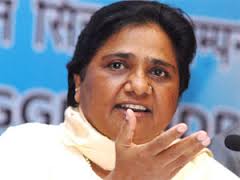
Akhilesh renames UP districts named after dalits by Mayawati

July 24, 2012
mayavathiLucknow, July 24: The Uttar Pradesh Cabinet on Monday approved a proposal to rename eight districts whose names were changed during former chief minister Mayawati's tenure. At a meeting chaired by chief minister Akhilesh Yadav, the state cabinet said Chhatrapati Shahuji Maharaj Nagar and Ramabai Nagar will revert to their original names, Amethi and Kanpur Dehat. The decision, the government said, was taken following requests from residents and people's representatives who said they were facing difficulties in identifying their districts both within and outside the state.

Restoring the original names of existing districts, in Monday's cabinet, the government also approved new names for the districts that were created during the BSP regime. Bheem Nagar, Prabudh Nagar and Pancheel Nagar, three districts that were created in September 2011, the cabinet said, would now be renamed as Sambhal, Shamli and Hapur, respectively. In a similar vein, while Kanshiram Nagar will now be Kasganj, Mahamaya Nagar and J P Nagar have also been restored to their original names -- Hathras and Amroha, respectively.

This is the third time the Samajwadi Party government has revoked BSP decisions. Earlier, the SP government also scrapped social welfare schemes named after Dalit icons, revoked quota system in promotions and renamed public utility services and environment awards that were constituted in the name of BSP founder Kanshi Ram.

Reacting sharply to the state government's decision, former CM Mayawati said "the act of naming districts after Dalit icons was meant to inspire people and usher the state towards social change". Down, but hardly out, the BSP supremo also warned the SP that it would have to pay, eventually, for resorting to "cheap popularity'' tactics.

In a landmark decision, the state cabinet also decided to allot up to 250 sq meters of free land to all persons displaced by floods in the state. Saying that land would be allotted on priority basis -- to persons of Scheduled Castes and tribes, other backward castes, farmers and rural craftspeople from the general category but living below the poverty line -- the government also added that the possession of land would be revoked if beneficiaries failed to construct houses on the land, or maintain it in keeping with the state government's directions.

Times View

In itself, restoring names by which different places have been known for a long time might seem like a good idea. However, in this particular case it is difficult to escape the conclusion that the move is driven more by a desire to undo all the previous regime did than by any considerations of public convenience. In general, the practice of repeatedly changing names of cities, districts, streets and so on is best avoided. Not only does it trigger a chain reaction of constant renaming, as in this case, it is a nuisance to the public at large which is suddenly confronted with a name it cannot associate with.


Comments

Add new comment

  • Coastaldigest.com reserves the right to delete or block any comments.
  • Coastaldigset.com is not responsible for its readers’ comments.
  • Comments that are abusive, incendiary or irrelevant are strictly prohibited.
  • Please use a genuine email ID and provide your name to avoid reject.
News Network
March 2,2020

Mar 2: Two more positive cases of the novel coronavirus -- one in Delhi and another in Telangana -were reported, the Union Health Ministry said on Monday.

The person from Delhi had travelled to Italy, it said adding he is being diagnosed at RML hospital.

The other person with the coronavirus infection has a travel history to Dubai, the ministry added.

"Both the patients are stable and being closely monitored," the ministry said.

Sunitha Krishnan is the name of the patient from Telangana and she is a social activist.

Krishnan has tweeted, "So going to enjoy hospitality at Gandhi Hospital for two days as admitted in the isolation ward suspected coronavirus. They have not started the tests yet( 1.30 hrs since I arrived).I believe the results make take 48hrs. At this pace, I have a feeling I am might be here sometime."

Comments

Add new comment

  • Coastaldigest.com reserves the right to delete or block any comments.
  • Coastaldigset.com is not responsible for its readers’ comments.
  • Comments that are abusive, incendiary or irrelevant are strictly prohibited.
  • Please use a genuine email ID and provide your name to avoid reject.
Agencies
August 4,2020

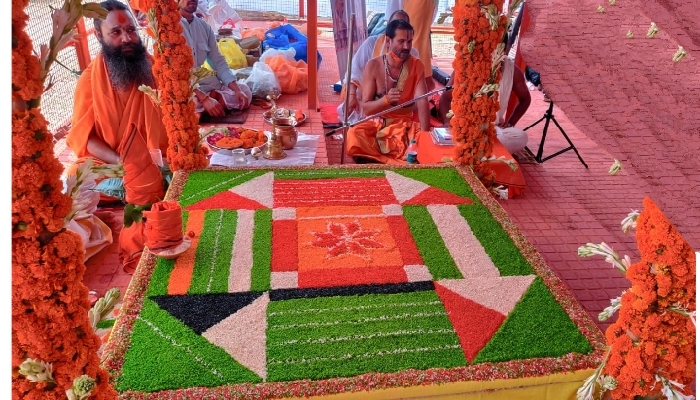
Ayodhya, Aug 4: Ramarchan puja begins at Ram Janmabhoomi site ahead of the foundation laying ceremony of Ram Temple in Ayodhya.
Ramarchan Puja is a prayer to invite all major gods and goddesses ahead of Lord Ram's arrival.

Mahesh Bhagchandka, one of the trustees of Ashok Singhal foundation as Yajman in the puja said, "This is being conducted at the temporary seat of Ramlalla. The pooja will be conducted in four phases."

Speaking about the third and fourth phases, he said: "In the third phase, Dashrath, father of Lord Ram with his wives will be worshipped and then all three brothers of Lord Ram - Laxman, Bharat and Shatrughan with their wives. Lord Hanuman ji will too be worshipped. Whereas in the fourth phase, Lord Ram will be worshipped."
Meanwhile, security has been heightened in Ayodhya ahead of the foundation laying ceremony.

Temples across the city is decorated with lights, diyas and flowers ahead of the grand event. Patna's Mahavir Mandir Trust is preparing over 1.25 lakh 'Raghupati Laddoos' for the occasion. Thes laddoos will be distributed as 'prasad' to devotees.

Uttar Pradesh Chief Minister Yogi Adityanath on Monday offered prayers at the Hanuman Garhi temple during his visit to Ayodhya to take stock of the preparations for the 'bhoomi pujan'.
He along with officials also visited 'Ram ki Paudi' to inspect the arrangements ahead of the foundation stone laying ceremony.

Prime Minister Narendra Modi is scheduled to lay the foundation stone of the Ram Temple in Ayodhya on August 5. 

Comments

Add new comment

  • Coastaldigest.com reserves the right to delete or block any comments.
  • Coastaldigset.com is not responsible for its readers’ comments.
  • Comments that are abusive, incendiary or irrelevant are strictly prohibited.
  • Please use a genuine email ID and provide your name to avoid reject.
News Network
January 1,2020

Jan 1: The ban on the practice of instant triple talaq, making it a penal offence and the increase in the strength of Supreme Court judges were two of the major achievements of the law ministry in 2019.

In July, Parliament gave its nod to The Muslim Women (Protection of Rights on Marriage) Bill, 2019. The new law makes talaq-e-biddat or any other similar form of talaq having the effect of instantaneous and irrevocable divorce pronounced by a Muslim husband void and illegal.

It makes it illegal to pronounce talaq three times in spoken, written or through SMS or WhatsApp or any other electronic chat in one sitting.

According to the new law, any Muslim who pronounces the illegal form of talaq upon his wife shall be punished with imprisonment for a term which may extend to three years, and shall also be liable to fine.

During the year, four new judges were appointed to the Supreme Court in September, taking its strength to 34, the highest-ever.

However, vacancies in high courts and lower courts are on the rise and convincing state governments and the 25 high courts to come on board to create an all-India judicial service to recruit judges for the subordinate courts tops the agenda of the Law Ministry in 2020.

Besides creating a consensus on setting up the All-India Judicial Services, the ministry will also have to focus on filling up vacancies in the high court. On an average, the vacancies stood at 400 throughout this year.

With more than 5,000 positions of judicial officers in district and subordinate courts lying vacant, the Law Ministry has pitched for setting up all-India judicial services.

The sanctioned strength of the judicial officers in district and subordinate courts was 22,644. The number of judicial officers in position and vacant posts is 17,509 and 5,135, respectively.

The government has proposed that while states and high courts can recruit judicial officers, the Union Public Service Commission (UPSC) can hold pan-India entrance tests.

The ministry has made it clear that such services would not encroach on the powers of the states.

As of now, the selection and appointment of judges in subordinate courts is the responsibility of the high courts and state governments concerned.

The Narendra Modi government has given a fresh push to the long-pending proposal to set up the new service to have a separate cadre for the lower judiciary in the country.

But there is a divergence of opinion among state governments and respective high courts on the constitution of the All India Judicial Service (AIJS).

One of the problems cited is that since several states have used powers under Code of Criminal Procedure (CrPC) and Code of Civil Procedure (CPC) to declare that the local language would be used in lower courts even for writing orders, a person say selected from Tamil Nadu may find it difficult to hold proceedings in states like Uttar Pradesh and Bihar.

The other point of opposition is that an all India service may hamper the career progression of state judicial services officers.

Another key issue the ministry has to handle in 2020 is vacancies in the 25 high courts.

Throughout 2019, on an average, the high courts faced a shortage of 400 judges.

According to Law Ministry data, as on September 1, the high courts had 414 vacant positions as compared to the sanctioned strength of 1,079 judges. The figure was 409 in August and 403 in July, as per the data.

A three-member Supreme Court collegium recommends the names of candidates for appointment as high court judges. In case of appointments to the Supreme Court, the collegium consists of five top judges of the top court.

High court collegiums shortlist candidates for their respective high courts and send the names to the law ministry.

The ministry, along with background check reports by the Intelligence Bureau, forwards it to the Supreme Court collegium for a final call.

The government has maintained that appointment of judges in the high courts is a "continuous collaborative process" between the Executive and the Judiciary, as it requires consultation and approval from various Constitutional authorities.

Vacancies keep arising on account of retirement, resignation or elevation of judges and increase in judges' strength. In June last year, the vacancy position stood at 399, while it was 396 in May.

In April, 399 posts of judges were vacant, while the figure was 394 in March. The vacancy position in February stood at 400 and in January, it was 392, according to the data collated by the Department of Justice.

Over 43 lakh cases are pending in the 25 high courts.

Another priority would be the finalisation of the memorandum of the procedure to guide the appointment and transfer of the Supreme Court and high court judges. The issue had now been pending for over two years now with the SC collegium and the government failing to reach a consensus.

Successive governments have also been working on making India a hub of international arbitration. It has taken several steps to change laws dealing with commercial disputes.

Comments

Add new comment

  • Coastaldigest.com reserves the right to delete or block any comments.
  • Coastaldigset.com is not responsible for its readers’ comments.
  • Comments that are abusive, incendiary or irrelevant are strictly prohibited.
  • Please use a genuine email ID and provide your name to avoid reject.