


Fresh incidents of ethnic violence in Assam; ‘Rajdhani Express’ attacked

July 24, 2012

asam


Kokrajhar (Assam), July 24: Fresh violence today rocked the trouble-torn Bodoland Territorial Administered Districts in Assam where the Rajdhani Express was attacked by some persons even as the entire train services to and from the Northeast was hit.

Unidentified persons pelted stones and attacked the coaches of the Guwahati-bound Rajdhani Express at Gossaigaon in Kokrajhar district damaging four coaches, though there was no casualty or injuries, North East Frontier Railway sources said here.

The train has been turned back and halted at Kamakhyaguri station bordering West Bengal, but the authorities were considering to take it to Coochbehar Sporadic incidents of violence and arson were reported from different parts of Kokrajhar, Chirang and Dhubri districts while the situation remains tense in neighbouring Bongaigaon and Udalguri districts.

Indefinite curfew continues in Kokrajhar while night curfew will continue in Dhubri and Chirang districts in the ethnic violence in BTAD districts which has claimed 21 districts, the police said.

More than 50,000 people have taken shelter in 75 relief camps set up by the district authorities, most of them in worst-affected Kokrajhar district. Assam Director-General of Police Jayanta Narayan Choudhury is scheduled to visit the violence-racked districts today to take stock of the situation.

Assam Revenue Minister Prithbi Majhi and agriculture Minister Nilamoni Sen Deka have rushed to the district on the direction of Chief Minister Tarun Gogoi while forest minister Rockybul Hussain, food and civil supplies minister Nazrul Islam and tourism minister Chandan Brahma were already camping there.

A delegation of BJP and Congress has also arrived in the trouble-torn districts to assess the situation.

Train services have been hit due to the violence with 31 trains halted and controlled at various places.

Railway authorities have urged the state government to provide adequate security to ensure safe movement of trains.

Meanwhile, Bodoland Territorial Council Chief Hagrama Mohilary today claimed that a section of the people have alleged that NDFB could have some role in the violence.

However, sources said the NDFB is now under a ceasefire agreement and the talks process has been initiated with it.

"I urge the NDFB to calm down and refrain from such activities while the government should take the initiative to bring those cadres who are still in the jungle to the mainstream and involve them in the peace process," Mohilary said.

He also alleged that there were inadequate security forces in the BTAD which was creating difficulties in maintaining law and order in the state.

"Our top priority is to stop violence in the districts and we urge the state government not to pull back Army deployment at this stage," Mohilary said.
violence

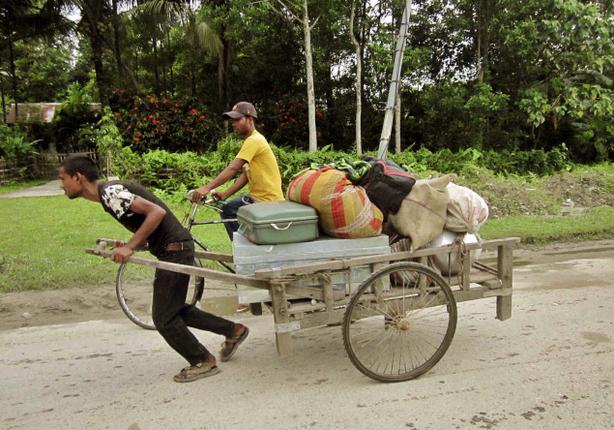
A villager carries his belongings to a safe place in Kokrajhar

Comments

Add new comment

  • Coastaldigest.com reserves the right to delete or block any comments.
  • Coastaldigset.com is not responsible for its readers’ comments.
  • Comments that are abusive, incendiary or irrelevant are strictly prohibited.
  • Please use a genuine email ID and provide your name to avoid reject.
News Network
January 6,2020

Jan 6: India’s Finance Ministry has delivered a challenge to its revenue collectors: meet tax targets despite $20 billion of corporate tax cuts.

Through a video conference on Dec. 16, officials were exhorted to meet the direct tax mop-up target of 13.4 trillion rupees ($187 billion), a government official told reporters. Collection in the eight months to November grew at 5% from a year earlier, against the desired 17%.

The missive shows Prime Minister Narendra Modi’s urgent need to buoy public finances in a slowing economy where April-November tax collections were half the amount budgeted. Authorities withheld some payments to states and have capped ministries’ expenditure as the fiscal deficit ballooned beyond the target.

The government’s efforts to maintain its deficit goal goes against advice from some quarters, including central bank Governor Shaktikanta Das, who urged more spending to spur economic growth.

It’s uncertain though how much room Modi’s administration has to boost expenditure, given that it may already be borrowing as much as 540 billion rupees through state-run companies, a figure that isn’t reflected on the federal balance sheet. Uncertainty about public finances pushed up sovereign yields in November and December, compelling Das to announce unconventional policies to keep costs in check.

“This is not a time to conceal the fiscal deficit by off-budget borrowing or deferring payments,” said Indira Rajaraman, an economist and a former member of the Reserve Bank of India’s board. “If they were to stick to the target, that would be catastrophic because there is so much pump-priming that is needed right now.”

GDP grew 4.5% in the quarter ended September, the slowest pace in more than six years as both consumption and investments cooled in Asia’s third-largest economy. Only government spending supported the expansion, piling pressure on Modi to keep stimulating.

S&P Global Ratings warned in December it may downgrade India’s sovereign ratings if economic growth doesn’t recover. Government support seems to be waning now, with ministries asked to cap spending in the final quarter of the financial year at 25% of the amount budgeted rather than 33% allowed earlier. This new rule will hamstring sectors including agriculture, aviation and coal, where not even half of annual targets have been disbursed.

As the federal government runs short of money, it’s been delaying payouts to state administrations.

Private hospitals have threatened to suspend cash-less services to government employees over non-payment of dues, while a builder informed the stock exchange about delayed rental payments from no less than the tax office itself.

India is considering a litigation-settlement plan that will allow companies to exit lingering tax disputes by paying a portion of the money demanded by the government, the Economic Times newspaper reported Saturday.

The move will help improve the ease of doing business besides unlocking a part of the almost 8 trillion rupees ($111 billion) caught up in these disputes. The step, which is being considered as part of the annual budget, could also bridge India’s fiscal gap.

Finance Minister Nirmala Sitharaman has refused to comment on the deficit goal before the official budget presentation due Feb. 1.

A deviation from target, if any, “will need to be balanced with a credible consolidation plan further-out,” said Radhika Rao, an economist at DBS Group Holdings Ltd. in Singapore.

Comments

Add new comment

  • Coastaldigest.com reserves the right to delete or block any comments.
  • Coastaldigset.com is not responsible for its readers’ comments.
  • Comments that are abusive, incendiary or irrelevant are strictly prohibited.
  • Please use a genuine email ID and provide your name to avoid reject.
News Network
July 31,2020

New Delhi, Jul 31: Air India has operated more than 2800 flights and flown over 3 lakh passengers worldwide till now under the Vande Bharat Mission.

"Air India under Vande Bharat Mission Operated more than 2800 flights and flown more than 3 lakh, 80 thousand passengers worldwide till now," Air India said in a tweet on Thursday.

The fifth phase of the Government of India's 'Vande Bharat' mission, aimed at evacuating Indian nationals stranded in various foreign countries owing to restrictions on air travel, will begin early next month, August 1.

"Under Vande Bharat Mission, we have already brought back more than 2.5 lakh stranded Indians from 53 commies," Air India had earlier said in a statement.

Over 7.88 lakh Indians stranded abroad due to coronavirus pandemic have returned under Vande Bharat Mission till July 22, Ministry of External Affairs had said.

The government started Vande Bharat Mission on May 7.

Comments

Add new comment

  • Coastaldigest.com reserves the right to delete or block any comments.
  • Coastaldigset.com is not responsible for its readers’ comments.
  • Comments that are abusive, incendiary or irrelevant are strictly prohibited.
  • Please use a genuine email ID and provide your name to avoid reject.
News Network
January 23,2020

Mumbai, Jan 23: Rashmi Sahijwala never expected to start working at the age of 59, let alone join India’s gig economy—now she is part of an army of housewives turning their homes into “cloud kitchens” to feed time-starved millennials.

Asia’s third-largest economy is battling a slowdown so sharp it is creating a drag on global growth, the International Monetary Fund said Monday, but there are some bright spots.

The gig economy, aided by cheap mobile data and abundant labour, has flourished in India, opening up new markets across the vast nation.

Although Indian women have long battled for access to education and employment opportunities, the biggest hurdle for many is convincing conservative families to let them leave home.

But new apps like Curryful, Homefoodi, and Nanighar are tapping the skills of housewives to slice, dice and prepare meals for hungry urbanites from the comfort of their homes.

The so-called cloud kitchens—restaurants that have no physical presence and a delivery-only model—are rising in popularity as there is a boom in food delivery apps such as Swiggy and Zomato.

“We want to be the Uber of home-cooked food,” said Ben Mathew, who launched Curryful in 2018, convinced that housewives were a huge untapped resource.

His company—which employs five people for the app’s daily operations—works with 52 women and three men, and the 31-year-old web entrepreneur hopes to get one million female chefs on-board by 2022.

“We usually train them in processes of sanitisation, cooking, prep time and packaging... and then launch them on the platform,” Mathew told news agency.

One of the first housewives to join Curryful in November 2018 shortly after its launch, Sahijwala was initially apprehensive, despite having four decades of experience in the kitchen.

But backed by her children, including her son who gave her regular feedback about her proposed dishes, she took the plunge.

Since then, she’s undergone a crash course in how to run a business, from creating weekly menus to buying supplies from wholesale markets to cut costs.

The learning curve was steep and Sahijwala switched from cooking everything from scratch to preparing curries and batters for breads in advance to save time and limit leftovers.

She even bought a massive freezer to store fruits and vegetables despite her husband’s reservations about the cost.

“I told him that I am a professional now,” she told news agency.

‘Internet restaurants’

Kallol Banerjee, co-founder of Rebel Foods which runs 301 cloud kitchens backing up 2,200 “internet restaurants”, was among the first entrepreneurs to embrace the concept in 2012.

“We could do more brands from one kitchen and cater to different customer requirements at multiple price points,” Banerjee told AFP.

The chefs buy the ingredients, supply the cookware and pay the utility bills.

The apps—which make their money through charging commission, such as more than 18 percent per order for Curryful—offer training and supply the chefs with containers and bags to pack the food in.

Curryful chef Chand Vyas, 55, spent years trying to set up a lunch delivery business but finally gave up after failing to compete with dabbawalas, Mumbai’s famously efficient food porters.

Today Vyas works seven hours a day, five days a week in her kitchen, serving up a bevy of Indian vegetarian staples, from street food favourites to lentils and rice according to the app’s weekly set menus.

“I don’t understand marketing or how to run a business but I know how to cook. So, the current partnership helps me focus on just that while Curryful takes care of the rest,” Vyas told AFP.

She pockets up to $150 (Rs 10,000 approx) a month after accounting for the commissions and costs, but hopes to earn more as the orders increase.

In contrast, a chef at a bricks-and-mortar restaurant takes home a monthly wage of between $300 (Rs 20,000 approx) and $1,000 (Rs 70,000) approx for working six days a week.

With India’s cloud kitchen sector expected to reach $1.05 billion by 2023, according to data platform Inc42, other companies are also keen to get a slice of the action.

Swiggy, for example, has invested 2.5 billion rupees ($35.3 million) in opening 1,000 cloud kitchens across the nation.

Back in her Mumbai kitchen, Sahijwala is elated to have embarked on a career at an age when her contemporaries are eyeing retirement.

Over the past year, she has seen her profit grow to $200 (Rs 15,000 approx) a month, but more importantly, she said, “My passion has finally found an outlet.

“I am just glad life has given me this chance.”

Comments

Add new comment

  • Coastaldigest.com reserves the right to delete or block any comments.
  • Coastaldigset.com is not responsible for its readers’ comments.
  • Comments that are abusive, incendiary or irrelevant are strictly prohibited.
  • Please use a genuine email ID and provide your name to avoid reject.