


Fresh incidents of ethnic violence in Assam; ‘Rajdhani Express’ attacked

July 24, 2012

asam


Kokrajhar (Assam), July 24: Fresh violence today rocked the trouble-torn Bodoland Territorial Administered Districts in Assam where the Rajdhani Express was attacked by some persons even as the entire train services to and from the Northeast was hit.

Unidentified persons pelted stones and attacked the coaches of the Guwahati-bound Rajdhani Express at Gossaigaon in Kokrajhar district damaging four coaches, though there was no casualty or injuries, North East Frontier Railway sources said here.

The train has been turned back and halted at Kamakhyaguri station bordering West Bengal, but the authorities were considering to take it to Coochbehar Sporadic incidents of violence and arson were reported from different parts of Kokrajhar, Chirang and Dhubri districts while the situation remains tense in neighbouring Bongaigaon and Udalguri districts.

Indefinite curfew continues in Kokrajhar while night curfew will continue in Dhubri and Chirang districts in the ethnic violence in BTAD districts which has claimed 21 districts, the police said.

More than 50,000 people have taken shelter in 75 relief camps set up by the district authorities, most of them in worst-affected Kokrajhar district. Assam Director-General of Police Jayanta Narayan Choudhury is scheduled to visit the violence-racked districts today to take stock of the situation.

Assam Revenue Minister Prithbi Majhi and agriculture Minister Nilamoni Sen Deka have rushed to the district on the direction of Chief Minister Tarun Gogoi while forest minister Rockybul Hussain, food and civil supplies minister Nazrul Islam and tourism minister Chandan Brahma were already camping there.

A delegation of BJP and Congress has also arrived in the trouble-torn districts to assess the situation.

Train services have been hit due to the violence with 31 trains halted and controlled at various places.

Railway authorities have urged the state government to provide adequate security to ensure safe movement of trains.

Meanwhile, Bodoland Territorial Council Chief Hagrama Mohilary today claimed that a section of the people have alleged that NDFB could have some role in the violence.

However, sources said the NDFB is now under a ceasefire agreement and the talks process has been initiated with it.

"I urge the NDFB to calm down and refrain from such activities while the government should take the initiative to bring those cadres who are still in the jungle to the mainstream and involve them in the peace process," Mohilary said.

He also alleged that there were inadequate security forces in the BTAD which was creating difficulties in maintaining law and order in the state.

"Our top priority is to stop violence in the districts and we urge the state government not to pull back Army deployment at this stage," Mohilary said.
violence

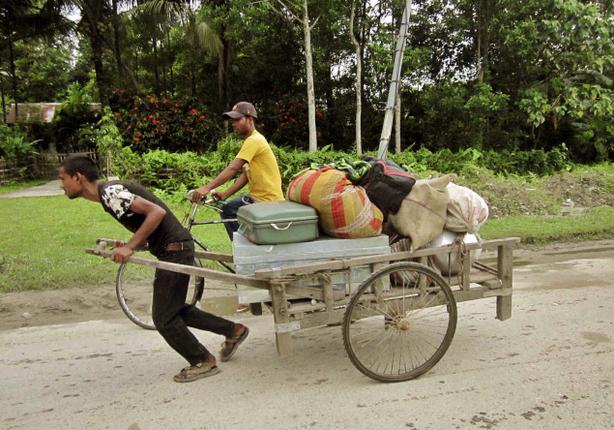
A villager carries his belongings to a safe place in Kokrajhar

Comments

Add new comment

  • Coastaldigest.com reserves the right to delete or block any comments.
  • Coastaldigset.com is not responsible for its readers’ comments.
  • Comments that are abusive, incendiary or irrelevant are strictly prohibited.
  • Please use a genuine email ID and provide your name to avoid reject.
Agencies
May 23,2020

New Delhi, May 23: The nationwide lockdown will no longer help India in its fight against COVID-19, and in its place community-driven containment, isolation and quarantine strategies have to be brought into play, leading virologist Shahid Jameel said.

The recipient of Shanti Swarup Bhatnagar Prize for Science and Technology also stressed that testing should be carried out vigorously to identify coronavirus hotspots and isolate those areas.

"Our current testing rate at 1,744 tests per million population is one of the lowest in the world. We should deploy both antibody tests and confirmatory PCR tests. This will tell us about pockets of ongoing infection and past (recovered) infection. This will provide data to open up gradually and let economic activity resume," Jameel told PTI in an interview.

He stressed that testing has to be dynamic to continuously monitor red, orange and green zones and change these based on that data.

About community transmission of COVID-19 in India, Jameel said the country reached that stage long ago.

"We reached community transmission a long time ago. It's just that the health authorities are not admitting it. Even ICMR's own study of SARI (severe acute respiratory illness) showed that about 40 per cent of those who tested positive for SARS-CoV-2 did not have any history of overseas travel or contact to a known case. If this is not community transmission, then what is?" he posed.

Lockdown bought India time in its fight against coronavirus, but continuing it is unlikely to yield any further dividend, Jameel said.

"Instead, community-driven local lockdowns, isolations and quarantines have to come into play. Building trust is most important so that people follow rules. A public health problem cannot be dealt with as a law-and-order problem."

The nationwide lockdown, initially imposed from March 25 to April 14, has been extended thrice and will continue at least till May 31. The virus has claimed 3,720 lives and infected over 1.25 lakh people in the country so far.

Jameel has expertise in the fields of molecular biology, infectious diseases, and biotechnology. He is the CEO of Wellcome Trust/Department of Biotechnology's India Alliance and is best known for extensive research in Hepatitis E virus and HIV.

He said COVID-19 will eventually be controlled through herd immunity, which is acquired in two ways – when a sufficient fraction of the population gets infected and recovers, and with vaccination.

"It is estimated that for SARS-CoV-2 at least 60 per cent of the population would have to be infected and recovered, or vaccinated. This will happen over the course of the next few years," Jameel said.

Herd immunity is reached when the majority of a population becomes immune to an infectious disease, either because they have become infected and recovered, or through vaccination. When that happens, the disease is less likely to spread to people who aren't immune, because there just aren't enough infectious carriers.

"India has 1.38 billion people, a population density of about 400/sq km and a healthcare system ranked at 143 in the world. If we allow 60 per cent people to get infected quickly in the hopes of herd immunity, that would mean 830 million infections," Jameel said.

"If 15 per cent need hospitalization that means about 125 million isolation beds (we have 0.3 million). If five per cent need oxygen and ventilatory support, this amounts to about 42 million oxygen support and ICU beds; we have 0.1 million oxygen support beds and 34,000 ICU beds. This would overwhelm the healthcare system causing mayhem," he said.

Jameel said if the population level mortality is 0.5 per cent that would mean 40 lakh deaths. "Are we prepared to pay this price for herd immunity in the short term? Clearly not," he said.

He said it is unlikely that a vaccine would be available by the end of the year.

"Even then, we don't know yet how long it would give protection – weeks, months, one year, a few years? I don't think we will return to pre-coronavirus days for at least the next 3-5 years. This is also a chance to evaluate if we want to return to those unsustainable, environment-damaging ways. COVID-19 is a timely warning to reform our way of living," he said.

Jameel said it is hard to predict but plausible that COVID-19 would return in second or third wave.

"Later waves come when we don't understand the disease and become lax. A comparison to Spanish Flu is not entirely valid because in 1918 no one knew what caused it. No one had seen a virus till the mid-1930s as the electron microscope needed to view those was invented in 1931," he said.

"Today we know a lot more about the pathogen, its genetic makeup, how it transmits and how to prevent it. We need to be sensible and follow expert advice," he said.

If there is any scientific evidence linking deforestation, rapid urbanisation, climate change with pandemics like COVID-19, he said zoonotic viruses -- those that jump from animals to humans -- happen so when wild animal–human contacts increase.

"Deforestation destroys animal habitats bringing them closer to humans. When you cut forests, bats come to roost on trees closer to human habitations. Their viruses in secretions/stool get transmitted to domestic animals and on to humans. This happened clearly with Nipah virus outbreak in Malaysia in 1997-98 from fruit bats to pigs to humans," he said.

"COVID-19 possibly arose in wet animal markets due to dietary habits that bring all kinds of live and dead wild animals in close contact with humans," Jameel added.

Comments

Add new comment

  • Coastaldigest.com reserves the right to delete or block any comments.
  • Coastaldigset.com is not responsible for its readers’ comments.
  • Comments that are abusive, incendiary or irrelevant are strictly prohibited.
  • Please use a genuine email ID and provide your name to avoid reject.
News Network
June 23,2020

New Delhi, Jun 23: With an increase of 14,933 new cases and 312 deaths in the last 24 hours, India's COVID-19 count reached 4,40,215 on Tuesday.

According to the latest update by the Union Ministry of Health and Family Welfare (MoHFW), 14,011 deaths have been recorded due to the infection so far in the country.

The rise in confirmed cases today is lower than the highest spike of 15 thousand plus cases registered on Sunday.

The count includes 1,78,014 active cases, and 2,48,190 cured/discharged/migrated patients.

Maharashtra with 1,35,796 confirmed cases remains the worst-affected by the infection so far in the country. The state's count includes 61,807 active, 67,706 cured, discharged patients while 6,283 deaths have been reported due to the infection so far.

Meanwhile, the national capital's confirmed coronavirus cases reached 62,655.

2,233 deaths have been reported in Delhi due to the infection so far.

Tamil Nadu has reported 62,087 cases so far with toll increased to 794.

Comments

Add new comment

  • Coastaldigest.com reserves the right to delete or block any comments.
  • Coastaldigset.com is not responsible for its readers’ comments.
  • Comments that are abusive, incendiary or irrelevant are strictly prohibited.
  • Please use a genuine email ID and provide your name to avoid reject.
News Network
May 6,2020

May 6: The government on Tuesday said that the Food Corporation of India, the nodal agency for procurement and distribution of foodgrains, has sufficient stocks in its godowns, even after meeting the requirement of additional wheat and rice provided free of cost during the lockdown period.

Food Minister Ram Vilas Paswan has given detailed information about the various steps taken by the government and the total stocks of food grains and pulses available with the government and sent to the states till now, an official statement said.

"FCI currently has 276.61 lakh tonnes rice and 353.49 lakh tonnes wheat. Hence a total of 630.10 lakh tonnes food grain stock is available," it said.

As against this, about 60 lakh tonnes of food grains is required for a month under the NFSA (National Food Security Act) and other welfare schemes.

Paswan said FCI stocks are comfortable even after fulfilling extra commitments during the lockdown.

Under the 'Pradhan Mantri Garib Kalyan Ann Yojana', the Centre is providing 5 kg of free food grains per month to 80 crore ration card holders. This free of cost wheat and rice will be provided for three months. Besides, 1 kg of pulses will also be supplied per family.

This is over and above the normal quota of 5 kg of food grains provided per month per person to about 80 crore people under the food law.

The minister informed that since the lockdown, about 69.52 lakh tonnes of food grains have been transported through 2,483 rail rakes.

Apart from rail route, transportation was also done through roads and waterways. A total of 137.62 lakh tonnes has been transported.

During the lockdown, NGOs and social institutions running relief camps can purchase wheat and rice directly from FCI Depots at Open Market Sales Scheme (OMSS) rate.

The state governments can also purchase food grains directly from FCI. Under the OMSS, the rate of rice is fixed at Rs 22 per kg and wheat at Rs 21 per kg.

Under the 'Pradhan Mantri Garib Kalyan Ann Yojana', for the next 3 months a total of 104.4 lakh tonnes rice and 15.6 lakh tonnes of wheat is required of which 59.50 lakh tonnes rice and 8.14 lakh tonnes wheat have been lifted by various states and UTs.

The Government of India is bearing 100 per cent financial burden of approximately Rs 46,000 crore under the scheme, the statement said.

For pulses, the total requirement for the next three months is 5.82 lakh tonnes.

So far, 2,20,727 tonnes of pulses have been dispatched, while 1,47,165 tonnes of pulses have reached the states/UTs and 47,490 tonnes have been delivered, it said.

Comments

Add new comment

  • Coastaldigest.com reserves the right to delete or block any comments.
  • Coastaldigset.com is not responsible for its readers’ comments.
  • Comments that are abusive, incendiary or irrelevant are strictly prohibited.
  • Please use a genuine email ID and provide your name to avoid reject.