


Fresh incidents of ethnic violence in Assam; ‘Rajdhani Express’ attacked

July 24, 2012

asam


Kokrajhar (Assam), July 24: Fresh violence today rocked the trouble-torn Bodoland Territorial Administered Districts in Assam where the Rajdhani Express was attacked by some persons even as the entire train services to and from the Northeast was hit.

Unidentified persons pelted stones and attacked the coaches of the Guwahati-bound Rajdhani Express at Gossaigaon in Kokrajhar district damaging four coaches, though there was no casualty or injuries, North East Frontier Railway sources said here.

The train has been turned back and halted at Kamakhyaguri station bordering West Bengal, but the authorities were considering to take it to Coochbehar Sporadic incidents of violence and arson were reported from different parts of Kokrajhar, Chirang and Dhubri districts while the situation remains tense in neighbouring Bongaigaon and Udalguri districts.

Indefinite curfew continues in Kokrajhar while night curfew will continue in Dhubri and Chirang districts in the ethnic violence in BTAD districts which has claimed 21 districts, the police said.

More than 50,000 people have taken shelter in 75 relief camps set up by the district authorities, most of them in worst-affected Kokrajhar district. Assam Director-General of Police Jayanta Narayan Choudhury is scheduled to visit the violence-racked districts today to take stock of the situation.

Assam Revenue Minister Prithbi Majhi and agriculture Minister Nilamoni Sen Deka have rushed to the district on the direction of Chief Minister Tarun Gogoi while forest minister Rockybul Hussain, food and civil supplies minister Nazrul Islam and tourism minister Chandan Brahma were already camping there.

A delegation of BJP and Congress has also arrived in the trouble-torn districts to assess the situation.

Train services have been hit due to the violence with 31 trains halted and controlled at various places.

Railway authorities have urged the state government to provide adequate security to ensure safe movement of trains.

Meanwhile, Bodoland Territorial Council Chief Hagrama Mohilary today claimed that a section of the people have alleged that NDFB could have some role in the violence.

However, sources said the NDFB is now under a ceasefire agreement and the talks process has been initiated with it.

"I urge the NDFB to calm down and refrain from such activities while the government should take the initiative to bring those cadres who are still in the jungle to the mainstream and involve them in the peace process," Mohilary said.

He also alleged that there were inadequate security forces in the BTAD which was creating difficulties in maintaining law and order in the state.

"Our top priority is to stop violence in the districts and we urge the state government not to pull back Army deployment at this stage," Mohilary said.
violence

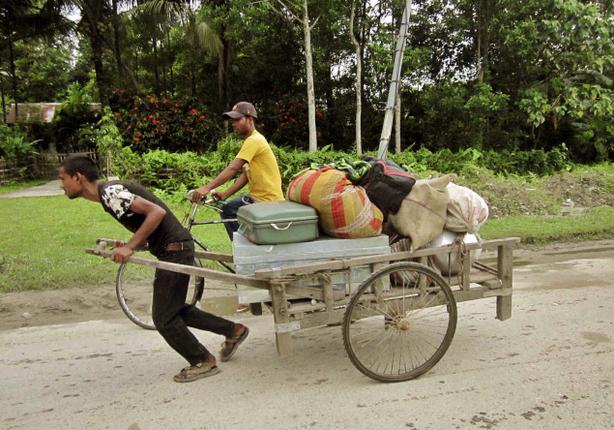
A villager carries his belongings to a safe place in Kokrajhar

Comments

Add new comment

  • Coastaldigest.com reserves the right to delete or block any comments.
  • Coastaldigset.com is not responsible for its readers’ comments.
  • Comments that are abusive, incendiary or irrelevant are strictly prohibited.
  • Please use a genuine email ID and provide your name to avoid reject.
News Network
July 19,2020

New Delhi, Jul 19: India's Covid-19 case fatality rate is "progressively falling" and is currently at 2.49 per cent, which is one of the lowest in the world, the Union Health Ministry said on Sunday, crediting efficient clinical management of hospitalised cases for it.

There are 29 states and union territories with a case fatality rate (CFR) lower than India's average, with five of them having a CFR of zero and 14 having fatality rate of less than 1 per cent.

The focused efforts of the Centre and state and UT governments on efficient clinical management of hospitalised cases have ensured that India's case fatality rate has fallen below 2.5 per cent, the ministry said.

With effective containment strategy, aggressive testing and standardized clinical management protocols based on holistic standard of care approach, the CFR has significantly dipped, it said.

"The CFR is progressively falling and currently, it is 2.49 per cent. India has one of the lowest fatality rates in the world," the ministry said.

From 2.82 per cent over a month earlier, India's Covid-19 case fatality rate declined to 2.72 per cent on July 10 and has further reduced to 2.49 per cent presently.

Under the guidance of the Centre, the state and UT governments have ramped up testing and hospital infrastructure by combining public and private sector efforts, the ministry said.

Many states have conducted the population surveys to map and identify the vulnerable population like the elderly, pregnant women and those with co-morbidities.

This, with the help of technological solutions like mobile apps, has ensured keeping the high-risk population under continuous observation, thus aiding early identification, timely clinical treatment and reducing fatalities, the ministry said.

"At the ground level, frontline health workers like ASHAs (Accredited Social Health Activists) and ANMs (Auxiliary Nursing Midwives) have done a commendable job of managing the migrant population and to enhance awareness at the community level.

"As a result, there are 29 States and UTs with CFR lower than India's average. This shows commendable work done by public health apparatus of the country," the ministry said.

Manipur, Nagaland, Sikkim, Mizoram, Andaman and Nicobar Islands have zero case fatality rate.

States and UTs having a CFR below the national average include Tripura (0.19 pc),  Assam (0.23 pc), Kerala (0.34 pc), Odisha (0.51 pc), Goa (0.60 pc), Himachal Pradesh (0.75 pc), Bihar (0.83 pc), Telangana (0.93 pc), Andhra Pradesh (1.31 pc), Tamil Nadu (1.45 pc), Chandigarh (1.71 pc), Rajasthan (1.94 pc), Karnataka (2.08 pc) and Uttar Pradesh (2.36 pc).

India saw a record single-day jump of 38,902 Covid-19 cases pushing its tally to 10,77,618 on Sunday, while the total number of recoveries increased to 6,77,422.

A total of 23, 672 patients have recuperated in the past 24 hours, the highest so far in a day, according to the health ministry data updated at 8 AM.

According to the Indian Council of Medical Research (ICMR), a cumulative total of 1,37,91,869 samples have been tested up to July 18 with 3,58,127 samples being tested on Saturday. 

Comments

Add new comment

  • Coastaldigest.com reserves the right to delete or block any comments.
  • Coastaldigset.com is not responsible for its readers’ comments.
  • Comments that are abusive, incendiary or irrelevant are strictly prohibited.
  • Please use a genuine email ID and provide your name to avoid reject.
News Network
May 26,2020

New Delhi, May 26: With India now in the bracket of top 10 nations worst hit by the novel coronavirus, experts have attributed the surge in cases to easing of travel restrictions and movement of migrants besides enhanced testing capacity.

According to AIIMS Director, Randeep Guleria, the present rise in cases has been reported predominantly from hotspot areas but there is a possibility of further rise in the number of COVID-19 cases in the coming few days due to increased travel.

"Those who are asymptomatic or are in presymptomatic stage will pass through screening mechanisms and may reach areas where there have been minimal or less cases," Guleria said.

He said there was a need for more intense surveillance and monitoring in areas where migrants have returned to contain the spread of the disease.

If proper social distancing and hand hygiene is not maintained at a time when people are out on roads, the coronavirus infection will transmit much faster, he said.

Guleria also noted that testing capacity has been significantly ramped up which is reflecting in the increasing number of cases being detected.

Commenting on the partial resumption of rail and road transport services and migrants returning to their native places, Dr Chandrakant S Pandav, former president of the Indian Public Health Association and Indian Association of Preventive and social medicine, said the floodgates have been opened.

"This is a classic case of creating an enabling environment for coronavirus to spread like wildfire. In the coming few days, the number will rise dramatically. While it is true that lockdown cannot go on forever, the opening up should have been in a measured, calibrated and informed manner," he said.

"Travelling leads to spread of the infection. Now, the government will have to ensure even stronger surveillance to curb the infection but if that will be done is something to be observed," he said.

The death toll due to COVID-19 rose to 4,167 and the number of cases climbed to 1, 45,380 in the country, registering an increase of 146 deaths and 6,535 cases since Monday 8 am, according to the Union Health Ministry.

Dr K K Aggarwal, President of the Confederation of Medical Association of Asia and Oceania (CMAAO), and former IMA President, said there will be a further surge in cases in the coming days if migration continues without any proper social distancing.

"Within the next ten days, the cases will cross two lakh. The very fact that number of cases was rising before the end of the third lockdown and continuing during the fourth lockdown means that people are not following physical distancing as required," he said.

"Even in the last week of May when the temperature is very high, the rising number of cases would mean that human-to-human transmission is more important than surface-to-human transmission. Normally in heat the surface-to-human transmission should have reduced the new cases by half which has not happened," Aggarwal said.

However, Professor K Srinath Reddy, president of the Public Health Foundation of India, said an increase in the number of cases reflects both an increase in testing rates and an increase in spread.

"What we need to see is the number of new tests performed per day and the number of new cases that were identified from them. That gives a better idea of the rate of spread than the total number of new cases alone.

"We also have to see if the testing criteria has remained the same between the two periods of comparison.We may open up gradually but will have to continue case detection, contact tracing and follow personal protection measures as vigorously as possible," he added.

A total of 31,26,119 samples have been tested as on May 26, 9 am and 92,528 samples have been tested in the last 24 hours, ICMR officials said.

India is the tenth most affected nation by the pandemic after the US, Russia, UK, Spain, Italy, Brazil, Germany, Turkey and France, as per the John Hopkins University data.

The country has recorded 6,088, 6,654, 6,767 and 6977 cases on May 22, 23, 24 and 25 respectively. Also, the number of RT-PCR tests for detection of COVID-19 in the country crossed the 30-lakh mark on Monday.

The first two phases of the lockdown led to 14-29 lakh COVID-19 cases being averted, while the number of lives saved in that period was between 37,000 and 78,000, the government said last Friday, citing various studies, and asserted that the unprecedented shutdown has paid "rich dividends" in the fight against the pandemic.

Comments

Add new comment

  • Coastaldigest.com reserves the right to delete or block any comments.
  • Coastaldigset.com is not responsible for its readers’ comments.
  • Comments that are abusive, incendiary or irrelevant are strictly prohibited.
  • Please use a genuine email ID and provide your name to avoid reject.
News Network
May 20,2020

United Nations, May 20: Highlighting India's long-standing history of promoting inclusive and peaceful societies, a top UN official on Tuesday voiced concern over incidents of "increased hate speech and discrimination" against minority communities in the country following the adoption of the Citizenship Amendment Act.

Under-Secretary-General and UN Special Adviser on the Prevention of Genocide Adama Dieng, however, welcomed Prime Minister Narendra Modi’s call for unity and brotherhood in the wake of the COVID19 pandemic.

Dieng said in a note to the media on Tuesday that he is "concerned over reports of increased hate speech and discrimination against minority communities in India" since the adoption of the Citizenship Amendment Act (CAA) in December 2019.

The Indian government has maintained that the CAA is an internal matter of the country and stressed that the goal is to protect the oppressed minorities of neighbouring countries.

The CAA, which was notified on January 10, grants Indian citizenship to non-Muslim minorities migrated to India from Afghanistan, Pakistan and Bangladesh till December 31, 2014, following persecution over their faith.

"While the objective of the act, to provide protection to minority communities is commendable, it is concerning that this protection is not extended to all groups, including Muslims. This is contrary to India’s obligations under international human rights law, in particular on non-discrimination,” Dieng said.

The Special Adviser recognised "India’s long standing and well recognised history of promoting inclusive and peaceful societies, with respect for equality and principles of non-discrimination.”

He also welcomed recent statements by Prime Minister Modi that the COVID-19 pandemic “does not see race, religion, colour, caste, creed, language or border before striking and that our response and conduct...should attach primacy to unity and brotherhood.”

Dieng encouraged the Government of India to "continue to abide by this guidance by ensuring that national laws and policies follow international standards related to non-discrimination and to address and counter the rise of hate speech through messages of inclusion, respect for diversity and unity.”

He further reiterated that he would continue to follow developments and expressed his readiness to support initiatives to counter and address hate speech.

The hate speech and the dehumanisation of others goes against international human rights norms and values, he added.

“In these extraordinary times brought about by the COVID-19 crisis it is more important than ever that we stand united as one humanity, demonstrating unity and solidarity rather than division and hate,” he said.

Dieng also expressed concern over reports of violence during demonstrations against CAA in some regions of India.

Comments

Add new comment

  • Coastaldigest.com reserves the right to delete or block any comments.
  • Coastaldigset.com is not responsible for its readers’ comments.
  • Comments that are abusive, incendiary or irrelevant are strictly prohibited.
  • Please use a genuine email ID and provide your name to avoid reject.