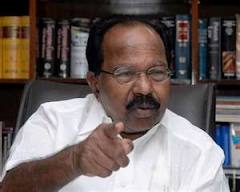
Modi's 'hang me' remark reprehensible, says Moily

July 26, 2012

moily


New Delhi, July 26: Congress ministers Thursday slammed Gujarat Chief Minister Narendra Modi for his remark "Hang me if I am guilty" with reference to the 2002 riots in the state, terming it "highly reprehensible and irresponsible".

In an interview to Urdu weekly Nai Duniya, Modi said "Hang me if I am guilty ('Main gunehgaar hoon toh mujhe phaansi par latkaa do')" on the Gujarat riots.

Modi, a Bharatiya Janata Party (BJP) leader, has been accused of giving tacit support to the riots in which more than 1,000 Muslims were killed following the Feb 27, 2002, Godhra train burning incident in which 57 'kar sewaks' returning from Ayodhya were burnt alive.

Union Corporate Affairs Minister M. Veerappa Moily, reacting to Modi's remark, said it was for the judiciary to decide on the guilty and take appropriate steps to punish them.

Asked if Modi's remark was aimed at appeasing the minorities, Moily said: "I don't know whether it is to appease minorities. But I think it is highly reprehensible and irresponsible".

Union Law Minister Salman Khurshid, taking a dig at Modi, said if the Gujarat chief minister was aiming to change his image with such a remark, it would be better to change his behaviour and role instead.

Khurshid told reporters: "I don't think we believe in kangaroo justice. Whatever the law is in the country will prevail. The courts will decide. The agencies that are working for the courts will have to decide, place the material before the court, and the court will take a decision."

"I don't think that we either in the streets can decide or that Modi can take a decision by himself," he said.

"We all have faith in the courts of the land and we will wait for the courts to say what they believe is the right thing to do," he said.

Asked if Modi's remark was aimed at a pro-minority image, Khurshid said: "If he wants to improve his image, let him. But I feel he should change his behaviour and his role (kirdar). That will be the best. Changing image will not help."

Modi's interview in Nai Duniya was conducted by Shahid Siddiqui, a former Rajya Sabha member from the Samajwadi Party.

The interview dealt with the post-Godhra riots, the state of Muslims in Gujarat and other sensitive issues.

Comments

Add new comment

  • Coastaldigest.com reserves the right to delete or block any comments.
  • Coastaldigset.com is not responsible for its readers’ comments.
  • Comments that are abusive, incendiary or irrelevant are strictly prohibited.
  • Please use a genuine email ID and provide your name to avoid reject.
Agencies
January 16,2020

New Delhi, Jan 16: United Forum of Bank Unions has decided to observe a two-day strike on January 31 and February 1, demanding early wage revision settlement which has been due since November 1, 2017, said the All India Bank Employees Association.

Union Finance Minister Nirmala Sitharaman will present her second Union Budget on February 1.

Banks will also hold a strike on March 11, 12 and 13. Also, an indefinite strike will be held from April 1.

General Secretary, All India Bank Officers' Confederation West Bengal Sanjay Das has stated that the nationwide strike has been called over several demands.

"The demands include--wage revision settlement at 20 per cent hike on payslip components with adequate loading thereof and scrapping off New Pension Scheme (NPS)," said Das.

There are several demands to hold the strike including the merger of special allowance with basic pay, updation of pension, improvement in the family pension system, five-day banking, allocation of staff welfare fund based on operating profits and exemption from income tax on retiral benefits without a ceiling.

"Other demands include-- a uniform definition of business hours, lunch hour etc in the branches, introduction of leave bank, defined working hours for the officers and equal wage for equal work for the contract employee," said Das.

Comments

Add new comment

  • Coastaldigest.com reserves the right to delete or block any comments.
  • Coastaldigset.com is not responsible for its readers’ comments.
  • Comments that are abusive, incendiary or irrelevant are strictly prohibited.
  • Please use a genuine email ID and provide your name to avoid reject.
Agencies
June 28,2020

New Delhi, Jun 28: Home Minister Amit Shah on Sunday targeted former Congress President Rahul Gandhi, saying he was indulging in "shallow-minded" politics and making statements that make Pakistan and China happy when soldiers are fighting a spirited battle.

Shah said the government is ready for a discussion in Parliament about the situation from 1962 (when India-China war took place) and it is sad that a former president of a party making statements, which are being celebrated in Pakistan and China.

The Home Minister's comments came during an interview with ANI when he was asked about Rahul's "Surrender (Prime Minister Narendra) Modi" remarks while criticising the BJP-led government on India-China border row.

Rahul has been consistent in his criticism of the government on the handling of both Covid-19 situation and India-China border row, which escalated into a "violent face-off" earlier this month in which 20 Indian soldiers were killed.

"Let there be a robust debate in Parliament. Let us have one. Let us discuss from 1962. Nobody is scared of debate. But one should not make a statement that makes Pakistan and China happy when the soldiers are fighting a spirited battle and the government is taking strong steps," he said.

Asked whether India can handle the anti-India propaganda unleashed by Rahul's 'Surrender Modi' hashtag, he said the government is capable of handling it but it is a matter of introspection for the former Congress president and his party that their remarks are being used against the country.

Modi's remarks at an all-party meeting that no one has intruded into Indian territory triggered a controversy with a section arguing that it went against the previous statement of External Affairs Minister S Jaishankar.

Claiming that he could not advise Rahul as it is Congress' job to do so, he said the government has fought Covid-19 well but some people have a twisted way of seeing things. He said India fought well against Covid-19 and the statistics will speak for itself as it is much better compared to the world.

Shah said under Modi's leadership, India is going to win both the battles -- Covid-19 and India-China border row.

The Home Minister also refused to be drawn into a question on whether Chinese soldiers are holding on to Indian territory on the border at present, saying the government is doing enough to address border row with China.

"I don't want to do anything that goes against my primary aim of this interview (to highlight the steps taken to fight Covid-19 pandemic in Delhi) and create headlines that keep citizens further in fear," Shah said.

When pointed out that people are also in panic due to the border situation, he said the government has taken steps to address the situation and at an appropriate time he would make comments, if needed.

Asked about his tweets on Emergency, which was targeted by Congress asking whether there is democracy in the BJP, he countered it saying that BJP has presidents L K Advani followed by Rajnath Singh, Nitin Gadkari, Rajnath again, himself and now J P Nadda.

"After Indira-ji, was there any Congress President from outside Gandhi family? What democracy do they talk about? I did not do any politics during Covid-19. You look at my tweets of the past 10 years. Every June 25, I give a statement," he said.

"Emergency should be remembered by people as it attacked the roots of our democracy. No one should ever forget it. There should be awareness about it. It is not about a party but about the attack on the country's democracy," he said.

Comments

Add new comment

  • Coastaldigest.com reserves the right to delete or block any comments.
  • Coastaldigset.com is not responsible for its readers’ comments.
  • Comments that are abusive, incendiary or irrelevant are strictly prohibited.
  • Please use a genuine email ID and provide your name to avoid reject.
News Network
February 19,2020

New Delhi, Feb 19: India will switch to the world's cleanest petrol and diesel from April 1 as it leapfrogs straight to Euro-VI emission compliant fuels from Euro-IV grades now - a feat achieved in just three years and not seen in any of the large economies around the globe.

India will join the select league of nations using petrol and diesel containing just 10 parts per million of sulphur as it looks to cut vehicular emissions that are said to be one of the reasons for the choking pollution in major cities.

Sanjiv Singh, Chairman of Indian Oil Corp (IOC) - the firm that controls roughly half of the country's fuel market, said almost all refineries began producing ultra-low sulphur BS-VI (equivalent to Euro-VI grade) petrol and diesel by the end of 2019 and oil companies have now undertaken the tedious task of replacing every drop of fuel in the country with the new one.

"We are absolutely on track for supplying BS-VI fuel from April 1. Almost all refineries have begun supplying BS-VI fuel and the same has reached storage depots across the country," he said.

From storage depots, the fuel has started travelling to petrol pumps and in the next few weeks all of them will only have BS-VI grade petrol and diesel, he said. "We are 100 per cent confident that fuel that will flow from nozzles at all the petrol pumps in the country on April 1 will be BS-VI emission compliant fuel."

India adopted Euro-III equivalent (or Bharat Stage-III) fuel with a sulphur content of 350 ppm in 2010 and then took seven years to move to BS-IV that had a sulphur content of 50 ppm. From BS-IV to BS-VI it took just three years.

"It was a conscious decision to leapfrog to BS-VI as first upgrading to BS-V and then shifting to BS-VI would have prolonged the journey to 4 to 6 years. Besides, oil refineries, as well as automobile manufacturers, would have had to make investments twice - first to producing BS-V grade fuel and engines and then BS-VI ones," he said.

State-owned oil refineries spent about Rs 35,000 crore to upgrade plants that could produce ultra-low sulphur fuel. This investment is on top of Rs 60,000 crore they spent on refinery upgrades in the previous switchovers.

BS-VI has a sulphur content of just 10 ppm and emission standards are as good as CNG.

Originally, Delhi and its adjoining towns were to have BS-VI fuel supplies by April 2019 and the rest of the country was to get same supplies from April 2020.

But oil marketing companies switched over to supply of BS-VI grade fuels in the national capital territory of Delhi on April 1, 2018.

The supply of BS-VI fuels was further extended to four contiguous districts of Rajasthan and eight of Uttar Pradesh in the National Capital Region (NCR) on April 1, 2019, together with the city of Agra.

BS-VI grade fuels were made available in 7 districts of Haryana from October 1, 2019.

Singh said the new fuel will result in a reduction in NOx in BS-VI compliant vehicles by 25 per cent in petrol cars and by 70 per cent in diesel cars.

The switchover, he said, is a tedious task as every drop of old, higher-sulphur content fuel has to be flushed out in depots, pipelines and tanks before being replaced by BS-VI.

"We are confident of disruption-free switchover to BS-VI supplies across the country," he said. "What we will be supplying is the best quality available anywhere in the world. You don't have any better fuel that is supplied in any part of the world. Perhaps our BS-VI fuel will be better than equivalent fuel in some parts of the US and Europe."

India adopted a fuel upgradation programme in the early 1990s. Low lead gasoline (petrol) was introduced in 1994 in Delhi, Mumbai, Kolkata and Chennai. On February 1, 2000, unleaded gasoline was mandated nationwide.

Similarly, BS-2000 (Euro-I equivalent, BS-1) vehicle emission norms were introduced for new vehicles from April 2000. BS-II (Euro-II equivalent) emission norms for new cars were introduced in Delhi from 2000 and extended to the other metro cities in 2001.

Benzene limits have been reduced progressively from 5 per cent in 2000 to 1 per cent nationwide. Lead content in gasoline was removed in phases and only unleaded gasoline is being produced and sold from February 1, 2000.

The octane number of gasoline signifies the improved performance of the engine. Loss in octane number due to phasing out of lead was made up by installing new facilities in the refinery and changes in refinery operation. RON (Research Octane Number) of gasoline for BS-2000 spec was increased to 88. This has over time been increased to 91.

Singh said sulphur reduction will reduce Particulate Matter (PM) emissions even in the in-use older generation diesel vehicles.


Comments

Add new comment

  • Coastaldigest.com reserves the right to delete or block any comments.
  • Coastaldigset.com is not responsible for its readers’ comments.
  • Comments that are abusive, incendiary or irrelevant are strictly prohibited.
  • Please use a genuine email ID and provide your name to avoid reject.