


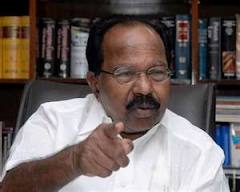
Modi's 'hang me' remark reprehensible, says Moily

July 26, 2012

moily


New Delhi, July 26: Congress ministers Thursday slammed Gujarat Chief Minister Narendra Modi for his remark "Hang me if I am guilty" with reference to the 2002 riots in the state, terming it "highly reprehensible and irresponsible".

In an interview to Urdu weekly Nai Duniya, Modi said "Hang me if I am guilty ('Main gunehgaar hoon toh mujhe phaansi par latkaa do')" on the Gujarat riots.

Modi, a Bharatiya Janata Party (BJP) leader, has been accused of giving tacit support to the riots in which more than 1,000 Muslims were killed following the Feb 27, 2002, Godhra train burning incident in which 57 'kar sewaks' returning from Ayodhya were burnt alive.

Union Corporate Affairs Minister M. Veerappa Moily, reacting to Modi's remark, said it was for the judiciary to decide on the guilty and take appropriate steps to punish them.

Asked if Modi's remark was aimed at appeasing the minorities, Moily said: "I don't know whether it is to appease minorities. But I think it is highly reprehensible and irresponsible".

Union Law Minister Salman Khurshid, taking a dig at Modi, said if the Gujarat chief minister was aiming to change his image with such a remark, it would be better to change his behaviour and role instead.

Khurshid told reporters: "I don't think we believe in kangaroo justice. Whatever the law is in the country will prevail. The courts will decide. The agencies that are working for the courts will have to decide, place the material before the court, and the court will take a decision."

"I don't think that we either in the streets can decide or that Modi can take a decision by himself," he said.

"We all have faith in the courts of the land and we will wait for the courts to say what they believe is the right thing to do," he said.

Asked if Modi's remark was aimed at a pro-minority image, Khurshid said: "If he wants to improve his image, let him. But I feel he should change his behaviour and his role (kirdar). That will be the best. Changing image will not help."

Modi's interview in Nai Duniya was conducted by Shahid Siddiqui, a former Rajya Sabha member from the Samajwadi Party.

The interview dealt with the post-Godhra riots, the state of Muslims in Gujarat and other sensitive issues.

Comments

Add new comment

  • Coastaldigest.com reserves the right to delete or block any comments.
  • Coastaldigset.com is not responsible for its readers’ comments.
  • Comments that are abusive, incendiary or irrelevant are strictly prohibited.
  • Please use a genuine email ID and provide your name to avoid reject.
News Network
January 14,2020

Chennai/New Delhi, Jan 14: India's annual electricity demand in 2019 grew at its slowest pace in six years with December marking a fifth straight month of decline, government data showed, amid a broader economic slowdown that led to a drop in sales of everything from cars to cookies and also to factories cutting jobs.

Electricity demand is seen as an important indicator of industrial output in the country and a sustained decline could mean a further slowdown in the economy.

India's power demand grew at 1.1% in 2019, data from the Central Electricity Authority showed, the slowest pace of growth since a 1% uptick seen in 2013. The power demand growth slowdown in 2013 was preceded by three strong years of consumption growth of 8% or more.

In December, the country's power demand fell 0.5% from the year-earlier period, representing the fifth straight month of decline, compared with a 4.3% fall in November.

But in India's western states of Maharashtra and Gujarat, two of India's most industrialised provinces, monthly demand increased.

In October, power demand had fallen 13.2% from a year earlier, its steepest monthly decline in more than 12 years, as a slowdown in Asia's third-largest economy deepened.

Industry accounts for more than two-fifths of India's annual electricity consumption, while homes account for nearly a fourth and agriculture more than a sixth.

The slower demand growth is a blow for many debt-laden power producers, who are facing financial stress and are owed over $11 billion by state-run distribution companies.

India's overall economic growth slowed to 4.5% in the July-September quarter, government data released in November showed, the weakest pace since 2013 as consumer demand and private investment fell.

The government has estimated growth in the current financial year that runs through to March will be the slowest since the 2008 global crisis.

"This reflects overall economic slowdown, because if you look at other high frequency data like diesel consumption, everywhere you are seeing contraction," Rupa Rege Nitsure, chief economist at L&T Financial Holdings.

But India's central bank will not have much scope to cut rates to stimulate the economy because inflation has been rising sharply and reached 7.35% in December compared with 1.97% in January last year.

Economists say India's growth will continue to hover around 4.5% levels in the Oct-Dec quarter.

"In the Oct-Dec quarter as well growth (GDP) will be around the same level as July-September. My estimate for the full year is around 4.7% growth," Nitsure said.

Comments

Add new comment

  • Coastaldigest.com reserves the right to delete or block any comments.
  • Coastaldigset.com is not responsible for its readers’ comments.
  • Comments that are abusive, incendiary or irrelevant are strictly prohibited.
  • Please use a genuine email ID and provide your name to avoid reject.
News Network
January 6,2020

Dehradun, Jan 6: Universities are centres of learning and will not be allowed to become "addas" of politics, HRD Minister Ramesh Pokhriyal 'Nishank' has said.

The minister was replying to questions from reporters in Haldwani on Sunday about protests against the amended Citizenship Act across university campuses.

"Universities are centres of learning where the country's future is in the making. We cannot let them become addas of politics," Nishank said.

He accused the opposition parties of trying to turn the universities into hotbeds of politics.

The new legislation passed by Parliament aims to grant citizenship to persecuted religious minorities from Pakistan, Bangladesh and Afghanistan who had taken refuge in India and there is nothing wrong in it, the Union Minister said

"When Pakistan was created, the population of religious minorities there stood at 22 per cent. Today it is a minuscule 3.7 per cent. Persecuted on the basis of their religion, they sought sanctuary in India. The CAA is meant only to grant them citizenship," he said.

Terming the law humanitarian, the minister said it was going to make no difference to the status of Muslims in India and wondered why the Congress was making such a hue and cry about it.

Nishank's press conference in Haldwani was part of the BJP's campaign to create awareness in favour of the amended Citizenship Act.

Comments

Add new comment

  • Coastaldigest.com reserves the right to delete or block any comments.
  • Coastaldigset.com is not responsible for its readers’ comments.
  • Comments that are abusive, incendiary or irrelevant are strictly prohibited.
  • Please use a genuine email ID and provide your name to avoid reject.
Agencies
January 22,2020

Kochi, Jan 22: The Left front government in Kerala on Monday decided to inform the Centre it would not cooperate with the updation of the NPR, saying there were fears among the public about the process and it has the "Constitutional responsibility" to alleviate them and ensure law and order.

A special cabinet meeting, chaired by Chief Minister Pinarayi Vijayan here, decided to inform the Registrar General and Census Commissioner under the Union Home Ministry that it was unable to cooperate with anything with regard to the updation of the NPR.

"The decision was taken as it was the Constitutional responsibility of the government to alleviate the fears of general public and ensure law and order situation in the state," a Chief Minister's Office release said.

However, the state would fully cooperate with the census procedures, it said.

The LDF government, which has been on a warpath against the Centre over the Citizenship Amendment Act, has last month stayed all activities related to updation of NPR, considering 'apprehensions' of public that it would lead to NRC in the wake of the controversial CAA.

"As the NPR is a process that leads to the National Register of Citizens (NRC), there is a sense of fear among the people that its implementation could lead to widespread insecurity", the CMO release said on Monday.

The experience of the state which had already compiled the NRC was an example for this, it added, in apparent reference to Assam.

Kerala had already stopped all procedures regarding the NPR updation, the release said adding there was also a report of the state police that the if the government went ahead with the procedures, it would adversely impact the law and order situation.

The district collectors have also informed the government that the Census procedures would be affected if the updation of the NPR was done along with it, the CMO release said.

The CPI(M)-led LDF government had recently convened a meeting of political parties and socio-religious organisations here on December 29 in the wake of the concerns among people in various stratas of the society, it said.

A special assembly session was convened and a resolution was passed requesting the Centre not to implement the CAA and the government had also approached the apex court against the law, it added.

Comments

Add new comment

  • Coastaldigest.com reserves the right to delete or block any comments.
  • Coastaldigset.com is not responsible for its readers’ comments.
  • Comments that are abusive, incendiary or irrelevant are strictly prohibited.
  • Please use a genuine email ID and provide your name to avoid reject.