


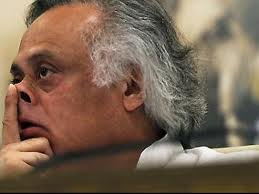
India is world's capital for open defecation: Ramesh

July 27, 2012
ramesh

New Delhi, July 27: Terming India as world's capital for open defecation, Drinking Water and Sanitation Minister Jairam Ramesh on Thursday said that 100,000 "bio-toilets" will be installed in about 300 backward gram panchayats in the next two years at a cost of Rs 150 crore.

"We are the world's capital for open defecation. It is a matter of shame, anguish, sorrow, anger," Ramesh said, noting over 60 percent of all open defecation takes place in India.

Speaking at a a function where a memorandum of understanding on bio-digester-based eco-friendly toilets was exchanged between the Defence Research and Development Organisation (DRDO) and the ministry in his and Defence Minister AK Antony's presence, Ramesh said the government intended to rid the country of open defecation in the next 10 years.

Ramesh, who is also rural development minister, said DRDO-developed bio-toilet had immense use for Indian Railways. He said his ministry had offered to equip it in all new railway coaches and share half the cost of retrofitting it in all the existing 50,000 coaches in the next four to five years. The project will cost about Rs 500 crore.

The minister said bio-toilets will also help curb manual scavenging which was still prevalent in about 15 lakh insanitary latrines.

He said the ministry intended to provide bio-toilets to 1,000 gram panchayats over the next four-five years. The minister said that funds for setting up bio-toilets will be provided by his ministry and DRDO and its private partner will be responsible for technology.

Ramesh said of 240,000 gram panchayats, only 28,000 had achieved the status of "nirmal gram" and his ministry intended that all panchayats achieve the status over the next 10 years.

Antony said that bio-toilet was a spin off from technology developed by DRDO for eco-friendly disposal of human waste for armed forces deployed in high altitude locations.

Minister of State for Statistics and Programme Implementation Srikant Jena said he would write to MPs for keeping apart money from MPLADS scheme for installing bio-toilets in their area.

DRDO bio-toilet is based on anaerobic biodegradation of organic waste by unique microbial consortium and works at wide temperature range. The onsortium has been made through acclimatisation, enrichment and bioaugumentation of cold-active bacteria collected from Antartica and other low temperature areas.


Comments

Add new comment

  • Coastaldigest.com reserves the right to delete or block any comments.
  • Coastaldigset.com is not responsible for its readers’ comments.
  • Comments that are abusive, incendiary or irrelevant are strictly prohibited.
  • Please use a genuine email ID and provide your name to avoid reject.
News Network
April 23,2020

Washington, Apr 23: Air pollution over northern India has plummeted to a 20-year-low for this time of the year, according to satellite data published by US space agency National Aeronautics and Space Administration (NASA).
The US space agency's satellite sensors observed aerosol levels at a 20-year low post the countrywide lockdown, implemented to slow the spread of the novel coronavirus.

"We knew we would see changes in atmospheric composition in many places during the lockdown," said Pawan Gupta, a Universities Space Research Association (USRA) scientist at NASA''s Marshall Space Flight Center. "But I have never seen aerosol values so low in the Indo-Gangetic Plain at this time of year," added Mr Gupta.

Acting Assistant Secretary of State for South and Central Asia Alice G Wells tweeted, "These images from NASA were taken each spring starting in 2016 and show a 20-year low in airborne particle levels over India. When India and the world are ready to work and travel again, let's not forget that collaborative action can result in cleaner air."

The data published with maps show aerosol optical depth (AOD) in 2020 compared to the average for 2016-2019. Aerosol optical depth is a measure of how light is absorbed or reflected by airborne particles as it travels through the atmosphere.

If aerosols are concentrated near the surface, an optical depth of 1 or above indicates very hazy conditions. An optical depth, or thickness, of less than 0.1 over the entire atmospheric vertical column is considered "clean." The data were retrieved by the Moderate Resolution Imaging Spectroradiometer (MODIS) on NASA's Terra satellite.

In the first few days of the lockdown, it was difficult to observe a change in the pollution signature. "We saw an aerosol decrease in the first week of the shutdown, but that was due to a combination of rain and the lockdown," said Mr Gupta.

Around March 27, heavy rain poured over vast areas of northern India and helped clear the air of aerosols. Aerosol concentrations usually increase again after such heavy precipitation.

"After the rainfall, I was really impressed that aerosol levels did not go up and return to normal. We saw a gradual decrease and things have been staying at the level we might expect without anthropogenic emissions," Mr Gupta said.

On March 25, the Indian government placed its 1.3 billion citizens under a strict lockdown to reduce the spread of COVID-19. The countrywide mandate decreased activity at factories and severely reduced car, bus, truck and airplane traffic. Every year, aerosols from anthropogenic (human-made) sources contribute to unhealthy levels of air pollution in many Indian cities.

Aerosols are tiny solid and liquid particles suspended in the air that reduce visibility and can damage the human lungs and heart.

In southern India though, the story is a little hazier. Satellite data show aerosol levels have not yet decreased to the same extent. In fact, levels seem to be slightly higher than in the past four years. The reasons are unclear but could be related to recent weather patterns, agricultural fires, winds or other factors.

"This a model scientific experiment," Robert Levy, program leader for NASA's MODIS aerosol products, said about the lockdown and its effects on pollution.

"We have a unique opportunity to learn how the atmosphere reacts to sharp and sudden reductions in emissions from certain sectors. This can help us separate how natural and human sources of aerosols affect the atmosphere," Mr Levy added.

Comments

Add new comment

  • Coastaldigest.com reserves the right to delete or block any comments.
  • Coastaldigset.com is not responsible for its readers’ comments.
  • Comments that are abusive, incendiary or irrelevant are strictly prohibited.
  • Please use a genuine email ID and provide your name to avoid reject.
News Network
January 9,2020

Dubai, Jan 9: A roadshow promoting Gujarat as an education hub of India will be held here from January 17, officials said.

Representatives of 22 universities and four colleges from Gujarat will be part of the two-day event organised by the Indian Consulate in Dubai.

"The roadshow will provide a glimpse of the thriving education sector in Gujarat and enable the interested candidates to get a first-hand understanding of the rich resources of the state in order to pursue higher education," according to a statement released by the Indian Consulate here on Wednesday.

A delegation led by Gujarat's Education Minister Bhupendrasinh Chudasama will take part in the event under the 'Study in Gujarat' campaign, the statement said.

The Principal Secretary of the state's Higher and Technical Education, Anju Sharma, will participate in the roadshow, which will conclude on January 18.

The participating educational institutions include Pandit Deendayal Petroleum University, Gujarat Forensic Science University, Nirma University, LD College of Engineering, Gujarat Arts and Science College, Vishwakarma Government College and SAL College.

"In the last decade and a half, Gujarat has been successful in establishing its identity as the leading educational hub of India. State of the art infrastructure, safe environment, curriculum at par with international standards and industry exposure gives students an edge during the course of their study," the statement said.

Comments

Add new comment

  • Coastaldigest.com reserves the right to delete or block any comments.
  • Coastaldigset.com is not responsible for its readers’ comments.
  • Comments that are abusive, incendiary or irrelevant are strictly prohibited.
  • Please use a genuine email ID and provide your name to avoid reject.
News Network
June 27,2020

New Delhi, Jun 27: India on Saturday crossed 5 lakh-mark with record highest spike of 18,552 cases of coronavirus reported in the country in the past 24 hours.

India has added more than 3.18 lakh COVID-19 cases since June 1.

According to the Union Ministry of Health and Family Welfare, this was the highest single-day spike of COVID-19 positive cases. Also, with 384 fatalities in the past 24 hours, the total deaths inched closer to the 16000 mark.

With this, the total number of active cases are 1,97,387 while a total of 2,95,880 people have been cured or discharged from hospitals. The death toll stands at 15685 with one person migrated outside India, according to the health ministry update at 8 am today.

Maharashtra continues to top the countrywide list with a total number of COVID-19 positive cases at 1,52,765.

Delhi has so far reported 77,240 confirmed cases while Tamil Nadu has reported 74622 cases till now, as per the MoHFW. Delhi, Mumbai and Chennai are the worst-hit cities in the country

According to the Indian Council of Medical Research (ICMR), the total number of samples tested up to June 26 is 79,96,707; the number of samples tested on June 26, Friday stands at 2,20,479.

Comments

Add new comment

  • Coastaldigest.com reserves the right to delete or block any comments.
  • Coastaldigset.com is not responsible for its readers’ comments.
  • Comments that are abusive, incendiary or irrelevant are strictly prohibited.
  • Please use a genuine email ID and provide your name to avoid reject.