


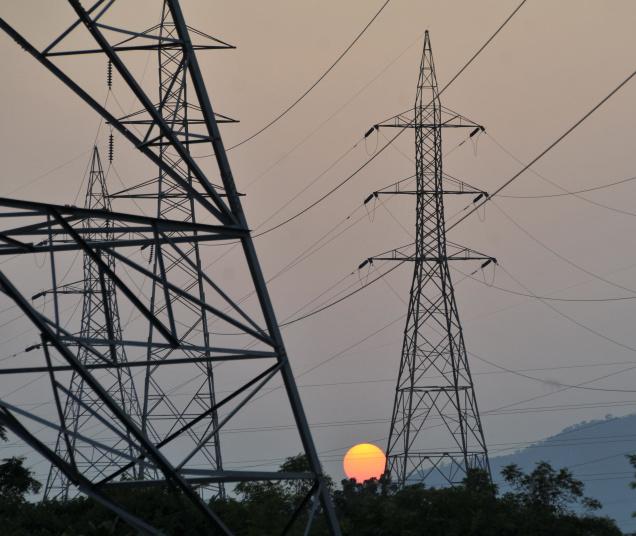
Northern India hit by one of the worst power breakdowns

July 30, 2012

power

New Delhi, July 30: In what was one of the worst power breakdowns in the country, the Northern Grid crashed early Monday morning plunging eight states into complete darkness, disrupting inter-state train services, adversely hitting health services and impacting millions of lives.

The tripping of the 400 KV Bina-Gwalior line, which flows into Agra-Bareilly at 2.35 a.m. wreaked havoc on the power generation and transmission systems leading to shut down of all major power plants including hydro power stations in the States of Punjab, Haryana, Rajasthan, Delhi, Uttrakhand, Himachal Pradesh, Jammu and Kashmir and the Union Territory of Chandigarh, which are all a part of the Northern Grid.

The immediate impact of the grid collapse was the shortage of around 32,000 MW of power. The last such collapse of the Northern Grid, which caters to around 28 per cent of the country’s population, took place in 2001. India currently faces around 8 to 12 per cent peak power deficit, according to the Central Electricity Authority (CEA).

The massive shutdown had a crippling effect on inter-state passenger and goods trains that came to a screeching halt. Early morning office goers and school children had a harrowing time as traffic signals went on the blink leading to traffic chaos in the affected States including the Capital Delhi.

Hospitals too had to scurry around for alternatives and back up supply. A majority of the hospitals claimed to have alternate supply arrangements, yet reports of services being disrupted trickled in from several places.

Operations at the major oil refineries in Panipat, Mathura and Bhatinda remained unaffected as these facilities have their own captive power plants and do not rely on the grid for supply.

While Power Minister, Sushil Kumar Shinde said he could not pin point the exact reason for the collapse, PGCIL and Northern Region Load Despatch Centre officials said that it was rampant overdrawal by Uttar Pradesh, Punjab and Haryana that led to the collapse that in turn paralysed services.

The last time the grid collapse occurred was in 2001, it has happened now after 10 years. At that time, the power breakdown took place at midnight and normalcy was restored by 4.30 pm.

PGCIL chairman and managing director, R.N. Nayak said the situation had been restored to normal by 4 pm. The Northern grid was generating around 29000 MW of power by late evening, which was about 2000 MW of the peak demand.

Hit by the sudden collapse of the grid system, the Power Grid Corporation of India Limited (PGCIL) officials swung into action with Mr. Nayak and his team of officials reaching their monitoring centre at 3 a.m. to assess the situation and work on a rescue package. By 8 a.m., PGCIL officials claimed to have restored around 40 per cent of power.

To run essential services, supply was diverted from the Western and Eastern Grids to the Northern region. Hydro power was also imported from the mountain kingdom of Bhutan to meet the deficit.

While he could not offer an explanation on what caused the collapse, Mr. Nayak said the agencies involved were at least “quick at restoring normalcy in a record time”.

Comments

Add new comment

  • Coastaldigest.com reserves the right to delete or block any comments.
  • Coastaldigset.com is not responsible for its readers’ comments.
  • Comments that are abusive, incendiary or irrelevant are strictly prohibited.
  • Please use a genuine email ID and provide your name to avoid reject.
News Network
January 12,2020

Kolkata, Jan 12: Strongly defending the new citizenship law, Prime Minister Narendra Modi said on Sunday the dispute that has arisen over it has made the world aware of persecution of religious minorities in Pakistan.

He, however, deplored that a section of the youth is being “misguided” over the Citizenship (Amendment) Act, which is aimed at giving and not taking away anybody's citizenship rights.

“CAA is not about taking away citizenship, it is about giving citizenship. Today, on National Youth Day, I would like to tell this to the youngsters of India, West Bengal, North East that this is not an overnight law for giving citizenship.

“We must all know that any person of any religion from any country of the world who believes in India and its Constitution can apply for Indian citizenship through due process. There's no problem in that,” he told a gathering at Belur Math, the headquarters of Ramkrishna Mission.

Modi said even Mahatma Gandhi had favoured Indian citizenship to those fleeing religious persecution and that his government has only delivered on the wishes of the freedom fighters.

Referring to anti-CAA protests in the North-East, Modi vowed to protect the distinct identity and culture of the people of the region, and asserted the new law will not hurt their interests.

“We've only done what Mahatma Gandhi had said decades ago. Should we send these refugees back to die? Are they our responsibility or not? Should we make them our citizens or not?” he said, evoking a thunderous applause by the gathering.

Modi said some people with political interests are deliberately spreading rumours about the new citizenship law, despite “complete clarity” over the CAA.

“Our initiative to amend the citizenship act has created a dispute. It is the result of our initiative that Pakistan will now have to answer why they have been persecuting minorities for the last 70 years. Human rights have been demolished in Pakistan,” he said.

Seeking to assuage the concerns of the people of the North-East, Modi called the region “our pride”. “Their culture, traditions and demography remains untouched by this amended law,” he said.

He said the citizenship law was only “changed a little” for those who were ill-treated in Pakisan after Partition.

“They were having a bitter time living there. Women were in danger of losing their pride,” he said.

“Young people have understood the whole thing but those who want to indulge in politics over it will not,” he said.

Modi said five years ago, there was disappointment among the youth of the country, but the situation has changed now.

“Not just India, the entire world has a lot of expectations from the youth of the country. The youth are not afraid of challenges....they challenge the challenges,” he said at the Belur Math, the abode of Swami Vivekananda for several years until his death in 1902, aged 39 years.

Modi, an ardent devotee of Vivekananda, spent the night at the Math.

He has a long association with the Ramkrishna Mission order founded by Vivekananda in 1897. Inspired by the teachings of Vivekananda, Modi had arrived at the Mission Ashram in Gujarat's Rajkot and expressed desire to join the order.

Swami Atmasthananda, who later went on to become the 15th president of the Ramakrishna Math and the Ramakrishna Mission, then headed the Rajkot branch and had advised him that sanyas was not for him and that he should work among people.

During those days, Modi used to regularly meet Atmasthananda and sought his spiritual guidance.

Although Modi went back after spending some time there his the relationship with Swami Atmasthananda and the Ramkrishna Mission continued.

Whenever Modi used to visit Kolkata, even during his days as Gujarat chief minister, he would travel to the Math.

In 2013, during his Kolkata visit, he had gone to Belur and sought the blessings from Atmasthananda.

He had in 2015 called on ailing Swami Atmasthananda at Ramakrishna Mission Seva Pratisthan, a hospital run by the Mission in south Kolkata and enquired about his health.

After Atmasthananda's death in 2017, Prime Minister Modi had termed it as a “personal loss”.

On Sunday, the prime minister paid tributes to Swami Vivekananda on his birth anniversary, which is celebrated as the National Youth Day, and spent some time in the spiritual leader's room in quietude.

Comments

Add new comment

  • Coastaldigest.com reserves the right to delete or block any comments.
  • Coastaldigset.com is not responsible for its readers’ comments.
  • Comments that are abusive, incendiary or irrelevant are strictly prohibited.
  • Please use a genuine email ID and provide your name to avoid reject.
Agencies
February 7,2020

Jammu & Kashmir, Feb 7: Former Jammu and Kashmir chief ministers Mehbooba Mufti and Omar Abdullah, besides two political stalwarts from NC and its arch-rival PDP were booked under the stringent Public Safety Act (PSA) by the administration on Thursday, officials said.

A magistrate accompanied by police served the order to Mufti at the bungalow where she has been detained, the officials said.

Abdullah was also booked under the PSA, they said.

National Conference general secretary and former minister Ali Mohammed Sagar, who wields a support base in downtown city, was served with a PSA notice public order by the authorities.

Similarly, senior PDP leader Sartaj Madani was booked under the PSA. Madani is the maternal uncle of former chief minister Mehbooba Mufti.

Both Sagar and Madani were detained in the aftermath of August 5 crackdown by the Centre on politicians following abrogation of special status of the erstwhile state, besides its bifurcation into two union territories.

Their six-month preventive custody was ending on Thursday.

Earlier, the officials had said that former NC legislator Bashir Ahmed Veeri was also booked under the PSA but later it turned out that he had been released.

Comments

Add new comment

  • Coastaldigest.com reserves the right to delete or block any comments.
  • Coastaldigset.com is not responsible for its readers’ comments.
  • Comments that are abusive, incendiary or irrelevant are strictly prohibited.
  • Please use a genuine email ID and provide your name to avoid reject.
News Network
January 19,2020

Mumbai, Jan 19: After Kerala and Punjab, the Maha Vikas Agadi (MVA) government is also mulling over a resolution against the Citizenship (Amendment) Act, 2019 in Maharashtra Assembly.

Speaking to news agency, Congress spokesperson Raju Waghmare said: "Our senior party leader Balasaheb Thorat has also shared his stand on the CAA. Even Chief Minister Uddhav Thackeray has said that we are against the CAA. As far as the resolution against CAA is concerned, our senior leaders of MVA will sit together and decide."

If this happens, then Maharashtra will be the third state to pass a resolution against CAA, which grants citizenship to non-Muslim refugees from Pakistan, Afghanistan, and Bangladesh, who came to India on or before December 31, 2014.

Emphasising that CAA is 'unconstitutional,' senior lawyer and Congress leader Kapil Sibal has said that every state Assembly has the constitutional right to pass a resolution and seek CAA's withdrawal.

He added that it would be problematic to oppose the CAA if the law is declared to be 'constitutional' by the Supreme Court.

"I believe the CAA is unconstitutional. Every State Assembly has the constitutional right to pass a resolution and seek its withdrawal. When and if the law is declared to be constitutional by the Supreme Court then it will be problematic to oppose it. The fight must go on!" Sibal tweeted.

Earlier speaking at the Kerala Literature Festival on Saturday, the Congress leader had said that constitutionally no state can say that it will not implement the amended Citizenship Act, as doing so will be "unconstitutional".

Kerala government has also approached the Supreme Court against the CAA following the passage of a resolution against it in the state Assembly.

Punjab chief minister Amarinder Singh has also announced that the Congress state government is going to join Kerala in the Supreme Court in the case.

Comments

Add new comment

  • Coastaldigest.com reserves the right to delete or block any comments.
  • Coastaldigset.com is not responsible for its readers’ comments.
  • Comments that are abusive, incendiary or irrelevant are strictly prohibited.
  • Please use a genuine email ID and provide your name to avoid reject.