Northern India hit by one of the worst power breakdowns

July 30, 2012

power

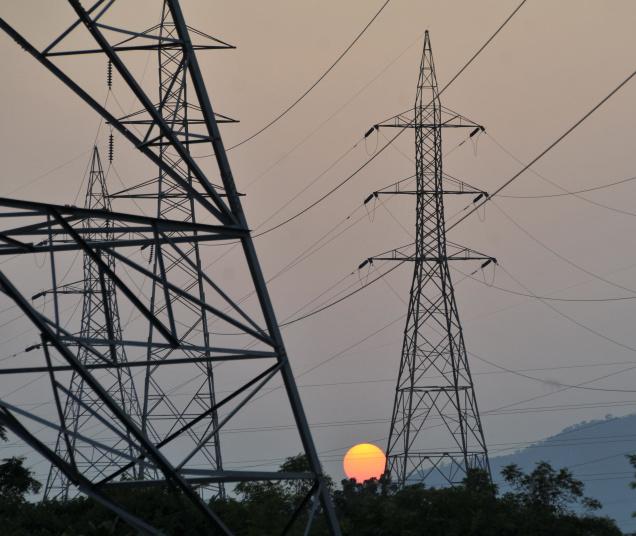
New Delhi, July 30: In what was one of the worst power breakdowns in the country, the Northern Grid crashed early Monday morning plunging eight states into complete darkness, disrupting inter-state train services, adversely hitting health services and impacting millions of lives.

The tripping of the 400 KV Bina-Gwalior line, which flows into Agra-Bareilly at 2.35 a.m. wreaked havoc on the power generation and transmission systems leading to shut down of all major power plants including hydro power stations in the States of Punjab, Haryana, Rajasthan, Delhi, Uttrakhand, Himachal Pradesh, Jammu and Kashmir and the Union Territory of Chandigarh, which are all a part of the Northern Grid.

The immediate impact of the grid collapse was the shortage of around 32,000 MW of power. The last such collapse of the Northern Grid, which caters to around 28 per cent of the country’s population, took place in 2001. India currently faces around 8 to 12 per cent peak power deficit, according to the Central Electricity Authority (CEA).

The massive shutdown had a crippling effect on inter-state passenger and goods trains that came to a screeching halt. Early morning office goers and school children had a harrowing time as traffic signals went on the blink leading to traffic chaos in the affected States including the Capital Delhi.

Hospitals too had to scurry around for alternatives and back up supply. A majority of the hospitals claimed to have alternate supply arrangements, yet reports of services being disrupted trickled in from several places.

Operations at the major oil refineries in Panipat, Mathura and Bhatinda remained unaffected as these facilities have their own captive power plants and do not rely on the grid for supply.

While Power Minister, Sushil Kumar Shinde said he could not pin point the exact reason for the collapse, PGCIL and Northern Region Load Despatch Centre officials said that it was rampant overdrawal by Uttar Pradesh, Punjab and Haryana that led to the collapse that in turn paralysed services.

The last time the grid collapse occurred was in 2001, it has happened now after 10 years. At that time, the power breakdown took place at midnight and normalcy was restored by 4.30 pm.

PGCIL chairman and managing director, R.N. Nayak said the situation had been restored to normal by 4 pm. The Northern grid was generating around 29000 MW of power by late evening, which was about 2000 MW of the peak demand.

Hit by the sudden collapse of the grid system, the Power Grid Corporation of India Limited (PGCIL) officials swung into action with Mr. Nayak and his team of officials reaching their monitoring centre at 3 a.m. to assess the situation and work on a rescue package. By 8 a.m., PGCIL officials claimed to have restored around 40 per cent of power.

To run essential services, supply was diverted from the Western and Eastern Grids to the Northern region. Hydro power was also imported from the mountain kingdom of Bhutan to meet the deficit.

While he could not offer an explanation on what caused the collapse, Mr. Nayak said the agencies involved were at least “quick at restoring normalcy in a record time”.

Comments

Add new comment

  • Coastaldigest.com reserves the right to delete or block any comments.
  • Coastaldigset.com is not responsible for its readers’ comments.
  • Comments that are abusive, incendiary or irrelevant are strictly prohibited.
  • Please use a genuine email ID and provide your name to avoid reject.
News Network
March 23,2020

Thiruvananthapuram, Mar 23: Amid a spurt in coronavirus cases, Kerala chief minister Pinarayi Vijayan has asked the Centre to give the states authority to give clearances for manufacturing masks, gloves and sanitisers.

In a letter addressed to prime minister Narendra Modi, Vijayan said during the crisis, masks and sanitisers are needed in large numbers.

"As an interim, states must be given authority to give clearances of manufacturing of items related to medical devices, sanitisers, chemicals, etc. which are needed for fighting Covid-19," Vijayan said in the letter.

He also sought permission for the state home department to use drones for the relevant applications related to Covid-19.

"In China and elsewhere in the world, drones have been used extensively in minimising human contact, disinfection, etc. Unfortunately, with the current laws pertaining to the use of drones, none of these is possible in India," the chief minister said.

He also sought permission to access and use facilities available with all central institutions and research labs operating in the state.

The chief minister shared the letter on his Twitter handle.

With 15 new positive cases of Covid-19, the total number of infected persons in Kerala had gone up to 67, including the three who were discharged after recovery last month.

Comments

Add new comment

  • Coastaldigest.com reserves the right to delete or block any comments.
  • Coastaldigset.com is not responsible for its readers’ comments.
  • Comments that are abusive, incendiary or irrelevant are strictly prohibited.
  • Please use a genuine email ID and provide your name to avoid reject.
News Network
February 19,2020

New Delhi, Feb 19: India will switch to the world's cleanest petrol and diesel from April 1 as it leapfrogs straight to Euro-VI emission compliant fuels from Euro-IV grades now - a feat achieved in just three years and not seen in any of the large economies around the globe.

India will join the select league of nations using petrol and diesel containing just 10 parts per million of sulphur as it looks to cut vehicular emissions that are said to be one of the reasons for the choking pollution in major cities.

Sanjiv Singh, Chairman of Indian Oil Corp (IOC) - the firm that controls roughly half of the country's fuel market, said almost all refineries began producing ultra-low sulphur BS-VI (equivalent to Euro-VI grade) petrol and diesel by the end of 2019 and oil companies have now undertaken the tedious task of replacing every drop of fuel in the country with the new one.

"We are absolutely on track for supplying BS-VI fuel from April 1. Almost all refineries have begun supplying BS-VI fuel and the same has reached storage depots across the country," he said.

From storage depots, the fuel has started travelling to petrol pumps and in the next few weeks all of them will only have BS-VI grade petrol and diesel, he said. "We are 100 per cent confident that fuel that will flow from nozzles at all the petrol pumps in the country on April 1 will be BS-VI emission compliant fuel."

India adopted Euro-III equivalent (or Bharat Stage-III) fuel with a sulphur content of 350 ppm in 2010 and then took seven years to move to BS-IV that had a sulphur content of 50 ppm. From BS-IV to BS-VI it took just three years.

"It was a conscious decision to leapfrog to BS-VI as first upgrading to BS-V and then shifting to BS-VI would have prolonged the journey to 4 to 6 years. Besides, oil refineries, as well as automobile manufacturers, would have had to make investments twice - first to producing BS-V grade fuel and engines and then BS-VI ones," he said.

State-owned oil refineries spent about Rs 35,000 crore to upgrade plants that could produce ultra-low sulphur fuel. This investment is on top of Rs 60,000 crore they spent on refinery upgrades in the previous switchovers.

BS-VI has a sulphur content of just 10 ppm and emission standards are as good as CNG.

Originally, Delhi and its adjoining towns were to have BS-VI fuel supplies by April 2019 and the rest of the country was to get same supplies from April 2020.

But oil marketing companies switched over to supply of BS-VI grade fuels in the national capital territory of Delhi on April 1, 2018.

The supply of BS-VI fuels was further extended to four contiguous districts of Rajasthan and eight of Uttar Pradesh in the National Capital Region (NCR) on April 1, 2019, together with the city of Agra.

BS-VI grade fuels were made available in 7 districts of Haryana from October 1, 2019.

Singh said the new fuel will result in a reduction in NOx in BS-VI compliant vehicles by 25 per cent in petrol cars and by 70 per cent in diesel cars.

The switchover, he said, is a tedious task as every drop of old, higher-sulphur content fuel has to be flushed out in depots, pipelines and tanks before being replaced by BS-VI.

"We are confident of disruption-free switchover to BS-VI supplies across the country," he said. "What we will be supplying is the best quality available anywhere in the world. You don't have any better fuel that is supplied in any part of the world. Perhaps our BS-VI fuel will be better than equivalent fuel in some parts of the US and Europe."

India adopted a fuel upgradation programme in the early 1990s. Low lead gasoline (petrol) was introduced in 1994 in Delhi, Mumbai, Kolkata and Chennai. On February 1, 2000, unleaded gasoline was mandated nationwide.

Similarly, BS-2000 (Euro-I equivalent, BS-1) vehicle emission norms were introduced for new vehicles from April 2000. BS-II (Euro-II equivalent) emission norms for new cars were introduced in Delhi from 2000 and extended to the other metro cities in 2001.

Benzene limits have been reduced progressively from 5 per cent in 2000 to 1 per cent nationwide. Lead content in gasoline was removed in phases and only unleaded gasoline is being produced and sold from February 1, 2000.

The octane number of gasoline signifies the improved performance of the engine. Loss in octane number due to phasing out of lead was made up by installing new facilities in the refinery and changes in refinery operation. RON (Research Octane Number) of gasoline for BS-2000 spec was increased to 88. This has over time been increased to 91.

Singh said sulphur reduction will reduce Particulate Matter (PM) emissions even in the in-use older generation diesel vehicles.

Comments

Add new comment

  • Coastaldigest.com reserves the right to delete or block any comments.
  • Coastaldigset.com is not responsible for its readers’ comments.
  • Comments that are abusive, incendiary or irrelevant are strictly prohibited.
  • Please use a genuine email ID and provide your name to avoid reject.
Agencies
July 27,2020

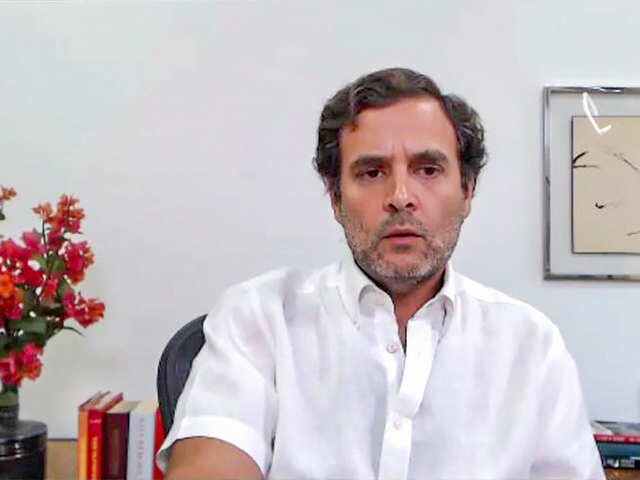
New Delhi, Jul 27: Congress leader Rahul Gandhi on Monday said he is not going to lie about Chinese transgressions in eastern Ladakh even if it costs him politically, asserting he will say the truth as far as Indian territory is concerned.

Gandhi made these remarks in a tweet, along with an over-a-minute-long video, as part of a series launched by him on the India-China face-off along the Line of Actual Control(LAC) in eastern Ladakh.

Asked in the video how he would react to people who say his questions to Prime Minister Narendra Modi on China weakened India, the former Congress chief said, "If you want me to lie that the Chinese have not entered this country, I am not going to lie. I will simply not do it. I do not care if my whole career goes to hell. I am not going to lie."

"This disturbs me. Frankly, it makes my blood boil. How can some other nation just come into our territory?"

"Hiding the truth is anti-national. Bringing it to people's attention is patriotic," Gandhi said.

"So frankly, I do not care if it costs me politically. I do not care if I have no political career at all after that. But I am going to say the truth as far as Indian territory is concerned," he added.

Gandhi has been repeatedly attacking the prime minister and the government over Chinese transgressions on the LAC in eastern Ladakh.

"As an Indian, my number one priority is the nation and its people," he said on Monday.

The Bharatiya Janata Party (BJP) has hit back at Gandhi over his attack on the government on the Ladakh face-off, alleging he is seeking to politicise defence and foreign policy matters and "wash their past sins of 1962 and weaken India".

BJP president JP Nadda has also alleged that for years, a dynasty has been trying to destroy Modi, while adding that those who want to destroy the prime minister will only end up causing further damage to their own party.

Comments

Add new comment

  • Coastaldigest.com reserves the right to delete or block any comments.
  • Coastaldigset.com is not responsible for its readers’ comments.
  • Comments that are abusive, incendiary or irrelevant are strictly prohibited.
  • Please use a genuine email ID and provide your name to avoid reject.