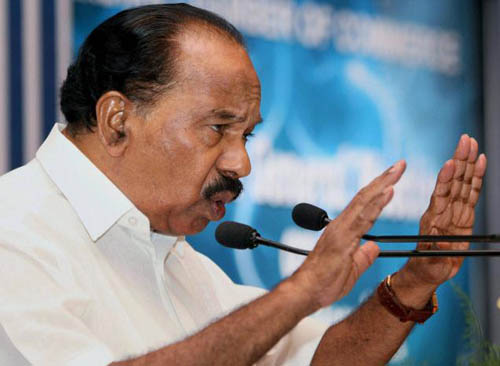
Moily: We’ll work out strategy to stabilise grid

August 1, 2012

moily_copy

New Delhi, August 1: The newly-appointed Power Minister Veerappa Moily on Wednesday refrained from blaming States for overdrawing electricity that may have led to the collapse of the three grids on Tuesday and said he will focus on combating the many troubles that are facing the sector.

Mr. Moily, who took charge of the ministry on Wednesday morning, said that he would take stock of the situation and start working on clearing the hurdles facing the sector.

“First thing is to stabilise the grid and it has to sustain. For that we will work out a proper strategy,” he told reporters.

Refraining from blaming the States for overdrawing the electricity from grids and not adhering to a discipline, Mr. Moily said he did not want to start his innings with a blame game.

“I don’t want to start with the blame game...at the appropriate time, we will find out short-term and medium-term solutions,” he said.

Taking over the reins of the ministry at a time when it is steeped in crisis, Mr. Moily will have to address the issues ranging from the failure of the three grids that plunged 21 States into darkness, to fuel shortages and the financial health of the distribution companies.

“I always like challenges in life...these things (electricity transmission and fuel issues) are very sensitive rather hyper sensitive in the sector, problems will crop up at the same time how we combat these problems that becomes a challenge,” Mr. Moily said.

Comments

Add new comment

  • Coastaldigest.com reserves the right to delete or block any comments.
  • Coastaldigset.com is not responsible for its readers’ comments.
  • Comments that are abusive, incendiary or irrelevant are strictly prohibited.
  • Please use a genuine email ID and provide your name to avoid reject.
News Network
June 18,2020

New Delhi, Jun 18: The border clash between Indian and Chinese soldiers in Ladakh broke the brittle quiet – and also the sense of security for anxious Chinese nationals in India who fear a backlash with anti-Chinese sentiment spiralling in the country.

With the high altitude violent face-off in eastern Ladakh’s Galwan Valley spurring hashtags such as “Boycott China” and “Teach Lesson to China” and leading to street protests, the undercurrents of tension were evident.

Wary of being identified, some said they had been reassured by their friends but were still apprehensive for themselves and their families.

"They (Chinese families) don''t want to speak to the media. They are not going out and are worried about their security and well being. Their families are also worried back home," Mohammed Saqib, secretary general of the India China Economic & Cultural Council, told PTI.

He added that his Chinese friends in India been calling him since they heard news about Monday night’s clashes in which 20 Indian soldiers were killed -- the worst military confrontation in five decades -- and expressed concern over growing anti-China sentiments.

A Chinese national from Beijing working in Gurgaon for a Chinese mobile firm initially refused to talk, saying he did not want to speak to the media and later shared his thoughts only on condition of anonymity.

"There is talk of border standoff and tensions, but we know Indians are very warm people and that is why I have told my family that all is fine here and they should not worry," he said.

Another Chinese national working in Gurgaon said he and his family are feeling the stress amid the spiralling conflict between India and China, but many friends have been reassuring him.

"They (Chinese in India) are under a lot of stress naturally. Such a conflict puts a lot of stress as they could bear the brunt and the same applies to Indians in China," B R Deepak, professor at the Centre for Chinese and South East Asian Studies of the Jawaharlal Nehru University said.

He said it was unfortunate that the border standoff derailed the commemorative programmes aimed at strengthening ties at a time the two countries were gearing to celebrate 70 years of establishment of diplomatic ties.

Experts also feel the border clash is likely to have a significant negative impact on the economic and people to people ties.

There are scores of Chinese in India working in various Chinese firms and also those who are studying in universities like JNU.

About 3,000 Chinese people, doing business or studying in big cities in India, were stranded in India at the start of the COVID-19 crisis, and about half of them returned to China before the lockdown began on March 25.

The Chinese Embassy in New Delhi announced on May 25 that they will arrange for flights to take back students, tourists and businesspersons to five Chinese cities, including Shanghai and Guangzhou.

"It will impact the psychology of the Chinese here. There are 2,000 Chinese firms in various sectors in India which are going to be impacted," Deepak said.

Future investments from the Chinese side could also be impacted, he said.

Moreover, as far as people-to-people contacts are concerned, the number of Chinese students choosing India as a preferred destination is likely to go down, Deepak said.

Alka Acharya, another China expert, said there are two kinds of impacts of such an incident -- short term and medium term.

Usually after the initial nationalistic reaction in the short term things tend to normalise in the medium term, but with such a border clash happening for the first time in decades clearly the resonance would be much more in both India and China, said Acharya, professor at the Centre for East Asian Studies, School of International Studies, in JNU.

“Due to the impact of the COVID-19 crisis on the economy, whether India can take a hardline in terms of economics towards China, is a tricky question,” she said.

In the immediate context, there may be a dip in economic ties with calls for boycott of Chinese goods and services, Acharya said.

The manner in which this crisis is resolved will affect how ties will be affected in the medium term, she said.

The headlines have added to the anxiety.

A group of ex-armymen gathered near the Chinese embassy to protest the killing of 20 Indian Army personnel in Ladakh’s Galwan Valley. And another group of around 10 protesters belonging to the Swadeshi Jagaran Manch protested near the Teen Murti roundabout in Central Delhi.

The anti-China sentiment prevalent among the common public is also finding a reflection in government policy with sources saying the Department of Telecom (DoT) is set to ask state-owned Bharat Sanchar Nigam Ltd (BSNL) not to use Chinese telecom gear in its 4G upgradation.

Trade bodies like CAIT are also calling for a boycott of Chinese products.

And Chinese handset maker Oppo cancelled the livestream launch of its flagship 5G smartphone in the country amid protests.

Monday night’s clashes between the Chinese and Indian troops in Galwan Valley significantly escalated the already volatile border standoff between the two countries.

The casualties on the Chinese side are not yet known. However, government sources, citing an American intelligence report, claimed the total number of soldiers killed and seriously wounded could be 35.


Comments

Add new comment

  • Coastaldigest.com reserves the right to delete or block any comments.
  • Coastaldigset.com is not responsible for its readers’ comments.
  • Comments that are abusive, incendiary or irrelevant are strictly prohibited.
  • Please use a genuine email ID and provide your name to avoid reject.
News Network
June 2,2020

New Delhi, Jun 2: Prime Minister Narendra Modi on Tuesday said India will definitely get its economic growth back as the government continues to pursue various reforms.

Speaking at industry association CII's annual session, he said the government has taken tough steps to fight the coronavirus pandemic and has also taken care of the economy.

"On the one hand we have to safe lives of our people and on the other hand we have to stabilise the economy and speed up the economy," he said.

He said he gets the confidence from farmers, small businesses and entrepreneurs for getting the economic growth back.

"Corona may have slowed our speed (of growth) but India has now moved ahead from lockdown with the phase one of unlock. Unlock Phase-1 has reopened a large part of the economy," he said.

He said intent, inclusion, investment, infrastructure and innovation are crucial for India to revert back to a high-growth trajectory.

Comments

Add new comment

  • Coastaldigest.com reserves the right to delete or block any comments.
  • Coastaldigset.com is not responsible for its readers’ comments.
  • Comments that are abusive, incendiary or irrelevant are strictly prohibited.
  • Please use a genuine email ID and provide your name to avoid reject.
News Network
January 7,2020

New Delhi, Jan 7: The government has asked public sector undertakings to dissuade their employees from participating in the 'Bharat Bandh' called on Wednesday and advised them to prepare a contingency plan to ensure smooth functioning of the enterprises.

Ten central trade unions have said around 25 crore people will participate in the nationwide strike to protest against the government's "anti-people" policies.

Trade unions INTUC, AITUC, HMS, CITU, AIUTUC, TUCC, SEWA, AICCTU, LPF, UTUC along with various sectoral independent federations and associations had adopted a declaration in September last to go on the nationwide strike on January 8.

"Any employee going on strike in any form, including protest, would face the consequences which, besides deduction of wages, may also include appropriate disciplinary action," said an office memorandum issued by the government.

"Suitable contingency plan may also be worked out to carry out the various functions of the ministry/department," it added.

It also issued instructions not to sanction casual leave or other kind of leave to employees if applied for during the period of the proposed protest or strike and ensure that the willing employees are allowed hindrance-free entry into the office premises.

The instructions issued by the Department of Personnel & Training prohibit the government servants from participating in any form of strike, including mass casual leave, go-slow and sit-down, or any action that abet any form of strike.

Besides, pay and allowances are not admissible to an employee for his absence from duty without any authority.

The central trade unions are protesting against labour reforms, FDI, disinvestment, corporatisation and privatisation policies and to press for a 12-point common demands of the working class relating to minimum wage and social security, among others.

Comments

Add new comment

  • Coastaldigest.com reserves the right to delete or block any comments.
  • Coastaldigset.com is not responsible for its readers’ comments.
  • Comments that are abusive, incendiary or irrelevant are strictly prohibited.
  • Please use a genuine email ID and provide your name to avoid reject.