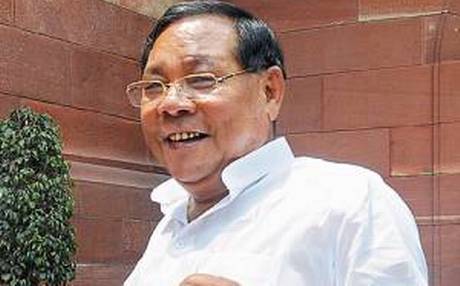
Sangma to float party, Congress worried

August 2, 2012

Sangma

Shillong, August 2: The ruling Congress in Meghalaya on Wednesday said that P A Sangma's decision to float a national party, exclusively for tribal communities could affect the state.

"Charity begins at home.... No brain drain is necessary when he could contribute so much to state politics," Meghalaya Pradesh Congress committee president and former CM D D Lapang said.

The comments came as on Tuesday when Sangma, projecting himself as a tribal leader, had categorically ruled out any possibility of his joining state politics and wishing to float a national party for tribals.

Comments

Add new comment

  • Coastaldigest.com reserves the right to delete or block any comments.
  • Coastaldigset.com is not responsible for its readers’ comments.
  • Comments that are abusive, incendiary or irrelevant are strictly prohibited.
  • Please use a genuine email ID and provide your name to avoid reject.
News Network
April 5,2020

New Delhi, April 5: People were seen buying diyas and candles across the country to light them at 9 p.m. on Sunday to fight the "darkness of coronavirus" as requested by Prime Minister Narendra Modi.

Although the country is under a lockdown and all the shops barring those selling essential items are shut, but a number of makeshift roadside shops and carts have cropped up selling earthen lamps or diyas at various places.

The earthen lamps, along with other 'puja samgari', are also sold near various temples. Those shops also opened on Sunday.

Gatherings at the temples and other religious places too are barred.
Those who did not find diyas in their localities contended with candles available at the local general stores.

Prime Minister Narendra Modi had on April 3 appealed to people in a televised address to light diyas and candles on April 5 at 9 pm to fight the darkness spread by coronavirus pandemic.

"Friends, amidst the darkness spread by the corona pandemic, we must continuously progress towards light and hope. We must defeat the deep darkness of the crisis by spreading the glory of light in all four directions," said the Prime Minister in a video message.

"And that is why, this Sunday, on April 5, we must all together, challenge the darkness spread by the corona crisis, introducing it to the power of light. On this day, we must awaken the superpower of 130 crore Indians. We must take the super resolve of 130 crore Indians to even greater heights," Modi said.

He asked the people to turn off all the lights in their homes and stand at doors or balconies and light candles or diyas, torches or mobile flashlights for 9 minutes on April 5.

"In that light, in that lustre, in that radiance, let us resolve in our minds that we are not alone, that no one is alone! 130 crore Indians are committed, through a common resolve!" he said.
PM Modi's call to light diyas, torches or mobile flashlights amid the lockdown has proved to be a boon for shopkeepers selling diyas and candles.

"Sales of diyas have increased to 50 per cent and we also got orders. It has happened because of Modi ji's appeal. We are with him in this," Ram Ravi Kumar, a shopkeeper in Delhi told news agency.

Vikas Kumar, a resident of Patna, said, "I have bought 50 diyas for today. PM Modi had said that people have to light the diyas for nine minutes after switching off light at home."
Modi has asked citizens to not assemble anywhere while participating in this programme and emphasised on the importance of social distancing to prevent coronavirus spread.

Meanwhile, the number of positive cases of coronavirus in the country continues to surge. As per the Ministry of Health and Family Welfare, the total number of confirmed COVID-19 cases is 3,374 with 79 deaths.

Comments

Add new comment

  • Coastaldigest.com reserves the right to delete or block any comments.
  • Coastaldigset.com is not responsible for its readers’ comments.
  • Comments that are abusive, incendiary or irrelevant are strictly prohibited.
  • Please use a genuine email ID and provide your name to avoid reject.
News Network
March 28,2020

Mumbai, Mar 28: Doctors in Mumbai have not been spared by the novel coronavirus. As Mumbai’s count for Covid-19 cases went up to 58, an octogenarian doctor from Saifee Hospital passed away on Friday. He was a suspected case of coronavirus with co-morbid conditions like diabetes and had a pacemaker implanted, said a press release from the state health department.

As per a statement from Saifee Hospital, he underwent a CT scan at Saifee Hospital and was diagnosed positive for Covid-19. The surgeon was transferred to the special isolation facility at PD Hinduja Hospital where he subsequently died. Behranwala’s close relatives had come down from England and were under quarantine.

In a statement, Saifee Hospital, where Behranwala underwent CT scan, said, "All containment and surveillance measures have been implemented to ensure the safety of our staff patients and visitors. Saifee Hospital reiterates that the Hospital is fully operational," said Dr Vernon Desa, Director (Medical governance and clinical compliance) Saifee Hospital.

In the second case, an Andheri-based doctor, aged 53, has been tested positive along with his 43-year-old wife and 20-year-old daughter. The family doesn’t have a travel history. The doctor reportedly came in contact with the virus through a patient. MCGM has taken samples of 60 patients who came in contact with the doctor. "As of now, no patient from his contact has tested positive," Assistant Commissioner, Vishwas Mote.

Another doctor who practiced at Vakola tested positive after he came in contact with a person having travel history to Italy, later tested positive. The doctor has been admitted at Raheja hospital and samples of his close contact have been taken.

Comments

Add new comment

  • Coastaldigest.com reserves the right to delete or block any comments.
  • Coastaldigset.com is not responsible for its readers’ comments.
  • Comments that are abusive, incendiary or irrelevant are strictly prohibited.
  • Please use a genuine email ID and provide your name to avoid reject.
News Network
January 1,2020

Jan 1: The ban on the practice of instant triple talaq, making it a penal offence and the increase in the strength of Supreme Court judges were two of the major achievements of the law ministry in 2019.

In July, Parliament gave its nod to The Muslim Women (Protection of Rights on Marriage) Bill, 2019. The new law makes talaq-e-biddat or any other similar form of talaq having the effect of instantaneous and irrevocable divorce pronounced by a Muslim husband void and illegal.

It makes it illegal to pronounce talaq three times in spoken, written or through SMS or WhatsApp or any other electronic chat in one sitting.

According to the new law, any Muslim who pronounces the illegal form of talaq upon his wife shall be punished with imprisonment for a term which may extend to three years, and shall also be liable to fine.

During the year, four new judges were appointed to the Supreme Court in September, taking its strength to 34, the highest-ever.

However, vacancies in high courts and lower courts are on the rise and convincing state governments and the 25 high courts to come on board to create an all-India judicial service to recruit judges for the subordinate courts tops the agenda of the Law Ministry in 2020.

Besides creating a consensus on setting up the All-India Judicial Services, the ministry will also have to focus on filling up vacancies in the high court. On an average, the vacancies stood at 400 throughout this year.

With more than 5,000 positions of judicial officers in district and subordinate courts lying vacant, the Law Ministry has pitched for setting up all-India judicial services.

The sanctioned strength of the judicial officers in district and subordinate courts was 22,644. The number of judicial officers in position and vacant posts is 17,509 and 5,135, respectively.

The government has proposed that while states and high courts can recruit judicial officers, the Union Public Service Commission (UPSC) can hold pan-India entrance tests.

The ministry has made it clear that such services would not encroach on the powers of the states.

As of now, the selection and appointment of judges in subordinate courts is the responsibility of the high courts and state governments concerned.

The Narendra Modi government has given a fresh push to the long-pending proposal to set up the new service to have a separate cadre for the lower judiciary in the country.

But there is a divergence of opinion among state governments and respective high courts on the constitution of the All India Judicial Service (AIJS).

One of the problems cited is that since several states have used powers under Code of Criminal Procedure (CrPC) and Code of Civil Procedure (CPC) to declare that the local language would be used in lower courts even for writing orders, a person say selected from Tamil Nadu may find it difficult to hold proceedings in states like Uttar Pradesh and Bihar.

The other point of opposition is that an all India service may hamper the career progression of state judicial services officers.

Another key issue the ministry has to handle in 2020 is vacancies in the 25 high courts.

Throughout 2019, on an average, the high courts faced a shortage of 400 judges.

According to Law Ministry data, as on September 1, the high courts had 414 vacant positions as compared to the sanctioned strength of 1,079 judges. The figure was 409 in August and 403 in July, as per the data.

A three-member Supreme Court collegium recommends the names of candidates for appointment as high court judges. In case of appointments to the Supreme Court, the collegium consists of five top judges of the top court.

High court collegiums shortlist candidates for their respective high courts and send the names to the law ministry.

The ministry, along with background check reports by the Intelligence Bureau, forwards it to the Supreme Court collegium for a final call.

The government has maintained that appointment of judges in the high courts is a "continuous collaborative process" between the Executive and the Judiciary, as it requires consultation and approval from various Constitutional authorities.

Vacancies keep arising on account of retirement, resignation or elevation of judges and increase in judges' strength. In June last year, the vacancy position stood at 399, while it was 396 in May.

In April, 399 posts of judges were vacant, while the figure was 394 in March. The vacancy position in February stood at 400 and in January, it was 392, according to the data collated by the Department of Justice.

Over 43 lakh cases are pending in the 25 high courts.

Another priority would be the finalisation of the memorandum of the procedure to guide the appointment and transfer of the Supreme Court and high court judges. The issue had now been pending for over two years now with the SC collegium and the government failing to reach a consensus.

Successive governments have also been working on making India a hub of international arbitration. It has taken several steps to change laws dealing with commercial disputes.


Comments

Add new comment

  • Coastaldigest.com reserves the right to delete or block any comments.
  • Coastaldigset.com is not responsible for its readers’ comments.
  • Comments that are abusive, incendiary or irrelevant are strictly prohibited.
  • Please use a genuine email ID and provide your name to avoid reject.