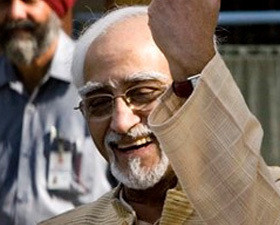
Hamid Ansari elected Vice-President again, defeats Jaswant Singh by 252 votes

August 7, 2012

hamid

New Delhi, August 7: UPA's Hamid Ansari has been elected for a second term as the Vice-President of India on Tuesday. Ansari, who got 490 votes, defeated NDA's Jaswant Singh by a margin of 252 votes.

As many as 600 electors from an effective electoral college of 787 members of Parliament had cast their vote by 1.00pm, Ansari's election agent and senior advocate Pravin Parekh said here.

Prime Minister Manmohan Singh, UPA chairperson Sonia Gandhi and Rahul Gandhi were among the early voters as polling began at 10.00am.

BJD, TDP and RSP have declared that they would abstain from voting. Union minister Vilasrao Deshmukh is ill and admitted to a Chennai hospital. The three parties together have 34 members in both Houses of Parliament.

BJP leaders L K Advani, Sushma Swaraj, Arun Jaitley, Murli Manohar Joshi, BSP supremo Mayawati and SP chief Mulayam Singh Yadav had cast their ballots before noon.

74-year-old Jaswant Singh, a former minister of external affairs and finance, has the support of NDA and AIADMK.

Comments

Add new comment

  • Coastaldigest.com reserves the right to delete or block any comments.
  • Coastaldigset.com is not responsible for its readers’ comments.
  • Comments that are abusive, incendiary or irrelevant are strictly prohibited.
  • Please use a genuine email ID and provide your name to avoid reject.
Agencies
March 1,2020

Kolkata, Mar 1: The Calcutta High Court has ruled that it is not mandatory for foreigners to produce a valid passport and its particulars for processing of application for grant of Indian citizenship if he is able to satisfy the appropriate authorities the reasons for non-availability of the document.

Justice Sabysachi Bhattacharya passed the order while disposing off a petition by granting the petitioner liberty to file an application before the authority "as contemplated in Rule 11 of the Citizenship Rules 2009, upon furnishing explanation as to the non-availability of the passport".

Bismillah Khan had filed the petition saying he was being denied the citizenship of India because of his inability to file an application under Section 5 (1) (c) of the Citizenship Act, 1955, apparently due to the mandatory requirement of furnishing a copy of the passport for such application.

The petitioner's counsel submitted that Khan was a Pakhtoon citizen and due to political turmoil in the said state, which subsequently merged partially into Afghanistan and partially into Pakistan, he, as a five-year old, had to migrate to India with his father in 1973.

Under such circumstances, the petitioner could not have any opportunity of having a valid passport, since they were refugees under distress, the counsel said.

The petitioner had previously approached a coordinate Bench of the court, wherein a single judge, passed an order on July 25, 2018, directing him to comply with the formalities required, as communicated by the secretary to the Government of India to the Secretary to the Government of West Bengal (Home), vide a letter dated December 7, 2017.

The court had then also given liberty to the petitioner to apply afresh before the appropriate authority under Section 5(1)(c) of the 1955 Act, having complied with all the formalities.

The petitioner then moved Bhattacharya's court submitting that a complete application as directed by the Coordinate Bench cannot be possibly filed by his client due to the mandatory requirement of uploading a copy of his passport, which the petitioner does not have due to reasons beyond his control.

The counsel said Khan is married to an Indian citizen, has a daughter and living in India for close to half a century.

The counsel for the union of India submitted that in view of no application having been filed by the petitioner, there is no scope of granting such proposed application at the present juncture for the Union.

The counsel argued that it is mandatory to file an application in Form III for the application of the petitioner under Section 5(1)(c) of the Act to be considered at all.

In view of the petitioner not complying with the mandatory requirement of submitting a copy of his passport, the state government cannot, under the law, forward such application to the union government.

After hearing all sides, Justice Bhattacharya said although the rule "contemplates that an application shall not be entertained unless the application is made in Form III, such provision ipso facto does not make the availability of a passport a mandatory requirement".

"..the Form given with the Rules or the Rules themselves cannot override the provision of the statute itself, under which the said Rules are framed, which does not stipulate such a mandate on the applicants for citizenship under Section 5 (1)(c) of the 1955 Act mandatorily to carry a passport".

The court said although such provision is included in the Form, which has to be complied with by the applicant, "it is nowhere indicated in such Form that all the relevant particulars, including the particulars regarding passport of the petitioner have to be furnished mandatorily, along with a copy of a valid foreign passport, even in the event the petitioner, for valid reasons, is not in a position to produce such passport".

Justice Bhattacharya ruled that under such circumstances, it cannot be held that the provision of producing a passport and its particulars is mandatory in nature and there has to be a relaxation in such requirement "in case the petitioner is able to satisfy the appropriate authorities the reasons for non- availability of such passport".

"Unless such a leeway is given to the applicants, genuine persons who otherwise have all the formal documents indicating that they have been residing in India for a long time and have married a resident of India would also be unable to apply for Indian Citizenship despite having lived their entire lives and contributed to the economy and diverse culture of this country."

He said such a scenario would be contradictory to the spirit of Article 14 of the Constitution of India.

"In such view of the matter, the requirement of having a passport has to be read as optional in Form III of the Citizenship Rules, 2009 and the authorities are deemed to have the power to relax such 6 requirement in the event the applicant satisfied the authorities for genuine reasons why the applicant is not in a position to produce such passport," the February 24 order said.

The court ruled that despite the provision of making applications online, a provision has to be made for persons who do not have all the particulars of their passport, which is read as optional, to file applications manually, which are to be treated as valid applications under Rule 5 of the Citizenship Rules, 2009.

The court also ordered that alternatively the necessary software be amended so that the online applications can be presented with or without passports, in the latter case furnishing detailed reasons as to non-furnishing of passports.

"Sanctioning of such forms, however, will be conditional upon the satisfaction of the relevant authorities about the reasons for the applicant not being able to produce her/his passport," the order said.


Comments

Add new comment

  • Coastaldigest.com reserves the right to delete or block any comments.
  • Coastaldigset.com is not responsible for its readers’ comments.
  • Comments that are abusive, incendiary or irrelevant are strictly prohibited.
  • Please use a genuine email ID and provide your name to avoid reject.
News Network
May 7,2020

New Delhi, May 7: Food ordering and delivery platform Swiggy on Thursday said its co-founder and CTO Rahul Jaimini will move away from active role in the company during the month to pursue another entrepreneurial venture.

Jaimini will be joining Pesto Tech, a career accelerator start-up, as their co-founder, Swiggy said in a statement.

He will continue to be a shareholder and board member of Swiggy, it added.

Functions currently led by Rahul, including platform engineering, analytics, IT and labs, will be realigned to Dale Vaz, Head of Engineering and Data Science, who has been with the company for close to two years, the statement said.

"Technology was crucial to what we set out to build when we started Swiggy. Nandan (Reddy) and I could not have asked for a better partner to handle this aspect of the company," Swiggy co-founder and CEO Sriharsha Majety said.

It was Rahul's immense passion to 'build for the billions' that drove technological innovations that set Swiggy apart as we grew phenomenally over the years, he added.

"Working with technology that has large scale impact is what excites me, and I am grateful to have had the opportunity to do just this at Swiggy and grow tremendously over the years," Jaimini said.

Comments

Add new comment

  • Coastaldigest.com reserves the right to delete or block any comments.
  • Coastaldigset.com is not responsible for its readers’ comments.
  • Comments that are abusive, incendiary or irrelevant are strictly prohibited.
  • Please use a genuine email ID and provide your name to avoid reject.
News Network
June 25,2020

India has jumped past 4.5 lakh coronavirus cases and 14,476 people have succumbed to the viral infection so far. In this backdrop, speaking to IANS in an exclusive interview, AIIMS Director Randeep Guleria said India is also vulnerable to second wave of coronavirus and people should continue to follow social distancing, wearing mask and other precautions, after cases begin to decline.

He added that in order to contain the outbreak of Covid-19, a limited lockdown in hotspots, where volume of cases is very high, may be considered along with a micro-plan to prevent leakage of cases from these areas to other non-containment areas. Excerpts of the interview are below:

Q: Reports say China and South Korea are witnessing a second wave of coronavirus infection, what is this second wave, is India also vulnerable to this?

A: When cases come down significantly, people tend to drop their guard against the viral infection, and this leads to the second wave (which means a sudden increase in the number of cases). After cases begin to decline, people should continue to follow the precautions -- continue to maintain social distancing and wear masks regularly. See what happened in Singapore, it was struck by a second wave of coronavirus. Look, what happened in the 1918 pandemic, people dropped their guard and the second wave of viral infection struck back. If people do not follow social distancing then the spike in cases is apparent. We need to take these precautions at least for one year. India is also vulnerable to this second wave.

Q: If Covid-19 cases continue to rise rapidly, do you think we need another lockdown in areas where volume of cases are very high?

A: A large volume of cases is concentrated in specific areas like hotspots, and in order to maintain things in order, we may need a limited lockdown in these areas. This should be followed by a micro-plan which entails extensive testing of people and also extensive contact tracing of people who have got in touch with positive people. Need to ensure there is no leakage of cases from these areas. People from these areas should not mix with others in non-containment areas. This will aid in containing the outbreak of the virus. People who have developed symptoms should get themselves tested, especially in the containment areas.

Q: With more than 4.5 lakh cases and close to 14,500 deaths, do you think India has reached its peak and a decline in cases is prominent?

A: The cases will continue to increase for some time. The doubling time of cases has also increased. But, the cases will also begin to flatten. Though, it is difficult to give an exact time period in this viral infection, it seems, the growth in cases will flatten in the end of July or beginning of August. A decline will come to this viral infection, but it does not mean that people should drop their guard. As a measure, we need to decrease community participation and citizens should continue to follow social distancing. People should get themselves tested. All these efforts will help in preventing people from contracting this virus. These precautions will also prevent us from the second wave, and we must continue to take precautions. The virus has not gone away, it is still lurking.

Q: India has crossed the 4.5 lakh coronavirus cases so far, although our recovery rate is good, but still 10,000 to 15,000 cases are reported daily. Why do cases continue to spiral, what is the reason?

A: We have to remember a few things -- the bulk of cases are in 10 cities, nearly 70 per cent, and if we take into account cases per million population, the number is not very high, as compared with countries including countries in Europe. Many European countries put together still do not add up to the Indian population. Do not compare India to countries like Italy, Spain etc. We need to focus on hotspots, which contribute to between 70 -80 per cent of cases, and we have to identify cases in these areas at an early stage. The population density is very high in these cities. People in lower socio-economic status are highly vulnerable to the viral infection, as many live together in small spaces and there is a lot of mixing of people happening there. Look at the market places, people are not following social distancing and not wearing masks. In fact, many are in close vicinity of each other.

Comments

Add new comment

  • Coastaldigest.com reserves the right to delete or block any comments.
  • Coastaldigset.com is not responsible for its readers’ comments.
  • Comments that are abusive, incendiary or irrelevant are strictly prohibited.
  • Please use a genuine email ID and provide your name to avoid reject.