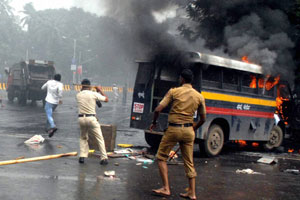
Two dead in Mumbai as anti-Assam riot protest turns violent

August 11, 2012

Mib

Mumbai, August 12: Two persons died and 14 others were injured when a protest here against Assam riots turned violent as demonstrators torched vehicles, including media vans, and pelted stones,forcing rpt forcing the police to fire in the air and use batons to disperse the unruly mob today.

Hundreds of people poured in at Azad Maidan Ground in south Mumbai this afternoon on a call given by a city-based outfit, Raza Academy, to denounce the riots in Assam and also alleged attacks on a minority community in Myanmar.

They suddenly turned unruly and torched vehicles, damaged buses and pelted stones. Police opened fire in the air and resorted to lathi-charge to disperse the mob and restore order, said a policeman deployed at the Azad Maidan.

At least, 16 persons were injured and two of them later succumbed in a Government hospital at south Mumbai. Among the injured were some media persons.

"Two persons, who were injured during the violence at Azad Maidan and were in critical condition, died while undergoing treatment at St George Hospital," a police officer told PTI.

Police said they were trying to ascertain the victims' identity. Security has been stepped up at religious places across the metropolis.

Azad Maidan, a regular venue for protests, is located near local civic body headquarters and Mumbai CST railway station. The bustling area wore a deserted look as policemen cordoned off the locality and patrolled the streets.

The situation has been brought under control, police said, adding cause of the violence was being probed.

Due to the unrest, suburban train services and road traffic were disrupted.

The injured are admitted in St George, G T and J J Hospitals, officials at Disaster Control Room said.

"Three media OB vans and a police vehicle were set on fire. A BEST (civic) bus, two four-wheelers and five two- wheelers were damaged in the stone pelting," they stated.

Meanwhile, Raza Academy distanced itself from the violence. "While we were protesting, some people got aggressive and started behaving violently," Mohammed Saeed, General Secretary of the academy, said. "We never encourage violence and strongly condemn such acts."

Comments

Add new comment

  • Coastaldigest.com reserves the right to delete or block any comments.
  • Coastaldigset.com is not responsible for its readers’ comments.
  • Comments that are abusive, incendiary or irrelevant are strictly prohibited.
  • Please use a genuine email ID and provide your name to avoid reject.
News Network
May 18,2020

May 18: The Central Board of Secondary Education (CBSE) on Monday announced the date sheet for the pending class 10 and 12 board exams, which will now be held from July 1 to 15.

The exams were postponed due to the nationwide lockdown imposed on March 25 to contain the spread of COVID-19.

The Class 10 board exams are pending only in the North East Delhi.

"The Class 10 exams will be staggered on four dates, starting July 1. The first paper will be Social Science, while the next day students will be required to appear for the Science exam,” said Sanyam Bhardwaj, the Controller of Examination, CBSE.

“On July 10, exams will be conducted for both courses of Hindi and on July 15 for both courses of English," he said.

On health guidelines for students, Bhardwaj said that they will be required to carry their own sanitiser bottles and wear masks to examination centres.

"Parents will have to ensure that their ward is not sick and candidates will have to strictly follow physical-distancing norms," he said.

For Class 12, the Home Science exam will be held on July 1, followed by both courses of Hindi the next day.

The Class 12 Business Studies exam has been scheduled for July 9, followed by Biotechnology on July 10 and Geography on July 11.

Comments

Add new comment

  • Coastaldigest.com reserves the right to delete or block any comments.
  • Coastaldigset.com is not responsible for its readers’ comments.
  • Comments that are abusive, incendiary or irrelevant are strictly prohibited.
  • Please use a genuine email ID and provide your name to avoid reject.
News Network
February 19,2020

New Delhi, Feb 19: India will switch to the world's cleanest petrol and diesel from April 1 as it leapfrogs straight to Euro-VI emission compliant fuels from Euro-IV grades now - a feat achieved in just three years and not seen in any of the large economies around the globe.

India will join the select league of nations using petrol and diesel containing just 10 parts per million of sulphur as it looks to cut vehicular emissions that are said to be one of the reasons for the choking pollution in major cities.

Sanjiv Singh, Chairman of Indian Oil Corp (IOC) - the firm that controls roughly half of the country's fuel market, said almost all refineries began producing ultra-low sulphur BS-VI (equivalent to Euro-VI grade) petrol and diesel by the end of 2019 and oil companies have now undertaken the tedious task of replacing every drop of fuel in the country with the new one.

"We are absolutely on track for supplying BS-VI fuel from April 1. Almost all refineries have begun supplying BS-VI fuel and the same has reached storage depots across the country," he said.

From storage depots, the fuel has started travelling to petrol pumps and in the next few weeks all of them will only have BS-VI grade petrol and diesel, he said. "We are 100 per cent confident that fuel that will flow from nozzles at all the petrol pumps in the country on April 1 will be BS-VI emission compliant fuel."

India adopted Euro-III equivalent (or Bharat Stage-III) fuel with a sulphur content of 350 ppm in 2010 and then took seven years to move to BS-IV that had a sulphur content of 50 ppm. From BS-IV to BS-VI it took just three years.

"It was a conscious decision to leapfrog to BS-VI as first upgrading to BS-V and then shifting to BS-VI would have prolonged the journey to 4 to 6 years. Besides, oil refineries, as well as automobile manufacturers, would have had to make investments twice - first to producing BS-V grade fuel and engines and then BS-VI ones," he said.

State-owned oil refineries spent about Rs 35,000 crore to upgrade plants that could produce ultra-low sulphur fuel. This investment is on top of Rs 60,000 crore they spent on refinery upgrades in the previous switchovers.

BS-VI has a sulphur content of just 10 ppm and emission standards are as good as CNG.

Originally, Delhi and its adjoining towns were to have BS-VI fuel supplies by April 2019 and the rest of the country was to get same supplies from April 2020.

But oil marketing companies switched over to supply of BS-VI grade fuels in the national capital territory of Delhi on April 1, 2018.

The supply of BS-VI fuels was further extended to four contiguous districts of Rajasthan and eight of Uttar Pradesh in the National Capital Region (NCR) on April 1, 2019, together with the city of Agra.

BS-VI grade fuels were made available in 7 districts of Haryana from October 1, 2019.

Singh said the new fuel will result in a reduction in NOx in BS-VI compliant vehicles by 25 per cent in petrol cars and by 70 per cent in diesel cars.

The switchover, he said, is a tedious task as every drop of old, higher-sulphur content fuel has to be flushed out in depots, pipelines and tanks before being replaced by BS-VI.

"We are confident of disruption-free switchover to BS-VI supplies across the country," he said. "What we will be supplying is the best quality available anywhere in the world. You don't have any better fuel that is supplied in any part of the world. Perhaps our BS-VI fuel will be better than equivalent fuel in some parts of the US and Europe."

India adopted a fuel upgradation programme in the early 1990s. Low lead gasoline (petrol) was introduced in 1994 in Delhi, Mumbai, Kolkata and Chennai. On February 1, 2000, unleaded gasoline was mandated nationwide.

Similarly, BS-2000 (Euro-I equivalent, BS-1) vehicle emission norms were introduced for new vehicles from April 2000. BS-II (Euro-II equivalent) emission norms for new cars were introduced in Delhi from 2000 and extended to the other metro cities in 2001.

Benzene limits have been reduced progressively from 5 per cent in 2000 to 1 per cent nationwide. Lead content in gasoline was removed in phases and only unleaded gasoline is being produced and sold from February 1, 2000.

The octane number of gasoline signifies the improved performance of the engine. Loss in octane number due to phasing out of lead was made up by installing new facilities in the refinery and changes in refinery operation. RON (Research Octane Number) of gasoline for BS-2000 spec was increased to 88. This has over time been increased to 91.

Singh said sulphur reduction will reduce Particulate Matter (PM) emissions even in the in-use older generation diesel vehicles.


Comments

Add new comment

  • Coastaldigest.com reserves the right to delete or block any comments.
  • Coastaldigset.com is not responsible for its readers’ comments.
  • Comments that are abusive, incendiary or irrelevant are strictly prohibited.
  • Please use a genuine email ID and provide your name to avoid reject.
News Network
February 28,2020

Feb 28: For 30-year-old Shabana Parveen, it was nothing sort of a miracle — giving birth to a healthy baby boy after surviving a brutal attack by a mob who kicked and assaulted her and her husband in northeast Delhi's Karawal Nagar.

Their home set afire by the mob, Ms Parveen's family is now pinning their hopes on the newborn who they called a "miracle baby".

Ms Parveen, her husband, two kids and mother-in-law were sleeping inside the house on Monday night when a mob barged into their house.

Narrating their ordeal, Ms Parveen's mother-in-law Nashima told PTI, "They hurled religious slurs, beat up my son. Some of them even kicked my daughter-in-law in the abdomen...as I went to protect her they came charging at me... We thought we would not survive that night. But with God's grace we somehow managed to escape from the clutches of the rioters."

"We rushed Parveen to a nearby hospital but doctors there asked us to go to Al-hind Hospital where she delivered a baby boy on Wednesday," she added.

Despite having lost their home for over two decades and all belongings, her family has overcome the initial shock and are now overjoyed with the birth of the "miracle baby".

Ms Nashima said she had no clue where the family would go after Ms Parveen was discharged from the hospital.

"It's all gone there. Nothing left. Maybe, we will go to some relative's place and see how we can re-build our life," she said.

Ali, 6, who held his one-day-old brother, caressing his forehead, said, "I will take care of him forever and save him from every ill."

The violence over the amended citizenship law in northeast Delhi has claimed 38 lives so far and left over 200 people injured. Frenzied mobs torched houses, shops, vehicles, a petrol pump and pelted stones at locals and police personnel.

Jaffrabad, Maujpur, Babarpur, Yamuna Vihar, Bhajanpura, Chand Bagh and Shiv Vihar are among the areas mainly affected by the clashes.

Comments

Add new comment

  • Coastaldigest.com reserves the right to delete or block any comments.
  • Coastaldigset.com is not responsible for its readers’ comments.
  • Comments that are abusive, incendiary or irrelevant are strictly prohibited.
  • Please use a genuine email ID and provide your name to avoid reject.