


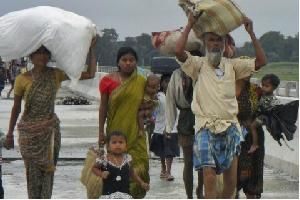
58,000 Bangladeshis went missing in India in 3 years

August 15, 2012

bangla

New Delhi, August 15: Actual figures of illegal immigrants from Bangladesh are a political hot potato. But, official data revealed a disturbing trend, where over 58,000 Bangladeshi citizens came to India and became traceless in the past three years. Bangladeshis were also found to be the worst offenders among foreigners as far as overstaying in India was concerned. Data, shared by the government in Lok Sabha on Tuesday, showed that as many as 82,585 Bangladeshis did not voluntarily return to their country between January 2009, and December 2011.

Though they all had visited India using their valid travel documents, they chose not to go back. Alarmed over their overstay, the government machineries did swing into action. But, only 23,653 out of total 82,585 Bangladeshi citizens could be traced and deported, leaving the whereabouts of 58,932 of them unknown.

The figure assumes significance amid debate over status of illegal Bangladeshi immigrants in the backdrop of the recent violence in Assam, where 77 people were killed in ethnic clashes between Bodo tribals and Muslims. In a written response to a Parliament question, the home ministry disclosed that 21,274 Bangladeshi nationals did not return to their country last year as compared to 28,667 in 2010 and 32,644 in 2009. Deportation figures revealed that 6,761 were sent back in 2011 as against 6,290 in 2010 and 10,602 in 2009.

Comments

Add new comment

  • Coastaldigest.com reserves the right to delete or block any comments.
  • Coastaldigset.com is not responsible for its readers’ comments.
  • Comments that are abusive, incendiary or irrelevant are strictly prohibited.
  • Please use a genuine email ID and provide your name to avoid reject.
Agencies
July 7,2020

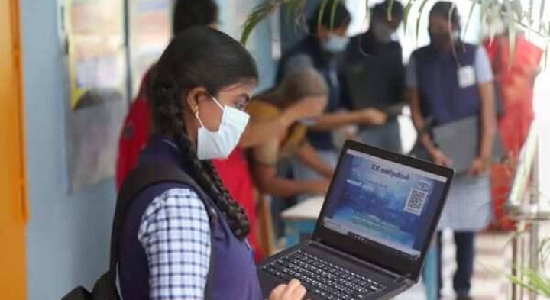
New Delhi, Jul 7: The University Grants Commission (UGC) has issued revised guidelines regarding the conduct of terminal semesters and final year exams by Universities and educational institutions. It has been suggested that exams may be completed by September in online or offline modes.

Releasing a statement, the UGC said it accepted the recommendations suggested by the expert committee. "In continuation to earlier Guidelines issued on 29.04.2020 and based on the Report of the Expert Committee, the UGC Revised Guidelines on Examination and Academic Calendar for the Universities in view of COVID-19 Pandemic were also approved by the Commission in its emergent meeting held on 6th July 2020," the statement read.

The Commission further said that while it was important to safeguard principles of health, safety and equal opportunities, it was also very important to ensure academic credibility, career opportunities and future progress of students.

"The Commission approved the recommendations of the Expert Committee regarding the conduct of terminal semester(s)/ final year(s) examinations by the universities/ institutions to be completed by the end of September 2020 in offline (pen & paper online/ blended (online + offline) mode," it added.

The UGC also said that if required it would also issue relevant details related to admissions and academic calendar in the universities and colleges. It asked the students to adopt the latest guidelines and complete the terminal semester or final year exams accordingly. 

Comments

Add new comment

  • Coastaldigest.com reserves the right to delete or block any comments.
  • Coastaldigset.com is not responsible for its readers’ comments.
  • Comments that are abusive, incendiary or irrelevant are strictly prohibited.
  • Please use a genuine email ID and provide your name to avoid reject.
Agencies
June 9,2020

New Delhi, Jun 9: BJP leader Jyotiraditya Scindia and his mother Madhavi Raje Scindia have tested positive for COVID-19 and are currently undergoing treatment in a Delhi hospital, India Today reported on Tuesday.

They were admitted on Monday to Max Super Specialty Hospital, Saket, after the two complained of throat irritation and fever.

"Not so good news: @JM_Scindia and his mother have tested positive for corona, The former Cong turned BJP leader from MP has been admitted to hospital.. Wish him a speedy recovery!" tweeted Rajdeep Sardesai, consulting editor at the India Today group.

Breaking now: Not so good news: @JM_Scindia and his mother have tested positive for corona, The former Cong turned BJP leader from MP has been admitted to hospital.. Wish him a speedy recovery!  @IndiaToday

— Rajdeep Sardesai (@sardesairajdeep) June 9, 2020

Scindia, former Congress MP from Guna constituency in Madhya Pradesh, quit the party and joined BJP last March. Scindia, who was once Minister of State with independent charge for Power, is the BJP candidate for the upcoming Rajya Sabha elections from Madhya Pradesh.

Comments

Add new comment

  • Coastaldigest.com reserves the right to delete or block any comments.
  • Coastaldigset.com is not responsible for its readers’ comments.
  • Comments that are abusive, incendiary or irrelevant are strictly prohibited.
  • Please use a genuine email ID and provide your name to avoid reject.
Agencies
July 29,2020

New Delhi, Jul 29: The new National Education Policy (NEP) approved by the Union Cabinet on Wednesday is set to usher in a slew of changes with the vision of creating an education system that contributes directly to transforming the country, providing high-quality education to all, and making India a global knowledge superpower.

The draft of the NEP by a panel headed by former Indian Space Research Organisation (ISRO) chief Kasturirangan and submitted to the Union Human Resource Development Minister Ramesh Pokhriyal when he took charge last year. The new NEP replaces the one formulated in 1986.

Some of the key highlights of the New Education Policy are:-

The policy aims to enable an individual to study one or more specialized areas of interest at a deep level, and also develop character, scientific temper, creativity, spirit of service, and 21st century capabilities across a range of disciplines including sciences, social sciences, arts, humanities, among others.

It identified the major problems facing the higher education system in the country and suggested changes such as moving towards multidisciplinary universities and colleges, with more institutions across India that offer medium of instruction in local/Indian languages, a more multidisciplinary undergraduate education, among others. 

The governance of such institutions by independent boards having academic and administrative autonomy has also been suggested.

Under the suggestions for institutional restructuring and consolidation, it has suggested that by 2040, all higher education institutions (HEIs) shall aim to become multidisciplinary institutions, each of which will aim to have 3,000 or more students, and by 2030 each or near every district in the country there will be at least one HEI.

The aim will be to increase the Gross Enrolment Ratio in HEIs including vocational education from 26.3 per cent (2018) to 50 per cent by 2035.

Single-stream HEIs will be phased out over time, and all will move towards becoming vibrant multidisciplinary institutions or parts of vibrant multidisciplinary HEI clusters.

It also pushes for more holistic and multidisciplinary education to be provided to the students.

Comments

Add new comment

  • Coastaldigest.com reserves the right to delete or block any comments.
  • Coastaldigset.com is not responsible for its readers’ comments.
  • Comments that are abusive, incendiary or irrelevant are strictly prohibited.
  • Please use a genuine email ID and provide your name to avoid reject.