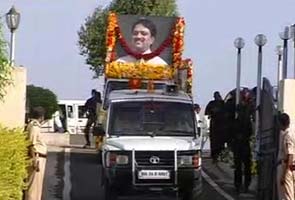
Sea of humanity pays respects to Deshmukh, funeral in evening

August 15, 2012

Vilasrao-Deshmukh

Latur, August 15: A sea of humanity poured out on all roads leading to Babhalgaon village in Latur district where the body of their beloved leader Vilasrao Deshmukh was brought for people to pay their last respects here Wednesday.

As a mark of respect to the departed leader, all shops and businesses remained closed for the second consecutive day Wednesday and many people observed fast, locals said.

Security arrangements at levels never before seen have been put in place since Wednesday morning when Deshmukh's body was brought by a special Indian Air Force aircraft to Latur for the last rites in his native village.

While thousands lined the route leading to the funeral site, over half a million people are likely to witness the last rites.

Deshmukh spent his childhood in Babhalgaon, became one of its youngest sarpanch (village head), and later went on to become Maharashtra chief minister twice and also a union minister.

He breathed his last in Chennai's Global Hospital Tuesday after a cardiac arrest following multiple organ failure.

Shortly after it arrived and got stuck in a traffic jam owing to the huge crowds on the roads, the cortege carrying the coffin was placed for public 'darshan' at the Dayanand School here.

Even as people filed past the coffin weeping, his sons Amit, Dheeraj and Reitesh accepted condolences from the host of dignitaries and VVIPs who have reached Latur for the funeral, scheduled Wednesday evening.

Prime Minister Manmohan Singh, Congress president Sonia Gandhi, Home Minister Sushilkumar Shinde, Agriculture Minister Sharad Pawar, Maharashtra Governor K.

Sankaranarayanan, Chief Minister Prithviraj Chavan and his cabinet colleagues are among the dignitaries expected at the funeral.

Bharatiya Janata Party president Nitin Gadkari, Maharashtra Navnirman Sena chief Raj Thackeray, Republican Party of India chief Ramdas Athavale and other opposition leaders will also pay their respects to the departed leader.

The state government has organised a state funeral for Deshmukh and declared a three-day official mourning.

Comments

Add new comment

  • Coastaldigest.com reserves the right to delete or block any comments.
  • Coastaldigset.com is not responsible for its readers’ comments.
  • Comments that are abusive, incendiary or irrelevant are strictly prohibited.
  • Please use a genuine email ID and provide your name to avoid reject.
News Network
January 24,2020

Kochi/Mumbai, Jan 24: Two students who recently returned from China have been kept under medical observation at the Ernakulam Government Medical College here for possible exposure to the coronavirus, an outbreak of which in China has triggered a global health scare.

Reports from Mumbai said two persons there too have been put observation at the civic-run Kasturba Hospital in Chinchpokali, PTI reported.

Health officials said no cases of the deadly infection have been detected.

One of the students being screened in Kerala and both being screen in Mumai have reported symptoms such as cold and fever and has been kept in isolation wards.

The additional district medical officer of Ernakulam, Dr S Sreedevi, said samples of the student’s body fluids would be sent to the National Institute of Virology in Pune for tests.

The youngster consulted a doctor at a private hospital and was referred to the Ernakulam hospital in the wake of the virus outbreak in Wuhan city of China.

A stringent screening system has been set up at the Kochi International Airport to screen passengers who have been in the affected province in China. Persons who have been to Wuhan and showing symptoms of cold, cough and fever are being immediately shifted to the Ernakulam hospital.

All quariantine facilities have been put in place there including an isolation ward and a ventilator.

The other person under observation in Kerala is an MBBS student from Kottayam district who recently returned from his college in China. The district medical office said she has no health issues. She was put under observation as a precautionary measure.

In Mumbai, 1,789 passengers have undergone thermal screening at the Chhatrapati Shivaji Maharaj International Airport for the coronavirus since January 19.

Coronavirus cases were first reported from Wuhan, the capital of central Chinas Hubei province in China.

In the wake of the coronavirus outbreak in China, doctors at international airports have been asked to screen travellers for symptoms if they are returning from China. All private doctors have been asked to alert the authorities if they observe symptoms of the coronavirus.

Comments

Add new comment

  • Coastaldigest.com reserves the right to delete or block any comments.
  • Coastaldigset.com is not responsible for its readers’ comments.
  • Comments that are abusive, incendiary or irrelevant are strictly prohibited.
  • Please use a genuine email ID and provide your name to avoid reject.
News Network
June 2,2020

New Delhi, Jun 2: Congress leader Rahul Gandhi on Monday took a jibe at Prime Minister Narendra Modi over Moody's Investors Service downgrading India's sovereign rating to the lowest investment rate and said that the global rating agency has rated his handling of the country's economy "a step above junk".

"Moody's has rated Modi's handling of India's economy a step above JUNK. Lack of support to the poor and the MSME sector means the worst is yet to come," the Congress leader tweeted citing a media report on Moody's downgrading the nation.

On Monday, Moody's downgraded the country's rating to "Baa3" from "Baa2". This comes at a time when the government is facing criticism from the Opposition over its handling of the COVID-19 situation and measures to boost the economy.

The government has already announced a stimulus package of Rs 20 lakh crore to deal with the situation.

Comments

Add new comment

  • Coastaldigest.com reserves the right to delete or block any comments.
  • Coastaldigset.com is not responsible for its readers’ comments.
  • Comments that are abusive, incendiary or irrelevant are strictly prohibited.
  • Please use a genuine email ID and provide your name to avoid reject.
News Network
February 19,2020

New Delhi, Feb 19: India will switch to the world's cleanest petrol and diesel from April 1 as it leapfrogs straight to Euro-VI emission compliant fuels from Euro-IV grades now - a feat achieved in just three years and not seen in any of the large economies around the globe.

India will join the select league of nations using petrol and diesel containing just 10 parts per million of sulphur as it looks to cut vehicular emissions that are said to be one of the reasons for the choking pollution in major cities.

Sanjiv Singh, Chairman of Indian Oil Corp (IOC) - the firm that controls roughly half of the country's fuel market, said almost all refineries began producing ultra-low sulphur BS-VI (equivalent to Euro-VI grade) petrol and diesel by the end of 2019 and oil companies have now undertaken the tedious task of replacing every drop of fuel in the country with the new one.

"We are absolutely on track for supplying BS-VI fuel from April 1. Almost all refineries have begun supplying BS-VI fuel and the same has reached storage depots across the country," he said.

From storage depots, the fuel has started travelling to petrol pumps and in the next few weeks all of them will only have BS-VI grade petrol and diesel, he said. "We are 100 per cent confident that fuel that will flow from nozzles at all the petrol pumps in the country on April 1 will be BS-VI emission compliant fuel."

India adopted Euro-III equivalent (or Bharat Stage-III) fuel with a sulphur content of 350 ppm in 2010 and then took seven years to move to BS-IV that had a sulphur content of 50 ppm. From BS-IV to BS-VI it took just three years.

"It was a conscious decision to leapfrog to BS-VI as first upgrading to BS-V and then shifting to BS-VI would have prolonged the journey to 4 to 6 years. Besides, oil refineries, as well as automobile manufacturers, would have had to make investments twice - first to producing BS-V grade fuel and engines and then BS-VI ones," he said.

State-owned oil refineries spent about Rs 35,000 crore to upgrade plants that could produce ultra-low sulphur fuel. This investment is on top of Rs 60,000 crore they spent on refinery upgrades in the previous switchovers.

BS-VI has a sulphur content of just 10 ppm and emission standards are as good as CNG.

Originally, Delhi and its adjoining towns were to have BS-VI fuel supplies by April 2019 and the rest of the country was to get same supplies from April 2020.

But oil marketing companies switched over to supply of BS-VI grade fuels in the national capital territory of Delhi on April 1, 2018.

The supply of BS-VI fuels was further extended to four contiguous districts of Rajasthan and eight of Uttar Pradesh in the National Capital Region (NCR) on April 1, 2019, together with the city of Agra.

BS-VI grade fuels were made available in 7 districts of Haryana from October 1, 2019.

Singh said the new fuel will result in a reduction in NOx in BS-VI compliant vehicles by 25 per cent in petrol cars and by 70 per cent in diesel cars.

The switchover, he said, is a tedious task as every drop of old, higher-sulphur content fuel has to be flushed out in depots, pipelines and tanks before being replaced by BS-VI.

"We are confident of disruption-free switchover to BS-VI supplies across the country," he said. "What we will be supplying is the best quality available anywhere in the world. You don't have any better fuel that is supplied in any part of the world. Perhaps our BS-VI fuel will be better than equivalent fuel in some parts of the US and Europe."

India adopted a fuel upgradation programme in the early 1990s. Low lead gasoline (petrol) was introduced in 1994 in Delhi, Mumbai, Kolkata and Chennai. On February 1, 2000, unleaded gasoline was mandated nationwide.

Similarly, BS-2000 (Euro-I equivalent, BS-1) vehicle emission norms were introduced for new vehicles from April 2000. BS-II (Euro-II equivalent) emission norms for new cars were introduced in Delhi from 2000 and extended to the other metro cities in 2001.

Benzene limits have been reduced progressively from 5 per cent in 2000 to 1 per cent nationwide. Lead content in gasoline was removed in phases and only unleaded gasoline is being produced and sold from February 1, 2000.

The octane number of gasoline signifies the improved performance of the engine. Loss in octane number due to phasing out of lead was made up by installing new facilities in the refinery and changes in refinery operation. RON (Research Octane Number) of gasoline for BS-2000 spec was increased to 88. This has over time been increased to 91.

Singh said sulphur reduction will reduce Particulate Matter (PM) emissions even in the in-use older generation diesel vehicles.


Comments

Add new comment

  • Coastaldigest.com reserves the right to delete or block any comments.
  • Coastaldigset.com is not responsible for its readers’ comments.
  • Comments that are abusive, incendiary or irrelevant are strictly prohibited.
  • Please use a genuine email ID and provide your name to avoid reject.