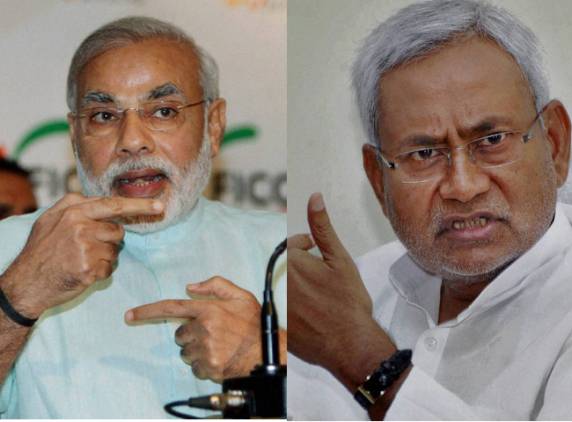
Nitish 'interview' sparks fresh headache for Modi

August 15, 2012

modinithis


New Delhi, August 15: Bihar Chief Minister Nitish Kumar was today quoted by a magazine as saying that he will break his alliance with BJP if Gujarat Chief Minister Narendra Modi is made its prime ministerial candidate and also that he was open to a post-poll tie-up with the Congress.

The Chief Minister, however, immediately denied as having given any such interview and said that 'The Week', the magazine concerned, had removed it from the website. The Week maintained that the interview had been conducted.

The magazine quoted Nitish, a senior JD(U) leader, as having said that he will discontinue his alliance with the BJP "within minutes" if Modi was made the prime ministerial candidate.

The chief minister was also quoted as having said that if the Congress promises to meet his demands he was open to the idea of a post-poll tie-up with that party after the next Lok Sabha elections. General Elections are due in 2014.

Comments

Add new comment

  • Coastaldigest.com reserves the right to delete or block any comments.
  • Coastaldigset.com is not responsible for its readers’ comments.
  • Comments that are abusive, incendiary or irrelevant are strictly prohibited.
  • Please use a genuine email ID and provide your name to avoid reject.
News Network
January 2,2020

Kolkata, Jan 2: In what could spark fresh tensions between West Bengal Chief Minister Mamata Banerjee and the BJP-led centre, the Union Ministry of Defence on Wednesday rejected her state's tableau proposal for the Republic Day parade on January 26.

"The tableau proposal of West Bengal government was examined by the expert committee in two rounds of meetings. The tableau proposal of the West Bengal government was not taken forward for further consideration by the committee after deliberations in the second meeting," the ministry said in its statement.

Twenty two proposals comprising 16 states and union territories and six ministries and departments have been shortlisted for the parade. The shortlist was compiled from as many as 56 tableau proposals - 32 from states and union territories and 24 from various ministries and departments - received by the central government.

"The expert committee examines the proposals on the basis of theme, concept, design and visual impact before making its recommendations. Due to time constraints arising out of the overall duration of the parade, only a limited number of tableaux can be shortlisted for participation in the parade," the statement read, adding that West Bengal was shortlisted for the 2019 Republic Day parade through a similar process.

"The rejection of the West Bengal tableau for the Republic Day parade is discriminatory. It has been done because West Bengal has been opposing the centre's CAA (Citizenship Amendment Act) and the NRC (National Register of Citizens) plans," Trinamool Congress MP Saugata Roy told news agency.

"West Bengal is known to be living state as far as culture, including arts, music and other things are concerned. So obviously, this is a discriminatory step taken by the central government against West Bengal," Mr Roy added.

The Trinamool Congress-led Bengal government is at loggerheads with the central government over several issues, and the expanding presence of the BJP in the eastern state ahead of the 2021 assembly elections has further intensified their rivalry.

Mamata Banerjee has repeatedly said that she will not allow Bengal to be a part of the proposed nationwide National Register of Citizens, an assertion that the BJP claims is proof of her minority appeasement strategy. Last month, a four-member delegation of Trinamool Congress politicians that visited BJP-ruled Uttar Pradesh to meet families of those killed in violent protests against the Citizenship Amendment Act were stopped by police personnel at the Lucknow airport.

The BJP leadership has now decided to launch a campaign blitzkrieg in West Bengal to counter what it claims is the Trinamool's "misinformation programmes" against the amended citizenship law and reach out to refugees. Protests across the country have currently put the party on the backfoot.

The Citizenship Amendment Act, for the first time, makes religion the test of citizenship in India. The government says it will help minorities from three Muslim-dominated countries get citizenship if they fled to India because of religious persecution before 2015. Critics say it is designed to discriminate against Muslims and violates the secular principals of the Constitution.

Brazilian President Jair Bolsonaro will be the chief guest at the Republic Day celebrations.

Comments

Add new comment

  • Coastaldigest.com reserves the right to delete or block any comments.
  • Coastaldigset.com is not responsible for its readers’ comments.
  • Comments that are abusive, incendiary or irrelevant are strictly prohibited.
  • Please use a genuine email ID and provide your name to avoid reject.
Agencies
June 22,2020

New Delhi, Jun 22: India's COVID-19 cases per lakh people is one of the lowest in the world despite its high population density, and the recovery rate has now reached almost 56 per cent, the Union Health Ministry said on Monday.

For every one lakh population, there are 30.04 coronavirus cases in India, while the global average is over three times at 114.67, the ministry said, referring to the WHO Situation Report 153, dated June 21.

“This low figure is thus a testimony to the graded, pre-emptive and pro-active approach the Government of India along with the states and UTs took for prevention, containment and management of COVID-19," the ministry said in a statement.

Citing the WHO Situation Report, the ministry said the US has 671.24 cases per lakh population, while Germany, Spain, Brazil and the UK have 583.88, 526.22, 489.42 and 448.86 cases per lakh population, respectively.

It said Russia has 400.82 cases per lakh people, while Italy, Canada, Iran and Turkey have 393.52, 268.98, 242.82 and 223.53, respectively.

Coming back to India, as on Monday morning, the total number of coronavirus cases stood at 4,25,282 and the death toll at 13,699, according to figures issued by the ministry.

In its update issued at 8 AM Monday, the ministry said 9,440 COVID-19 patients recovered in the last 24 hours, taking the total number of recoveries to 2,37,195, a recovery rate of 55.77 per cent.

Presently, there are 1,74,387 active cases and all are under medical supervision, it said.

"The difference between the recovered patients and the active COVID-19 cases continues to widen. Today, the number of recovered patients has crossed the number of active patients by 62,808," the ministry said.

The COVID-19 testing infrastructure is continuously being ramped up and number of government labs has been increased to 723 and the private labs to 262, adding up to a total of 985, it said.

According to the Indian Council of Medical Research, a total of 69,50,493 samples have been tested up to 21 June, 1,43,267 of them just on Sunday.

On Monday, the country added 14,821 new COVID-19 cases in a single day, pushing the tally to 4,25,282, while the death toll rose to 13,699 with 445 new fatalities reported till 8 am.

The country breached the four lakh-mark on Sunday, eight days after crossing three lakh COVID-19 cases. It has recorded 2,34,747 infections since June 1.

Monday was the 11th day in a row when the country registered over 10,000 cases.

Comments

Add new comment

  • Coastaldigest.com reserves the right to delete or block any comments.
  • Coastaldigset.com is not responsible for its readers’ comments.
  • Comments that are abusive, incendiary or irrelevant are strictly prohibited.
  • Please use a genuine email ID and provide your name to avoid reject.
News Network
May 24,2020

New Delhi, May 24: The Indian economy is likely to slip into recession in the third quarter of this fiscal as loss in income and jobs and cautiousness among consumers will delay recovery in consumer demand even after the pandemic, says a report.

According to Dun & Bradstreet's latest Economic Observer, the country's economic recovery will depend on the efficacy and duration of implementation of the government's stimulus package.

"The multiplier effect of the stimulus measures on the economy will depend on three key aspects i.e. the time taken for effecting the withdrawal of the lockdown, the efficacy of implementation and duration of execution of the measures announced," Dun & Bradstreet India Chief Economist Arun Singh said.

The report noted that the government's larger-than-expected stimulus package is likely to re-start economic activities.

Besides, measures taken by the Reserve Bank of India like reducing the repo rate by a further 40 basis points to 4 per cent, extending the moratorium period by three months and facilitating working capital financing will also help stimulate the momentum.

Singh said while the measures announced by the government are "positive", most of them have been directed towards strengthening the supply side of the economy, and "it is to be noted that supply needs to be matched with demand", he said.

Besides, "in the absence of cash-in-hand benefits under the government's stimulus package, demand for goods and services is expected to remain depressed", he added.

He further said the loss in income and employment opportunities, and cautiousness among consumers, will lead to a delayed recovery in consumer demand, even after the pandemic. As debt and bad loan levels increase, the banking sector might face challenges.

The report further noted that even as the monetary stimulus is expected to inject liquidity and stimulate demand for a wider section of the economy, the channelisation of funds from the financial institutions will be subjected to several constraints.

The foremost concern being increase in risk averseness, as the balance sheets of firms, households, and banks/NBFCs have weakened considerably and low demand for funds by firms as production activities have been on a standstill during the lockdown period, Singh said.

India has been under lockdown since March 25 to contain the spread of the coronavirus, resulting in supply disruptions and demand compression.

Prime Minister Narendra Modi imposed a nationwide lockdown to control the spread of coronavirus on March 25. It has been extended thrice, with some relaxations. The fourth phase of the lockdown is set to expire on May 31. 

Comments

Add new comment

  • Coastaldigest.com reserves the right to delete or block any comments.
  • Coastaldigset.com is not responsible for its readers’ comments.
  • Comments that are abusive, incendiary or irrelevant are strictly prohibited.
  • Please use a genuine email ID and provide your name to avoid reject.