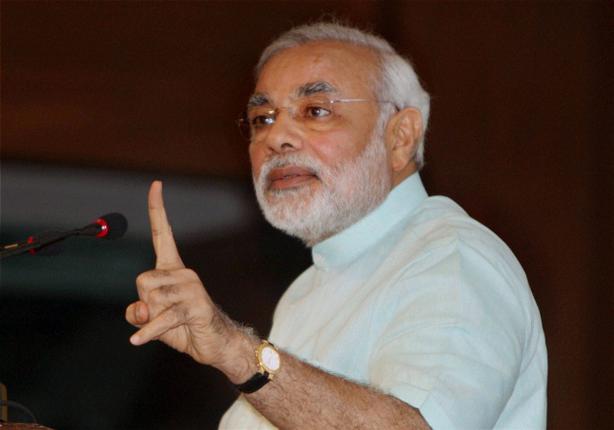
If voted to power, Congress will take Gujarat to 18th century: Narendra Modi

August 16, 2012
modi16q

Ahmedabad, August 16: Taking a dig at the Congress, Gujarat Chief Minister Narendra Modi on Wednesday said the main Opposition party will take the state to the 18th century if it is voted to power.

The Bharatiya Janata Party (BJP) stalwart claimed the Gujarat Congress leaders were making remarks which were at variance with the Independence Day address made by Prime Minister Manmohan Singh.

While the Prime Minister spoke about the need to attract foreign investments and develop infrastructure, the Congress leaders say Gujarat does not need roads, industries or educational institutions, he said at a gathering in Ahmedabad.

"The Prime Minister, in his address, said there is a need to attract Foreign Direct Investment (FDI) and also focus on industrialisation for employment generation in the country. He spoke about the need to strengthen infrastructure, but state Congress leaders say just the opposite of it.

"The state Congress leaders were seen on TV saying they don't need roads, industries, educational institutions, hospitals, universities, and that just half a chapati would suffice for them," Modi said, implying the party leaders were criticising the BJP government's policies aimed at attracting FDI and setting up industries.

As the crowd burst into laughter, Modi said "Congress aims to take you back to the 18th century. Would you like to go to the 18th century rule?"

Assembly election is due in December in Gujarat. Modi was speaking at the inaugural function of a river front development project along the banks of Sabarmati.

Attacking the UPA Government, he said it was the Centre's responsibility to provide affordable living to people in this era of rising prices.

"They had claimed to contain price rise within 100 days of coming to power, but have been unable to do so. The poor of the country are asking the Centre - what happened to your promise of checking price rise within 100 days?"


Comments

Add new comment

  • Coastaldigest.com reserves the right to delete or block any comments.
  • Coastaldigset.com is not responsible for its readers’ comments.
  • Comments that are abusive, incendiary or irrelevant are strictly prohibited.
  • Please use a genuine email ID and provide your name to avoid reject.
News Network
May 10,2020

New Delhi, May 10: The Delhi government has asked district magistrates to release 2,446 Tablighi Jamaat members from quarantine centres and ensure that they do not stay in any other place except their homes.

The district magistrates will explore the possibility of sending those Tablighi members, who belong to other states, in buses to their designated places in accordance with social distancing norms and other protocols, DDMA Special CEO K S Meena said in a letter to deputy commissioners (administration).

As man as 567 foreign attendees of the congregation held in Delhi's Nizamuddin area in March, will be handed over to the police, Meena said.

"They (foreign Jamaat attendees) will be handed over to police in connection with several violations like visa violation," a government official said on Saturday.

Delhi Home Minister Satyendar Jain had recently ordered the release of Tablighi members who have completed their required quarantine period in centres and tested negative for COVID-19.

"Out of such people belonging to Delhi, who could be released as per prescribed guidelines should be issued passes to travel from the quarantine centres.

"Under no circumstances, the aforesaid persons should be allowed to stay in any other places including mosques," Meena said in the letter.

In respect of those Tablighi members belonging to other states, it should be ensured by the nodal officer and the area ACP that such people reach their place of residence, he also said.

"The DC should also inform the respective resident commissioner of their states in respect of each and every movement of such persons from Delhi," the Delhi Disaster Management Authority (DDMA) Special CEO said.

Thousands of Tablighi Jamaat members had been taken out of its Markaz (centre) in Nizamuddin, where they had gathered for a religious congregation, and quarantined as the area became a major hotspot after a number of members tested positive for coronavirus.

On March 31, the Delhi Police's Crime Branch had lodged an FIR against seven people, including Maulana Saad Kandhalvi, on a complaint by Station House Officer, Nizamuddin, for holding the congregation.

Comments

Add new comment

  • Coastaldigest.com reserves the right to delete or block any comments.
  • Coastaldigset.com is not responsible for its readers’ comments.
  • Comments that are abusive, incendiary or irrelevant are strictly prohibited.
  • Please use a genuine email ID and provide your name to avoid reject.
News Network
February 6,2020

Feb 6: India has been ranked 40th out of 53 countries on a global intellectual property index, even as the country has shown improvement in terms of scores when it comes to the protection of IP and copyright issues, a top American industry body said on Wednesday.

India was placed at 36th position among 50 countries in 2019.

India's score, however, increased from 36.04 per cent (16.22 out of 45) in 2019 to 38.46 per cent (19.23 out of 50) in 2020, a 2.42 per cent jump in an absolute score.

However, India's relative score increased by 6.71 per cent, according to the International IP Index released by Global Innovation Policy Center or GIPC of the US Chambers of Commerce.

This year, it finds itself on the 40th place among 53 countries. Two new Index economies (Greece and the Dominican Republic) scored ahead of India. The Philippines, and Ukraine leapfrogged India.

"Since the release of the 2016 National IPR Policy, the government of India has made a focused effort to support investments in innovation and creativity through increasingly robust IP protection and enforcement," the GIPC said.

Since 2016, India has improved the speed of processing for patent and trademark applications, increased awareness of IP rights among Indian innovators and creators, and facilitated the registration and enforcement of those rights, it added.

According to the eighth edition of the annual report, India's score on the Chamber's International IP Index demonstrates the country's growing investment in IP-driven innovation and creativity. The Index specifically highlights a number of reforms over the last year that strengthen India's overall IP ecosystem, it said.

"In 2019, the Delhi High Court used dynamic injunctions to disable access to copyright-infringing content online, resulting in an increase in India's score on two of the copyright-related indicators," it said.

"The use of these injunctions places India alongside global leaders in copyright enforcement, including Singapore and the UK. As a result, India scores ahead of 24 other economies in the copyright indicators," the report said.

The Delhi High Court also issued a series of judgements that provide clarity on existing statutes related to trademark protection online, resulting in a score increase on one of the trademark-related indicators, it added.

The courts issued two precedential rulings that raised the bar for the damages awarded in IP-infringement cases and may provide a deterrent for future infringement. This resulted in an increase in score on one of the trademark-related indicators, it said.

Global Innovation Policy Center or GIPC said India also continues to score well in the Systemic Efficiency indicator, scoring ahead of 28 other economies in these indicators.

"This is a result of a concerted effort by the Indian government to consult with stakeholders during IP policy formation and create greater awareness about the importance of IP protection,” it said adding that India also remains a leader in the use of targeted incentives and IP assets for small and medium-sized enterprises (SMEs).

“To continue this upward trajectory, much work remains to be done to introduce transformative changes to India’s overall IP framework and take serious steps to consistently implement strong IP standards," the report said.

GIPC has identified several challenges for India. Prominent among them being patentability requirements, patent enforcement, compulsory licensing, patent opposition, regulatory data protection, transparency in reporting seizures by customs, and Singapore Treaty of Law of TMs and Patent Law Treaty.

"We are encouraged that Indian policymakers seem to recognize this Index as a valuable resource in their efforts to strengthen the country’s promising innovation ecosystem and enhance its competitiveness in an increasingly knowledge-based global economy,” the report said.

Observing that no other economy stands to gain more from strong Indian IP than India itself, the report said for example, no industry has been hurt more by copyright violations in India than the country’s own Bollywood industry, which loses almost USD3 billion to piracy each year.

"The number one way the Modi administration can demonstrate its commitment to the success of the Atal Innovation Mission, Accelerating Growth for New India’s Innovations, Make in India, Digital India, and Startup India is to strengthen its IP framework in ways that promote the legal and regulatory certainty necessary for greater R&D investment, high-value jobs, and greater innovative and creative outputs,” it said.

"Strong IP standards can further solidify India's position as the world’s fastest-growing economy, bolstering its reputation as a destination for doing business, foreign businesses’ ability to invest and make in India, thereby supporting the growth of India’s own innovative and creative industries," the report said.


Comments

Add new comment

  • Coastaldigest.com reserves the right to delete or block any comments.
  • Coastaldigset.com is not responsible for its readers’ comments.
  • Comments that are abusive, incendiary or irrelevant are strictly prohibited.
  • Please use a genuine email ID and provide your name to avoid reject.
News Network
June 24,2020

New Delhi, Jun 24: Over 1,500 urban and multi-state cooperative banks will be brought under the supervisory power of the Reserve Bank of India (RBI), said Union Minister Prakash Javadekar on Wednesday.

"Government banks, including 1,482 urban cooperative banks and 58 multi-state cooperative banks, are now being brought under supervisory powers of Reserve Bank of India (RBI); RBI's powers as they apply to scheduled banks will apply for cooperative banks as well," Javadekar said at a press conference, through video conferencing.

"The decision to bring 1,540 cooperative banks under RBI's supervision will give an assurance to more than 8.6 crore depositors in these banks that their money amounting to Rs 4.84 lakh crore will stay safe," he added.

The Minister of Information and Broadcasting further said that the Union Cabinet has approved a scheme "for interest subvention of 2 per cent to Shishu loan category borrowers under Pradhan Mantri Mudra Yojana, outstanding as on March 31, 2020, for one year to eligible borrowers."

The Minister also said that the Union Cabinet has approved the declaration of Kushinagar Airport in Uttar Pradesh as an international airport.

Comments

Add new comment

  • Coastaldigest.com reserves the right to delete or block any comments.
  • Coastaldigset.com is not responsible for its readers’ comments.
  • Comments that are abusive, incendiary or irrelevant are strictly prohibited.
  • Please use a genuine email ID and provide your name to avoid reject.