


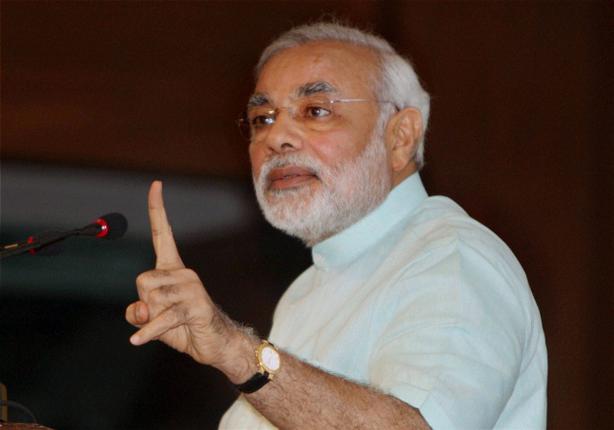
If voted to power, Congress will take Gujarat to 18th century: Narendra Modi

August 16, 2012
modi16q

Ahmedabad, August 16: Taking a dig at the Congress, Gujarat Chief Minister Narendra Modi on Wednesday said the main Opposition party will take the state to the 18th century if it is voted to power.

The Bharatiya Janata Party (BJP) stalwart claimed the Gujarat Congress leaders were making remarks which were at variance with the Independence Day address made by Prime Minister Manmohan Singh.

While the Prime Minister spoke about the need to attract foreign investments and develop infrastructure, the Congress leaders say Gujarat does not need roads, industries or educational institutions, he said at a gathering in Ahmedabad.

"The Prime Minister, in his address, said there is a need to attract Foreign Direct Investment (FDI) and also focus on industrialisation for employment generation in the country. He spoke about the need to strengthen infrastructure, but state Congress leaders say just the opposite of it.

"The state Congress leaders were seen on TV saying they don't need roads, industries, educational institutions, hospitals, universities, and that just half a chapati would suffice for them," Modi said, implying the party leaders were criticising the BJP government's policies aimed at attracting FDI and setting up industries.

As the crowd burst into laughter, Modi said "Congress aims to take you back to the 18th century. Would you like to go to the 18th century rule?"

Assembly election is due in December in Gujarat. Modi was speaking at the inaugural function of a river front development project along the banks of Sabarmati.

Attacking the UPA Government, he said it was the Centre's responsibility to provide affordable living to people in this era of rising prices.

"They had claimed to contain price rise within 100 days of coming to power, but have been unable to do so. The poor of the country are asking the Centre - what happened to your promise of checking price rise within 100 days?"


Comments

Add new comment

  • Coastaldigest.com reserves the right to delete or block any comments.
  • Coastaldigset.com is not responsible for its readers’ comments.
  • Comments that are abusive, incendiary or irrelevant are strictly prohibited.
  • Please use a genuine email ID and provide your name to avoid reject.
News Network
June 8,2020

New Delhi, June 8: Only 20.26 lakh migrant workers of the targeted 8 crore such labourers have received free food grains in May and June (2020), according to data released by the Ministry of Consumer Affairs, Food and Public Distribution.

In the middle of May, as part of the Rs 20 lakh crore Atma Nirbhar Bharat package, the Modi government had announced that migrant labourers who are not covered under the National Food Security Act (NFSA) or any state-run PDS scheme, will receive free food grains for two months.

"Non-card holders shall be given 5 kg wheat or rice per person and 1 kg chana per family per month for the next 2 months. About 8 crore migrants will benefit from this scheme that will cost the government Rs 3500 crore,” Finance Minister Nirmala Sitharaman had said at a press conference following PM Modi’s announcement.

But the Ministry of Consumer Affairs, Food and Public Distribution said on Sunday, "The states and UTs have lifted 4.42 LMT (lakh metric tonne) of food grains and distributed 10,131 MT of it to 20.26 lakh beneficiaries."

It added, "The Government of India also approved 39,000 MT pulses for 1.96 crore migrant families. Around 28,306 MT gram/dal have been dispatched to the states and UTs. A total 15,413 MT gram have been lifted by various states and UTs". The state governments, the ministry added, had distributed only 631MT (metric tonnes) of gram so far.

Because of the constant movement of migrant workers, the Centre had said that the states will be responsible for identifying the migrants and subsequent food distribution.

The Centre claims it is spending approximately Rs 3,109 crore for food grains and Rs 280 crores for grams/chana under this package.

Comments

Add new comment

  • Coastaldigest.com reserves the right to delete or block any comments.
  • Coastaldigset.com is not responsible for its readers’ comments.
  • Comments that are abusive, incendiary or irrelevant are strictly prohibited.
  • Please use a genuine email ID and provide your name to avoid reject.
News Network
April 23,2020

Washington, Apr 23: Air pollution over northern India has plummeted to a 20-year-low for this time of the year, according to satellite data published by US space agency National Aeronautics and Space Administration (NASA).
The US space agency's satellite sensors observed aerosol levels at a 20-year low post the countrywide lockdown, implemented to slow the spread of the novel coronavirus.

"We knew we would see changes in atmospheric composition in many places during the lockdown," said Pawan Gupta, a Universities Space Research Association (USRA) scientist at NASA''s Marshall Space Flight Center. "But I have never seen aerosol values so low in the Indo-Gangetic Plain at this time of year," added Mr Gupta.

Acting Assistant Secretary of State for South and Central Asia Alice G Wells tweeted, "These images from NASA were taken each spring starting in 2016 and show a 20-year low in airborne particle levels over India. When India and the world are ready to work and travel again, let's not forget that collaborative action can result in cleaner air."

The data published with maps show aerosol optical depth (AOD) in 2020 compared to the average for 2016-2019. Aerosol optical depth is a measure of how light is absorbed or reflected by airborne particles as it travels through the atmosphere.

If aerosols are concentrated near the surface, an optical depth of 1 or above indicates very hazy conditions. An optical depth, or thickness, of less than 0.1 over the entire atmospheric vertical column is considered "clean." The data were retrieved by the Moderate Resolution Imaging Spectroradiometer (MODIS) on NASA's Terra satellite.

In the first few days of the lockdown, it was difficult to observe a change in the pollution signature. "We saw an aerosol decrease in the first week of the shutdown, but that was due to a combination of rain and the lockdown," said Mr Gupta.

Around March 27, heavy rain poured over vast areas of northern India and helped clear the air of aerosols. Aerosol concentrations usually increase again after such heavy precipitation.

"After the rainfall, I was really impressed that aerosol levels did not go up and return to normal. We saw a gradual decrease and things have been staying at the level we might expect without anthropogenic emissions," Mr Gupta said.

On March 25, the Indian government placed its 1.3 billion citizens under a strict lockdown to reduce the spread of COVID-19. The countrywide mandate decreased activity at factories and severely reduced car, bus, truck and airplane traffic. Every year, aerosols from anthropogenic (human-made) sources contribute to unhealthy levels of air pollution in many Indian cities.

Aerosols are tiny solid and liquid particles suspended in the air that reduce visibility and can damage the human lungs and heart.

In southern India though, the story is a little hazier. Satellite data show aerosol levels have not yet decreased to the same extent. In fact, levels seem to be slightly higher than in the past four years. The reasons are unclear but could be related to recent weather patterns, agricultural fires, winds or other factors.

"This a model scientific experiment," Robert Levy, program leader for NASA's MODIS aerosol products, said about the lockdown and its effects on pollution.

"We have a unique opportunity to learn how the atmosphere reacts to sharp and sudden reductions in emissions from certain sectors. This can help us separate how natural and human sources of aerosols affect the atmosphere," Mr Levy added.

Comments

Add new comment

  • Coastaldigest.com reserves the right to delete or block any comments.
  • Coastaldigset.com is not responsible for its readers’ comments.
  • Comments that are abusive, incendiary or irrelevant are strictly prohibited.
  • Please use a genuine email ID and provide your name to avoid reject.
Agencies
August 8,2020

New Delhi, Aug 7: With the highest single-day spike of 62,538 cases, India's COVID-19 count rose to 20,27,075 on Friday, said Union Ministry of Health and Family Welfare.

The total cases include 6,07,384 active cases, 13,78,106 cured/discharged/migrated, and 41,585 deaths, according to the Ministry of Health.

The country's COVID-19 positive cases crossed the 10 lakh mark on July 17 when the total positive cases stood at 10,03,832 in India.

Maharashtra with 1,46,268 active cases and 3,05,521 cured and discharged patients continues to be the worst affected. The state has also reported 16,476 deaths due to the infection.

Tamil Nadu has 54,184 active cases while 2,14,815 patients have been discharged after treatment in the state. 4,461 deaths have been reported due to COVID-19 in the state.

Total COVID-19 cases in Andhra Pradesh are 1,96,789 including 1,12,870 recoveries, 82,166 active cases, and 1,753 deaths, as per the last health bulletin.

Delhi reported 1,192 new COVID-19 cases and 23 deaths on Friday. The total count of cases in the national capital has risen to 1,42,723. 

According to the Health Department, a total of 1,108 recoveries have been reported in Delhi in the last 24 hours.

The total number of cases includes 1,28,232 recoveries, 10,409 active cases, and 4,082 deaths.

According to the official data, 5,612 RT-PCR/CBNAAT/TrueNat tests and 17,773 rapid antigen tests were conducted today.

A total of 11,43,703 test has been conducted so far. The Union Health Ministry said that India continues its track record of testing more than 6 lakh COVID-19 samples each day for the fourth successive day.

"Expanded diagnostic lab network and facilitation for easy testing across the country have given a boost, and with 6,39,042 tests conducted in the last 24 hours, India has done 2,27,88,393 tests presently. The Tests Per Million (TPM) has seen a sharp increase to 16,513," the ministry said.

As many as 473 new COVID-19 cases were reported in Jammu and Kashmir today; 128 from Jammu division and 345 from Kashmir division.

The total number of cases stood at 23,927 including 7,260 actives cases, 16,218 recoveries, and 449 deaths.

The government of Mizoram informed that 19 new COVID-19 cases were reported in the state, taking the total number of cases to 558.
The number of active cases is 270 while 288 people have been discharged. No death reported in the state to date.

Bihar Health Department said, 3646 new cases reported in the state on August 6. Total tally reaches 71,794.

Similarly, 244 new COVID-19 cases, 77 recoveries, and five deaths were reported in Puducherry on Friday, taking the total number of cases to 4,862, including 1,873 active cases, 2,914 recoveries, and 75 deaths.

1,063 new cases of COVID-19 cases, 381 recovered and 23 deaths reported in Punjab in the last 24 hours. State tally rises to 21,930 including 7,351 active cases, 14,040 cured/discharged and 539 deaths.

Meanwhile, 1,074 new cases of COVID-19 and 22 deaths reported in Gujarat in last the 24 hours. State tally rises to 68,885 including 14,587 active cases, 51,692 cured/discharged and 2,606 deaths, the State Health Department said.

According to the Union Health Ministry, West Bengal has 23,829 active cases with 1,902 deaths so far while, Karnataka has 75,076 active cases of the virus with 80,281 recovered and 2,897 deaths so far.

Comments

Add new comment

  • Coastaldigest.com reserves the right to delete or block any comments.
  • Coastaldigset.com is not responsible for its readers’ comments.
  • Comments that are abusive, incendiary or irrelevant are strictly prohibited.
  • Please use a genuine email ID and provide your name to avoid reject.