Northeast migrants flee Pune, Bangalore, Chennai

August 17, 2012

rly_station

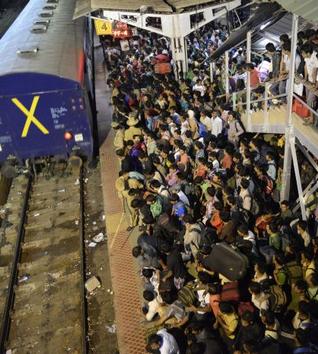
New Delhi, August 17: Fearing reprisals over the violence against Muslims in Assam, people from the northeast continued to flee from cities such as Bangalore, Chennai, Pune and Mumbai, even as ethnic clashes between Bodos and Muslims that began in July spread to Baksa, Nalbari and Kamrup districts on Thursday.

More than 3,000 labourers from the northeast living in Chennai thronged the station to take the weekly Egmore-Dibrugarh Express after they heard of rumours of planned attacks on them. Only 300 could board the crowded train; the rest were waiting for the next trains coming from Bangalore.

Things were no better in Bangalore where more people from the northeast quit their jobs to leave the city, despite Karnataka chief minister Jagadish Shettar's assurance of security. At least 6,800 people fled Bangalore on three special trains on Wednesday night.

In Assam, at least 19 people were injured in two incidents reported on Thursday. In Gossaigaon in Kokrajhar, miscreants threw acid at nine Muslims, while in Tamulpur in Baksa, 10 Bodos agitating against the arrest of protesters were injured in clashes with police.

The Army is out in Baksa, in addition to the lower Assam districts of Kokrajhar, Dhubri, Chirang and Bongaigaon since July 25.

Comments

Add new comment

  • Coastaldigest.com reserves the right to delete or block any comments.
  • Coastaldigset.com is not responsible for its readers’ comments.
  • Comments that are abusive, incendiary or irrelevant are strictly prohibited.
  • Please use a genuine email ID and provide your name to avoid reject.
News Network
January 13,2020

New Delhi, Jan 13: Walmart, the world’s largest retailer, has fired around 50 of its India executives as part of its restructuring in the country, three sources with direct knowledge said.

The move underscores the struggles Walmart has faced in expanding its wholesale business in India. The Bentonville, Arkansas based company currently operates 28 wholesale stores where it sells goods to small shopkeepers, and not to retail consumers.

The firings mostly affected executives in the company’s real estate division because the growth in the wholesale model has not been that robust, two of the sources said.

“It’s happening because focus is shifting to e-commerce rather than physical (stores),” said one source, who declined to be identified as the decision is not public.

Walmart did not respond to a request for comment.

Walmart has placed bold bets on India’s e-commerce sector. In 2018, it paid $16 billion to acquire a majority stake in India’s online marketplace Flipkart, in its biggest global acquisition.

The second source added that while Walmart could slow down the pace of opening new wholesale stores, the focus will increasingly be on boosting sales through business-to-business and retail e-commerce.

Some of the executives were sacked last week and more could be let go on Monday, two sources said.

In a statement to India’s Economic Times newspaper, which first reported the news, Walmart said it was always looking for ways to operate more effectively and that “this requires us to review our corporate structure to ensure that we are organized in the right way to best meet the needs of our members.”

Walmart has around 600 staff in its India head office out of a total of around 5,300 nationally, one of the sources said.

Comments

Add new comment

  • Coastaldigest.com reserves the right to delete or block any comments.
  • Coastaldigset.com is not responsible for its readers’ comments.
  • Comments that are abusive, incendiary or irrelevant are strictly prohibited.
  • Please use a genuine email ID and provide your name to avoid reject.
News Network
March 25,2020

Kolkata, Mar 25: Amid the countrywide lockdown in the wake of coronavirus outbreak, Chief Minister Mamata Banerjee on Wednesday said that all police stations will take responsibility to deliver food at doorsteps under the supervision of District Magistrates and Police Superintendents.
"As we have to ensure that there is no scarcity of food, all Police stations will take responsibility to deliver food at doorsteps and it will be monitored by District Magistrates and Police Superintendents," said Banerjee at a press conference here.
She also said that under the social pension schemes, the pension holders will get their pension of March and April together.
Speaking on local police blocking people involved in essential services, she said, "The Officer-in-charge will have to ensure that the local police know about the rules and exemptions during the lockdown."
"If any police official or an administrative official is found flouting the lockdown norms, then strict action will be taken against them," she added.
The Chief Minister also said, "If somebody needs to help us by giving materials then they need to contact health department official Sanjay Bansal, whose contact number is - 9051022000."
"The government has also launched a State emergency relief fund wherein people can donate. For donation, the account number is 628005501339, IFSC: ICIC0006280 and website: wb.gov.in," she said.
She also said that on March 31 the government will review the situation.
According to a recent update by the Ministry of Health and Family Welfare, a total of 562 positive cases for coronavirus have been confirmed in the country.

Comments

Add new comment

  • Coastaldigest.com reserves the right to delete or block any comments.
  • Coastaldigset.com is not responsible for its readers’ comments.
  • Comments that are abusive, incendiary or irrelevant are strictly prohibited.
  • Please use a genuine email ID and provide your name to avoid reject.
Agencies
July 30,2020

Mumbai, Jul 30: Counterfeiting incidents have increased 24 per cent in the country in 2019 over the previous year, creating an over Rs 1 lakh crore hole in the economy, according to a report.

The report also said counterfeiters are having a free run due to the pandemic-driven disruptions to organised supply chains and the resultant spike in consumer demand.

According to the report by ASPA, a self-regulated industry body of anti-counterfeiting and traceability solutions providers, counterfeiting has risen steadily in the last few years, and exploiting the pandemic as a cover for their activities.

Between February and April 2020, over 150 incidents of counterfeiting cases were reported, mostly about fake PPE kits, sanitisers and masks taking advantage of the high demand for these products, it noted.

"There was a 24 per cent increase in counterfeiting in 2019 over 2018, leading to the loss of more than Rs 1 lakh crore to the overall economy," said Nakul Pasricha, president of Authentication Solution Providers Association.

The association works with global authorities like the International Hologram Manufacturers Association, Counterfeit Intelligence Bureau of the Interpol, and domestic industry lobbies like Ficci, he said.

Counterfeiting is a universal issue and is 3.3 per cent of global trade, according to the OECD data, impacting social and economic development across the world.

The report lists the currency, FMCG, alcohol, pharma, documents, agriculture, infrastructure, automotive, tobacco, lifestyle and apparel, as the 10 sectors impacted most by counterfeiting.

Among these, currency, alcohol and FMCG continue to be the top three sectors with the highest counterfeiting in the last two years. The FMCG sector is most vulnerable, as counterfeit incidents rose 63 per cent between 2018 (79) and 2019 when the reported cases jumped to 129.

Within the states, the fakers have a free run in Uttar Pradesh, Bihar, Rajasthan, Madhya Pradesh, Bengal, Punjab, Jharkhand, Delhi, Gujarat, and Uttarakhand, calling for urgent actions to frame anti-counterfeiting policy measures.

According to the report, UP continues to be on top followed by Bihar, Rajasthan, and together these three states represent almost 45 per cent of all counterfeiting reported in the last two years.

What is more alarming is that counterfeiting is not limited to high-end luxury items today, as common everyday items as fake cumin seeds, mustard cooking oil, ghee, hair oils, soaps, baby care vaccines and medicines are aplenty in the markets.

"There is an urgent need for building and nurturing authentication ecosystems in the country with the active involvement and active participation of all stakeholders," said Pasricha.


Comments

Add new comment

  • Coastaldigest.com reserves the right to delete or block any comments.
  • Coastaldigset.com is not responsible for its readers’ comments.
  • Comments that are abusive, incendiary or irrelevant are strictly prohibited.
  • Please use a genuine email ID and provide your name to avoid reject.