


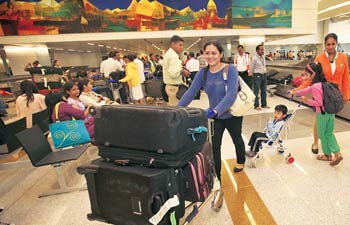
Govt auditor's (CAG) report slams levy of development fee on passengers at Delhi airport

August 17, 2012

aviation_lands

New Delhi, August 17: The government's auditor shared with parliament today a report that says that thousands of crores have been lost in the way in which coal mines were allocated to private players; another report finds fault with how the Delhi international airport was privatised. The government has prepped a detailed defense for both sectors; it will argue that the auditor's calculations are erroneous.

The Comptroller and Auditor General's (CAG) report on the Delhi airport finds that 1.63 lakh crores were lost in the way in which land was leased .

The government's auditor has also objected to the permission granted by the government to the Delhi airport consortium to charge passengers a development fee to help raise funds for the project. The auditor said this was not part of the original contract. The CAG says Delhi International Airport Limited (DIAL) will get an undue benefit of over Rs. 3,400 crore from the development fee.

DIAL charges passengers between Rs. 400 and Rs. 2600, depending on whether they're flying domestically or internationally.

The Delhi airport is run by a public-private partnership between the GMR group, which has 54% stake, and the Airports Authority of India, which is part of the government. Germany's Fraport AG and Malaysia Airport Holdings are the other minority partners in the venture that has operated the Delhi airport since 2006.

The auditor says that land was given to the airport project at highly concessional rates - 4800 acres were allotted, of which 239 acres could be used for commercial purposes like shops at Rs. 100 a year. The auditor says that the earnings from this commercial exploitation will be 1.63 lakh crores.

But in a statement earlier this year, the public-private partnership that handles the airport, referred to as DIAL (Delhi International Airport Limited), rebutted that "It (Rs. 1.63 lakh crore) is simply the absolute amount of revenues that accrue to DIAL over 58 years (45.99 per cent of the same will be shared with Airport Authority of India) - and does not represent the time value of money."

The government will point out that the token rent charged for the land saves the state-run Airports Authority of India hundreds of crores as stamp duty. The government will also emphasise that the concessions available to GMR to run the Delhi airport were part of the bid documents and were available to every bidder, so no preferential treatment was shown to GMR, which landed the project.

The CAG further points out that DIAL was allowed to extend its contract (for Operations, Maintenance and Development of the airport) for another 30 years. This, they say, is a deviation from the cabinet decision of September 11, 2003. The CAG, in its report, says, no infrastructure operator may be allowed to renew lease or extend its contract on identical terms.

The government says this position is factually incorrect as the decision to extend the contract was taken by an Empowered Group of Ministers (EGoM) - which had been constituted - based on a cabinet note of 2003.


Comments

Add new comment

  • Coastaldigest.com reserves the right to delete or block any comments.
  • Coastaldigset.com is not responsible for its readers’ comments.
  • Comments that are abusive, incendiary or irrelevant are strictly prohibited.
  • Please use a genuine email ID and provide your name to avoid reject.
Agencies
June 6,2020

Mumbai, Jun 6: Republic TV Editor-in-Chief Arnab Goswami faces a new complaint, this time under the Cable Televisions Network (Regulation) Act, 1995, for allegedly running the television channel "to create communal hatred, religious polarisation and threatening national integrity".

Social activist Nilesh Navlakha last month lodged a criminal complaint with the Commissioner of Police, Pune, through his lawyer Asim Sarode, under Section 2 of the Act.

"We have narrated six prominent, recent debate shows conducted by Goswami in which his arguments and words used were communal in nature which he kept repeating in his shows. The words and tonality are intended to promote communal attitudes and news is based on religious innuendos and half-truths," Sarode contended.

This leads to propaganda based on hatred, religious polarization and communal divide, said Navlakha in a statement.

He further said that the misuse of freedom of expression by Goswami and his channel posed a serious threat before the independent media as it violates the freedom of expression of the viewers, as it is the viewers' right to get correct, complete and true information.

Elaborating about Goswami's behaviour, Navlakha said that he has created what is termed 'Impulse Control Disorder' in psychiatry.
Sarode said: "Intermittent Explosive Disorder is a kind of 'impulse control disorder' which involves sudden episodes of impulsive, aggressive, violent behaviour or angry verbal outbursts in which you react grossly out of proportion to the situation."

They said that there are some more media persons displaying such tendencies in Hindi and English journalism, showing whatever is convenient and blow it out of proportion to give meanings which are out-of-context and disrupts the fabric of democracy while not fitting into journalism's ethics.

The complaint also alleged that Goswami and his channel are actually into "brainwashing" the viewers in a way that they will get converted into haters of some communities and terror for some religions.

"This is not less than running an organised crime syndicate of making the human minds to follow a fanatic terrorist thought process. When WhatsApp group admins are being booked under the law, then why the CTNRA provisions are not being invoked against such tendencies," Sarode asked.

In the complaint, it is pointed out how eminent persons have walked out of Goswami's shows because of his name-calling tactics, like labelling cricketer Sachin Tendulkar "anti-national" in one of his shows.

Navlakha and Sarode claimed that Goswami has violated the Programme Code under the CTNRA, the channel has indicated it is against sovereignty, integrity and security as also against public order, decency and morality, making it a serious issue and a cognizable offence.

It urged the Pune police chief to take suitable action against the wrongs committed to disturb the peace, law and order in society and book Goswami under the CTNRA Section's 16, which attracts a jail term of two years plus fine.

Comments

Add new comment

  • Coastaldigest.com reserves the right to delete or block any comments.
  • Coastaldigset.com is not responsible for its readers’ comments.
  • Comments that are abusive, incendiary or irrelevant are strictly prohibited.
  • Please use a genuine email ID and provide your name to avoid reject.
coastaldigest.com web desk
June 9,2020

Bijnor: A 17-year-old Dalit youth was shot dead by four miscreants belonging to the upper caste of Hinduism after the former tried to enter a temple in Uttar Pradesh.

The deceased was identified as Vikas Jatav. The accused had tried to stop the deceased from entering into a temple. 

On being stopped from entering the temple located in Domkhera village, Jatav raised and objection and started arguing with the accused. 

The accused were identified as - Lala Chauhan, Horam Chauhan, Bhushan and Jasveer. The incident took place on May 31, according to the father of the deceased. 

How it happened 
On May 31, Jatav went to a temple in Domkhera to offer his prayers. The four accused, however, did not let him go inside. Following this, an argument broke out between the accused and the 17-year-old boy. 

On the same day, the victim approached the police and lodged a complaint in relation to the incident. The police, however, did not take any action against the accused men. 

Late night on Saturday, Jatav was sleeping inside his house when the four men barged in and opened fire at him. 

Hearing the gunshots, Jatav's family rushed to rescue him, following which, the accused escaped. Vikas was profusely bleeding after being shot and succumbed to the injuries before he could reach the hospital. 

Lala Chauhan and Horam were nabbed by the police while the other two are still at large. The four accused have been booked under section 302 (murder) of the Indian Penal Code (IPC) and the SC/ST Act.

Comments

Add new comment

  • Coastaldigest.com reserves the right to delete or block any comments.
  • Coastaldigset.com is not responsible for its readers’ comments.
  • Comments that are abusive, incendiary or irrelevant are strictly prohibited.
  • Please use a genuine email ID and provide your name to avoid reject.
News Network
February 14,2020

New Delhi/Washington, Feb 14: India has offered to partially open up its poultry and dairy markets in a bid for a limited trade deal during US President Donald Trump's first official visit to the country this month, people familiar with the protracted talks say.

India, the world's largest milk-producing nation, has traditionally restricted dairy imports to protect the livelihoods of 80 million rural households involved in the industry.

But Prime Minister Narendra Modi is trying to pull all the stops for the US President's February 24-25 visit, aimed at rebuilding bonds between the world's largest democracies.

In 2019, President Trump suspended India's special trade designation that dated back to 1970s, after PM Modi put price caps on medical devices, such as cardiac stents and knee implants, and introduced new data localization requirements and e-commerce restrictions.

President Trump's trip to India has raised hopes that he would restore some of the country's US trade preferences, in exchange for tariff reductions and other concessions.

The United States is India's second-largest trade partner after China, and bilateral goods and services trade climbed to a record $142.6 billion in 2018. The United States had a $23.2 billion goods trade deficit in 2019 with India, its 9th largest trading partner in goods.

India has offered to allow imports of US chicken legs, turkey and produce such as blueberries and cherries, government sources said, and has offered to cut tariffs on chicken legs from 100 per cent to 25 per cent. US negotiators want that tariff cut to 10 per cent. The Modi government is also offering to allow some access to India's dairy market, but with a 5 per cent tariff and quotas, the sources said. But dairy imports would need a certificate they are not derived from animals that have consumed feeds that include internal organs, blood meal or tissues of ruminants.

New Delhi has also offered to lower its 50 per cent tariffs on very large motorcycles made by Harley-Davidson, a tax that was a particular irritant for President Trump, who has labelled India the "tariff king." The change would be largely symbolic because few such motorcycles are sold in India.

President Trump will be feted in PM Modi's home state of Gujarat, then hold talks in New Delhi and attend a reception that the hosts have promised will be bigger than the one organised for former president Barack Obama in 2015.

But it is far from clear whether India's offers will be enough to satisfy US Trade Representative Robert Lighthizer, who cancelled plans for a trip to India this week. Instead, he has held telephone talks with Commerce Minister Piyush Goyal.

The US dairy industry remained sceptical on Thursday that a viable deal is at hand.

"We're always looking for market access, but in terms of India, as of today I'm not aware of any real progress going on," said Michael Dykes, president of the International Dairy Foods Association and a member of USTR's agricultural trade policy advisory committee.

Mr Dykes said the US dairy industry was looking for access in viable commercial quantities.

A USTR spokesman and India's trade ministry did not respond to requests for comment.

A parliament panel is reviewing a draft data privacy law that imposes stringent controls over cross-border data flows and gives the government powers to seek user data from companies.

It is not clear whether it will be passed, or in what form, but the possibilities have unnerved US companies and could raise compliance requirements for Google, Amazon.com Inc, and Facebook.

The draft law is not part of the trade discussions, Indian officials say, because the issue is too difficult to resolve at the same time.

"The privacy and localization piece will be raised independently and in concert with the trade discussions," said a Washington-based source with knowledge of the US administration's thinking.

President Trump on Tuesday was non-committal about sealing a trade deal before his visit. "If we can make the right deal, we'll do it," he told reporters.

Two US sources said progress had been made on proposed alterations to the medical device price caps. India's new import tariffs on medical devices, walnuts, toys, electronics and other products on February 1 surprised US negotiators, however.

The new tariffs were aimed at China, which also makes medical devices, according to an Indian government source. "We have to protect our market and our companies," the source said.

Comments

Add new comment

  • Coastaldigest.com reserves the right to delete or block any comments.
  • Coastaldigset.com is not responsible for its readers’ comments.
  • Comments that are abusive, incendiary or irrelevant are strictly prohibited.
  • Please use a genuine email ID and provide your name to avoid reject.