


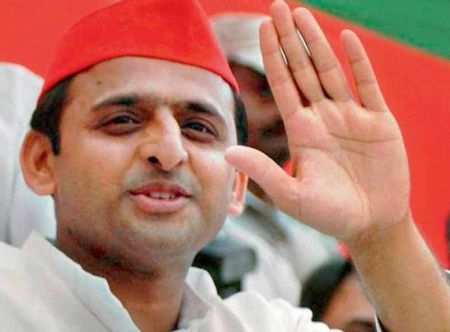
Akhilesh Yadav goes 'soft' on Mayawati's corruption

August 17, 2012
Akhilesh

Lucknow, August 17: The Samajwadi Party (SP) government rode to power earlier this year in March after winning elections on the issue of corruption in previous Bahujan Samaj Party (BSP) regime. However, contrary to the repeated assurances that it would weed out corruption and take strict action against the accused, the Akhilesh Yadav-led SP government seems to be protecting those named in various alleged scams which occurred during the Mayawati rule.

Sample this: while Rs 1200 crore sugar mill sale scam has been put in the back burner, the government has not given sanction to the CBI for prosecuting senior officials and doctors named in the Rs-5700 crore National Rural Health Mission (NRHM) scam and a through probe in the Rs 1000-crore Noida farm house land allotment scam is being unnecessarily delayed. Further, the inquires ordered in over a dozen other scams are moving at a snail's pace.

In the Noida farm house land allotment scam, the government has been accused of trying to protect the officials involved in the scam. First preliminary inquiry was delayed and the matter was referred to the Lokayukta only after media highlighted the anomalies. Now, it has come to light that the required procedure was not followed before sending the case to Lokayukta. As a result, the Lokayukta has returned the government's request to probe the scam.

In the NRHM scam, the government is sitting over CBI's request to for sanction of prosecution of prime accused IAS officer Pradeep Shukla and over 20 doctors named in investigations. Further, Shukla, who was arrested by the CBI, was not even put under suspension by the state government for the period he was in the jail for 90 days before getting bail on August 13. Significantly, senior SP minister and chief minister's uncle Shivpal Yadav visited Shukla in jail.

In sugar mill scam, the SP government after coming to power had promised to take action but did nothing. When accused by some opposition parties of going easy on Mayawati, the government constituted a 9-member team headed by chief secretary in June this year to probe the matter again, despite the fact that the Comptroller and Auditor General had already found anomalies worth Rs 1200 crore in sale of 21 government sugar mills during BSP rule.

Though SP leaders continue to blame the corruption in previous BSP regime for the mess in the state, they have done little, barring suspensions of lower rung officials, to send a strong signal that their government is against corruption. Even the decision to refer anomalies in construction of Dalit memorials to the Lokayukta was taken after High Court issued a notice on a public interest litigation (PIL) seeking information about action taken in the scam.

Other alleged scams which are bring probed but at a snail's pace include anomalies in construction of toilets in rural households, arbitrary use of urgency clause for acquiring over 10,000 acre of agriculture land in Noida for housing projects, irregularities in appointment of about 72,000 primary teachers, anomalies in construction of canals and irregularities in allotment of contracts for mining, excise and high security number plates among other cases.


Comments

Add new comment

  • Coastaldigest.com reserves the right to delete or block any comments.
  • Coastaldigset.com is not responsible for its readers’ comments.
  • Comments that are abusive, incendiary or irrelevant are strictly prohibited.
  • Please use a genuine email ID and provide your name to avoid reject.
News Network
June 15,2020

Sitamarhi, Jun 15: Eyewitness accounts from locals in Bihar's Sitamarhi district recount the brutality and intimidation by Nepal's security personnel who on June 12 had resorted to unprovoked firing on a group of people at the international border, which left one Indian dead and two others injured.

"18-20 shots were fired for over one hour and everyone is in shock even now," said Nitish Kumar, a resident of Jankinagar recalling the incident that took place early on Friday morning.

Nepal's Armed Police Force (APF) opened fire at the Lalbandi-Jankinagar border in which three men - Vikesh Yadav, Umesh Ram and Uday Thakur - suffered gunshot injuries. Vikash Yadav succumbed to his injuries on Friday itself.

Another person Lagan Kishore, who was at the border with his family to meet his daughter-in-law, a Nepali national and her family, said he was detained by the APF personnel who dragged him to the other side of the border.

Lagan Kishore said that the Nepali personnel abused and hit him with rifle butts and even abused his son and later resorted to firing.

Several residents of Jankinagar, who spoke to media, termed the incident as "unfortunate and shocking".

Nitish Kumar recalled: "A family was here to meet their in-laws (Nepali nationals). The daughter-in-law was talking to her family while her husband and her father-in-law sat a little distance away. Suddenly I saw Nepali personnel abusing her husband who complained about it to his father. All of a sudden the Nepali forces started thrashing them and then opened fire. They also took the father into custody."

"We were all shocked. I could hear about 18-20 gunshots fired over a period of one hour," Kumar said.

Another local, Ajit Kumar, said he was perplexed with the behaviour of the Nepali Police.

"There used to be no problems earlier. We don't understand what happened to the Nepal Police that day. The firing is unfortunate. If this continues, how will people in the border area live?" he questioned.

Ajit Kumar stated that such an incident has taken place for the first time. "People from here go to work in fields in Nepal and their people come to work in our fields. Such a thing has happened for the first time. About 80 per cent of our people are married to Nepalis," he said.

Many people who live in the adjoining districts of Bihar, which shares over 600 kilometres of border with Nepal, have relatives on either side of the border.

Meanwhile, Nepali police have claimed that Lagan Kishore, who was taken into custody following the firing by APF and handed over to Indian Security Forces at no man's land on June 13, was detained for trying to snatch a weapon from one of their personnel during an altercation.

However, both Kishore and his family have denied the claims and said he was "dragged" across the border and was beaten.

Kishore said that during the firing he had rushed towards the Indian side but Nepalese personnel hit him with rifle butt and took him to Nepal's Sangrampur. He was also asked to confess that he was taken into custody from the Nepali side.

"We ran to return to India when they started firing, but they dragged me from the Indian side, hit me with a rifle butt and took me to Nepal's Sangrampur. They told me to confess that I was brought there from Nepal. I told them you can kill me but I was brought there from India," said Kishore.

Kishore's son also said that Nepali personnel started abusing them and hit him and his father.

Speaking to ANI, Kishore's son said, "We went to meet my brother-in-law. Security personnel started abusing me but I could not understand their language. However, my brother's wife asked them to not abuse. After that, they came to the Indian side and hit me. I told my father about the incident and he confronted them."

"They started beating him and called fellow personnel who started firing and dragged my father from the Indian side, hit him with a rifle butt and took him to Nepal''s Sangrampur," he said.

Relations have become strained between India and Nepal after the latter released a map showing parts of Indian Territory-Lipulekh, Kalapani and Limpiyadhura as its own.

Comments

Add new comment

  • Coastaldigest.com reserves the right to delete or block any comments.
  • Coastaldigset.com is not responsible for its readers’ comments.
  • Comments that are abusive, incendiary or irrelevant are strictly prohibited.
  • Please use a genuine email ID and provide your name to avoid reject.
News Network
May 25,2020

Domestic flights resumed operations on a truncated schedule on Monday with the first aircraft departing from the Delhi Airport for Pune, more than two months after a nationwide lockdown was announced to combat COVID-19.

The first flight to take off was an IndiGo aircraft to Pune, flying passengers stranded in the national capital since the lockdown was announced on March 24.

Passengers were screened at the airport with electronic thermometers, and revised protocol for air travel that included santisation of luggage through ultra-violent scanners, and maintaining physical distancing.

Only asymptomatic passengers were allowed to enter the airport.

Passengers were also seen wearing face masks and face shields given to them at the embarkation point by the airline to minimise the chances of infection while onboard.

The first flight arrived at Delhi Airport from Ahmedabad – a SpiceJet aircraft – at around 8:00 am.

BJD Lok Sabha member Anubhav Mohanty was among those who took the Air Vistara flight to Bhubaneshwar that departed Delhi airport at 6:50 am.

The first flight to take off from Mumbai was an IndiGo aircraft that departed for Patna at 6:45 am, while passengers from Lucknow were the first to reach the financial capital on an IndiGo aircraft that touched down at 8:20 am.

The food & beverage and retail outlets, which were closed for the past 63 days, opened at Terminal 3 of Delhi’s Indira Gandhi International (IGI) Airport.

The flight services resumed after a day of long and hard negotiations between the Centre and the states on Sunday.

All states finally agreed to accept at least some flights but announced different quarantine and self-isolation rules for arriving passengers to address apprehension about infections being brought in from other cities.

The Centre had issued guidelines for all modes of domestic travel that advised all asymptomatic passengers to self-monitor their health parameters for 14 days on completion of the journey and report to health authorities if they displayed any symptoms for COVID-19.

However, the Centre had allowed state governments to prescribe their own health protocols for disembarking passengers which led to differential guidelines across the country.

Comments

Add new comment

  • Coastaldigest.com reserves the right to delete or block any comments.
  • Coastaldigset.com is not responsible for its readers’ comments.
  • Comments that are abusive, incendiary or irrelevant are strictly prohibited.
  • Please use a genuine email ID and provide your name to avoid reject.
News Network
March 25,2020

India will suspend all domestic flights from midnight Tuesday, the final piece of a nationwide lockdown that threatens Prime Minister Narendra Modi’s attempts to revive an economy already expanding at the slowest pace in more than a decade.

The flight ban compliments a cancellation of all passenger trains through March 31, as authorities try to halt the spread of the coronavirus in the world’s second-most populous country, which has poorly equipped hospitals and inadequate social security. Modi on Monday held a conference call with some of India’s top entrepreneurs and bankers, who urged policymakers to immediately slash interest rates by as much as a full percentage point, transfer cash to the poorest citizens, and suspend loan-repayments.

Over the past three days, state after state has declared curfews and India’s international borders have been shut for most visitors since March 11. India so far has 492 virus cases, including nine deaths. But experts say the country could be on the same trajectory as Italy, where the outbreak quickly escalated, causing hospitals to overflow.
A traveller stands outside a near-empty Delhi Junction Railway Station in Delhi, March 22.

"This is the biggest lockdown in world history,” said Raghu Raman, a former soldier with the Indian Army and founder of the National Intelligence Grid, an umbrella database aimed at countering terrorism. “This strategic pause gives decision-makers more time to arrest the exponential spread of the virus and evaluate trade-offs.”

Controlling the outbreak is crucial for Modi, who remains India’s most popular political leader currently though his economic management has faced criticism. Foreign investors are selling Indian assets at an unprecedented pace and failure to contain deaths and infections could erode some of the prime minister’s personal appeal at home.

Oxford Economics slashed India’s January-March growth forecast to 3%, a number not seen even during the worst of the global financial crisis. The main equity gauge rose about 3% on Tuesday after a record 13.2% plunge Monday, and the rupee stayed near its all-time low.

“A part of the cerebral cortex that senses fear and survival seems to have activated in the minds of investors,” said Umesh Mehta, Mumbai-based head of research at Samco Securities Ltd. “The only relief in this market can come from either policy makers and regulators, or from some positive news that a cure for the pandemic is near.”

Bloomberg Economics estimates Modi’s administration needs at least 1% of gross domestic product -- $30 billion -- to meaningfully respond to the virus outbreak. Meanwhile, the nation’s billionaires are diverting their factories to manufacture medical equipment and pledging to keep paying their staff even as production grinds to a halt. India allowed companies to use their philanthropy funds to prevent the spread of the coronavirus.

Reliance Industries Ltd., controlled by India’s richest man Mukesh Ambani, has helped equip a hospital in Mumbai dedicated to patients of Covid-19, the disease caused by the coronavirus. It will also build quarantine centers and produce 100,000 facemasks a day and other personal protective equipment for health workers. The group’s telecom unit will offer free broadband to enable work-from-home during the lockdown and will pay its lowest paid workers twice a month to protect household incomes.

Ambani joins Mahindra & Mahindra Ltd. Chairman Anand Mahindra and Vedanta Resources Ltd. Chairman Anil Agarwal -- a combined worth of more than $40 billion between the trio -- who have so far made pledges.

Indian companies are responding to Modi’s shutdown call. Maruti Suzuki India Ltd., Tata Motors Ltd., Toyota Kirloskar Motor, Hero MotoCorp., Samsung Electronics Co. and LG Electronics Inc., Mahindra Group, TVS Motor Co., Kia Motors Corp., Renault Nissan Automotive India Private Ltd., and Yamaha Motor India are among companies that have announced factory suspensions.

Policymakers are aware of the risks of such a move. India -- with a record 5.9 trillion rupees of local corporate debt maturing this year -- faces “waves of default” if cash flows aren’t maintained, the government’s principal economic adviser Sanjeev Sanyal said an interview.

Finance Minister Nirmala Sitharaman last week said the government will announce a relief package for coronavirus-affected sectors as soon as possible. The Reserve Bank of India, which is due to review interest rates April 3, announced a 1 trillion rupee cash injection on Monday.

“Let me assure, whatever it takes to keep the cash flow going in the economy will be done,” Sanyal said. “We need to make sure that when we are past the health storm, we still have an economy that has not gotten gridlocked. Because unwinding that would be more difficult.”

Comments

Add new comment

  • Coastaldigest.com reserves the right to delete or block any comments.
  • Coastaldigset.com is not responsible for its readers’ comments.
  • Comments that are abusive, incendiary or irrelevant are strictly prohibited.
  • Please use a genuine email ID and provide your name to avoid reject.