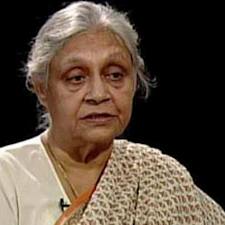
States should check migration to ease pressure on Delhi: Sheila Dikshit

August 18, 2012

Migration

New Delhi, August 18: Identifying migration as a major challenge facing Delhi, Chief Minister Sheila Dikshit today asked major states to develop infrastructure in their cities so people don't come to the national capital in search of job.

Speaking at an interaction with top industry leaders, organised by CII, Ms Dikshit also appealed to the Centre to build more new cities across the country to ease pressure on Delhi.

"The state governments must develop bigger cities, comfortable cities. All the states will have to think why their people are migrating from their states. If the states provide them opportunities and livelihood, build better cities, then I do not think the migration will continue," she said.

Noting that city government has been continuously enhancing Delhi's infrastructure to cater to the rising population, the Chief Minister said concrete steps must be initiated to cut increasing flow of people to the national capital.

"More than half a million people come to Delhi every year primarily in search of job. The increasing number of people is putting pressure on our infrastructure... The infrastructure in Delhi is not bad. But it needs to be upgraded constantly to meet the demand," she said.

The Chief Minister had floated the idea of declaring National Capital Region (NCR) comprising Delhi and satellite towns as a common economic and taxation zone which she felt would have cut down the increasing flow of migrants into the city.

Ms Dikshit has been asking Union Urban Development Ministry to take appropriate steps to develop "counter-magnet centres" in neighbouring states to ease the pressure on Delhi.

In the interaction attended by over 75 industry leaders, the Chief Minister also emphasised the need for governance reform and improving work culture by the private sector.

"We need to have major reforms in governance. I think we need a cultural change both at the government and in private sector in improving our systems," she said.

Ms Dikshit also highlighted achievements of her government and appealed to the industry captains to exploit the favourable environment in the city for further growth of the services sector.

She said her government has significantly improved transport infrastructure though much needs to be done to further upgrade it.

Speaking about justice delivery system, Ms Dikshit said rate of disposal of cases is highest in Delhi compared to other states.


Comments

Add new comment

  • Coastaldigest.com reserves the right to delete or block any comments.
  • Coastaldigset.com is not responsible for its readers’ comments.
  • Comments that are abusive, incendiary or irrelevant are strictly prohibited.
  • Please use a genuine email ID and provide your name to avoid reject.
News Network
February 21,2020

Patna, Feb 21: The country is paying the price for failure to send Muslims to Pakistan and bring Hindus to India after the Islamic state came into being at the time of Independence, Union minister Giriraj Singh has said, triggering a fresh controversy.

The BJP leader made the remark in Purnea district in the Seemanchal region of Bihar which has a sizeable Muslim population and where the Begusarai MP was canvassing in favor of the Citizenship (Amendment) Act.

Highlighting the need for such a legislation, he told reporters late Thursday "when our forefathers were fighting for Independence from British rule, Jinnah was pushing for the creation of an Islamic state".

"Our forefathers, however, committed a mistake. Had they ensured that all our Muslim brothers were sent to Pakistan and Hindus brought here, the need for such a move (CAA) would not have arisen. This did not happen and we have paid a heavy price for it," the outspoken BJP leader said.

The CAA, which seeks to fast-track granting citizenship to non-Muslim refugees from Pakistan, Bangladesh and Afghanistan who might have fled their home countries because of religious persecution, has become a major bone of contention since it is feared that a country-wide National Register for Citizens (NRC) may follow.

The Narendra Modi government, which had formerly hinted that a country-wide NRC was on the anvil, seems to have put it on the backburner though a section of citizens across the country, especially Muslims, have been organizing protests out of fear that, if implemented, the NRC may result in a large number of people becoming stateless.

Singh has often been in the crosshairs of the opposition for placing his foot in the mouth. This time, however, his words were frowned upon even by NDA ally Lok Janshakti Party, founded by his cabinet colleague Ram Vilas Paswan and now headed by his son Chirag Paswan.

The young LJP chief, who kicked off a state-wide "Bihar First-Bihari First" yatra here Friday morning, to project the NDAs progressive face ahead of the assembly polls due later this year, expressed strong disapproval of Singh's utterance and noted the coalition had to suffer in the Delhi polls because of "divisive" remarks by BJP leaders.

"We are an NDA constituent but many times our coalition partners say things which the LJP does not at all agree with. This one (Giriraj Singhs statement) is such an example. Had a person of my party spoken in this fashion, I would have taken responsibility and acted," Paswan said.

He said he had placed his view repeatedly on record that the coalition had to suffer on account of divisive remarks, Paswan said in apparent reference to inflammatory speeches by BJP leaders like Union minister Anurag Thakur and BJP MP Parvesh Verma, among others.

"The people of Delhi voted on the basis of performance. We wish they do so again in Bihar and real issues don't get drowned in political cacophony.

"The Nitish Kumar government has accomplished a lot, though much more needs to be achieved. We wish to reach out to people with our vision for the future, said Paswan, before he embarked on the yatra on a customized bus decorated like a chariot in front of which he offered prayers and smashed a coconut.

Meanwhile, Giriraj Singh who loves to wear his Hindu nationalism on the sleeves was busy joining issue with Asaduddin Owaisi's AIMIM which has been under attack for controversial remarks by its leader Waris Pathan.

Sharing video of an old speech by Owaisis brother Akbaruddin which had landed him in jail, besides Pathan's recent remark, Singh asked the opposition RJD-Congress combine in Bihar and the "tukde tukde gang" whether they wanted to "convert India into Pakistan".

Comments

Add new comment

  • Coastaldigest.com reserves the right to delete or block any comments.
  • Coastaldigset.com is not responsible for its readers’ comments.
  • Comments that are abusive, incendiary or irrelevant are strictly prohibited.
  • Please use a genuine email ID and provide your name to avoid reject.
Agencies
June 29,2020

From March through May, around 1 crore migrant workers fled India’s megacities, afraid to be unemployed, hungry and far from family during the world’s biggest anti-Covid-19 lockdown.

Now, as Asia’s third-largest economy slowly reopens, the effects of that massive relocation are rippling across the country. Urban industries don’t have enough workers to get back to capacity, and rural states worry that without the flow of remittances from the city, already poor families will be even worse off -- and a bigger strain on state coffers.

Meanwhile, migrant workers aren’t expected to return to the cities as long as the virus is spreading and work is uncertain. States are rolling out stimulus programs, but India’s economy is hurtling for its first contraction in more than 40 years, and without enough jobs, a volatile political climate gets more so.

“This will be a huge economic shock, especially for households of short-term, cyclical migrants, who tend to come from vulnerable, poor and low-caste and tribal backgrounds,” said Varun Aggarwal, a founder of India Migration Now, a research and advocacy group based in Mumbai.

In the first 15 days of India’s lockdown, domestic remittances dropped by 90%, according to Rishi Gupta, chief executive officer of Mumbai-based Fino Paytech Ltd., which operates the country’s biggest payments bank.

By the end of May, remittances were back to around 1750 rupees ($23), about half the pre-Covid average. Gupta’s not sure how soon it’ll fully recover. “Migrants are in no hurry to come back,” Gupta said. “They’re saying that they’re not thinking of going back at all.”

If workers stay in their home states long term, policymakers will have more than remittances to worry about. If consumption falls and the new surplus of labor drives wages down, Agarwal said, “there will also be a second-order shock to the local economy. Overall, not looking good.”

India announced a $277 billion stimulus package in May and followed it up with a $7 billion program aimed at creating jobs for 125 days for migrants in villages across 116 districts. Separately, local authorities are also looking for solutions.

Officials in Bihar have identified 2,500 acres of land that could be made available to investors, said Sushil Modi, deputy chief minister of Bihar, a state in east India. “We can use this crisis as an opportunity to speed up reforms,” he said.

The investors haven’t materialised yet, and in the meanwhile, state governments are relying on the national cash-for-work program that guarantees 100 days worth of wages per household.

Skilled workers don’t want to do manual labor offered through the program, and even if they did, says Amitabh Kundu of RIS, many think of it as beneath their station. “There will be an increase in social tensions,” he predicts. “Caste may again start playing a role. It’s absolute chaos.”

For skilled workers, initiatives vary:

* Uttar Pradesh, which received 3.2 million people, is compiling lists of skilled workers who need employment and trying to place them with local manufacturing and real estate industry associations. So far, the government says, it’s placed 300,000 people with construction and real estate firms.

* Bihar has placed returners in state-run infrastructure projects and hired others to stitch uniforms and make furniture for government-run schools, even as they waited in quarantine centres, said Pratyay Amrit, head of the state’s disaster management department.

* The eastern state of Odisha announced an urban wage employment program aimed at putting as many as 450,000 day labourers to work through September. Some 25,000 people have been employed, so far, under the scheme, G. Mathivathanan, principal secretary for housing and urban development said.

Attracting Investments

It’s not clear any of this will be enough to make a dent, says Ravi Srivastava, professor at New Delhi-based Institute of Human Development, adding that the states don’t have much of a track record on economic development.

“It was the failure of these states to improve governance and put development plans in place that led to the out-migration in the first place,” he said.

But officials and workers’ rights advocates see opportunity. Uttar Pradesh has established liaisons to encourage companies from the US, Japan and South Korea to establish manufacturing in the state. There and in Madhya Pradesh and Rajasthan, the government has made labour laws more friendly to employers, making it easier to hire and fire workers.

Modi, the minister from Bihar, said the migration may also give workers--historically a disenfranchised group--new power, particularly as urban centres struggle. “The way industries treated workers during the lockdown -- didn’t pay them, the living conditions were poor -- now these industries will realize the value of this force,” Modi said.

“In the days to come, labour will emerge as a force that can’t be ignored anymore,” he added. “That’s the new normal. We will work out how to ensure dignity, rights to our people who are going to work in other states.”

Bihar is due for elections by November, a vote that could be an early test of the mass migration’s political consequences. The state is currently governed by a coalition that includes Prime Minister Narendra Modi’s Bharatiya Janata Party. Amitabh Kundu, a fellow at the Research and Information System for Developing Countries, a New Delhi-based government think-tank, said migrant workers are likely to be angry voters.

“Chief ministers are telling these migrants that they will not have to go back for work,” he said. “But their capacity to do something miraculous in the next four to five months is doubtful. If they can retain even one-fourth of the migrants, I would call it a success.”


Comments

Add new comment

  • Coastaldigest.com reserves the right to delete or block any comments.
  • Coastaldigset.com is not responsible for its readers’ comments.
  • Comments that are abusive, incendiary or irrelevant are strictly prohibited.
  • Please use a genuine email ID and provide your name to avoid reject.
News Network
May 19,2020

New Delhi, May 19: In a fresh blow to saffronite journalist Arnab Goswami, the Supreme Court of India today rejected his plea seeking transfer of the investigation of a case, filed against him for defaming Congress interim president Sonia Gandhi, to the CBI. The court also refused to quash the FIRs filed against him.

Goswami, editor-in-chief of Republic TV, has been booked in connection with a TV show on the gathering of migrants outside Bandra railway station on April 14. This apart, multiple FIRs have been filed against him for his show on Palghar lynching. In that show, he had posed certain questions on the incident to Congress President Sonia Gandhi, following which Congress workers lodged complaints against him in various states.

Extending Goswami’s interim protection from arrest by three weeks, the Supreme Court said, “Right of a journalist under 19 1 (a) higher…Free citizens can’t exist if news media can’t speak.”

During the earlier hearing, Senior Advocate Harish Salve, appearing for Goswami, had urged the court to transfer the probe to an agency like CBI. He said the “nature of the” second FIR against Goswami over a show on the migrant gathering outside Bandra station on April 14 “shows that it’s arm-twisting tactic”. 

“They are trying to stifle an unpleasant voice. This is a political party targeting a journalist. All complainants are members of one political party. They have a problem with the government. They want to teach this journalist a lesson,” he added.

Objecting to Salve’s plea to transfer the case to the CBI, Maharashtra government counsel, Senior Advocate Kapil Sibal, had said, “CBI investigation will go into your hands”. 

Sibal denied that Goswami was being harassed and said he was only asked relevant questions. He said Goswami should “stop this communal violence and communal mongering”.

Comments

Add new comment

  • Coastaldigest.com reserves the right to delete or block any comments.
  • Coastaldigset.com is not responsible for its readers’ comments.
  • Comments that are abusive, incendiary or irrelevant are strictly prohibited.
  • Please use a genuine email ID and provide your name to avoid reject.