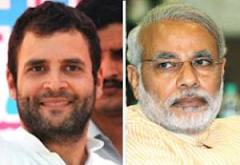
It will be Rahul Gandhi versus Narendra Modi in 2014 Lok Sabha polls: Beni Prasad Verma

August 20, 2012

contro

Barabanki, August 20: In comments that can stoke a fresh controversy, Union minister Beni Prasad Verma today said the next Lok Sabha elections will see a direct fight between Rahul Gandhi and Narendra Modi.

A day after he said that the SP chief Mulayam Singh Yadav was "dreaming" of becoming Prime Minister, Verma today said that parties like Samajwadi Party do not have all India presence and hence cannot form a government at the Centre.

"The government (at the Centre) will either be of Congress or Modi. Why they (SP) are misleading. Does the public not understand all this.... If Rahul Gandhi is our candidate, then the election in 2014 will be Rahul Gandhi versus Gujarat chief minister Narendra Modi. No other party is in between," Verma said.

The Union minister, however, steered clear of drawing a parallel between Prime Minister Manmohan Singh and Rahul Gandhi saying "If Rahul Gandhi will become Prime Minister, he will do so with the blessing of Manmohan Singh".

Verma also hailed the Prime Minister as a "frank" person saying the country will never get such a "gentle" person as Prime Minister. "The whole world considers him an honest persons except the Opposition parties in our country," he said.

Verma said that he always wanted Rahul Gandhi to become the Prime Minister but the decision on when has to be taken by the Congress President and the Prime Minister.

"Who fights for Muslims. It is Congress, which fights for them at the national level. Small insignificant parties have misled them. Congress is concerned about Muslims, Hindus, Christians and all and on the other had there are the traders of votes, who are concerned only about their votes," he said.

Asked to comment on the statement of Samajwadi Party leader Mohan Singh that he should be sacked from the Union Cabinet, Verma said he would not like to react to "small time" leaders who have managed to get a Rajya Sabha membership.

"If he can, let him have me removed from the Cabinet. My ideology will remain the same...I don't take cognizance of seasonal frogs," he said.

Verma, however, refused to comment on Singh's statement that SP would withdraw support if he does not apologize.

He had yesterday alleged that due to interference of Samajwadi party supremo Mulayam Singh Yadav in UP government, it could not function properly.

"Due to interference of Mulayam, the state government cannot function properly and he is responsible for this", Verma had said while talking to reporters yesterday. Verma said he would not blame chief minister Akhilesh Yadav, saying he is "like my son". On Mulayam Singh stating that a third front government at the Centre will emerge in 2014 if SP won 60 seats in UP, Beni said that Yadav was dreaming of becoming Prime Minister but it would not happen.

Comments

Add new comment

  • Coastaldigest.com reserves the right to delete or block any comments.
  • Coastaldigset.com is not responsible for its readers’ comments.
  • Comments that are abusive, incendiary or irrelevant are strictly prohibited.
  • Please use a genuine email ID and provide your name to avoid reject.
Agencies
June 6,2020

Mumbai, Jun 6: Republic TV Editor-in-Chief Arnab Goswami faces a new complaint, this time under the Cable Televisions Network (Regulation) Act, 1995, for allegedly running the television channel "to create communal hatred, religious polarisation and threatening national integrity".

Social activist Nilesh Navlakha last month lodged a criminal complaint with the Commissioner of Police, Pune, through his lawyer Asim Sarode, under Section 2 of the Act.

"We have narrated six prominent, recent debate shows conducted by Goswami in which his arguments and words used were communal in nature which he kept repeating in his shows. The words and tonality are intended to promote communal attitudes and news is based on religious innuendos and half-truths," Sarode contended.

This leads to propaganda based on hatred, religious polarization and communal divide, said Navlakha in a statement.

He further said that the misuse of freedom of expression by Goswami and his channel posed a serious threat before the independent media as it violates the freedom of expression of the viewers, as it is the viewers' right to get correct, complete and true information.

Elaborating about Goswami's behaviour, Navlakha said that he has created what is termed 'Impulse Control Disorder' in psychiatry.
Sarode said: "Intermittent Explosive Disorder is a kind of 'impulse control disorder' which involves sudden episodes of impulsive, aggressive, violent behaviour or angry verbal outbursts in which you react grossly out of proportion to the situation."

They said that there are some more media persons displaying such tendencies in Hindi and English journalism, showing whatever is convenient and blow it out of proportion to give meanings which are out-of-context and disrupts the fabric of democracy while not fitting into journalism's ethics.

The complaint also alleged that Goswami and his channel are actually into "brainwashing" the viewers in a way that they will get converted into haters of some communities and terror for some religions.

"This is not less than running an organised crime syndicate of making the human minds to follow a fanatic terrorist thought process. When WhatsApp group admins are being booked under the law, then why the CTNRA provisions are not being invoked against such tendencies," Sarode asked.

In the complaint, it is pointed out how eminent persons have walked out of Goswami's shows because of his name-calling tactics, like labelling cricketer Sachin Tendulkar "anti-national" in one of his shows.

Navlakha and Sarode claimed that Goswami has violated the Programme Code under the CTNRA, the channel has indicated it is against sovereignty, integrity and security as also against public order, decency and morality, making it a serious issue and a cognizable offence.

It urged the Pune police chief to take suitable action against the wrongs committed to disturb the peace, law and order in society and book Goswami under the CTNRA Section's 16, which attracts a jail term of two years plus fine.

Comments

Add new comment

  • Coastaldigest.com reserves the right to delete or block any comments.
  • Coastaldigset.com is not responsible for its readers’ comments.
  • Comments that are abusive, incendiary or irrelevant are strictly prohibited.
  • Please use a genuine email ID and provide your name to avoid reject.
News Network
June 27,2020

New Delhi, Jun 27: Delhi Environment Minister Gopal Rai on Saturday called an emergency meeting here to discuss the situation following a locust attack in neighbouring Gurugram.

The minister also directed the administration to be alert, an official said.

"After the emergency meeting, an advisory will be issued on steps to be taken to deal with the situation," Rai told PTI.

He asked the officials of the Agriculture department to make field visits to areas close to Gurugram.

The development secretary, divisional commissioner, director, Agriculture department, and the district magistrates of South Delhi and West Delhi will attend the meeting, the official said.

Earlier in the day, the skies over many parts of Gurugram turned dark as swarms of locusts descended on the town.

However, the migratory pests are likely to spare the national capital for now, officials said.

The swarms of locusts, spread across two kilometres, moved from west to east. They entered Gurugram around 11.30 am, K L Gurjar of the Locust Warning Organisation, Ministry of Agriculture, told PTI.

The pests, he said, were headed towards Faridabad and Palwal in Haryana.

Alarmed at the invasion of the locusts, which settled on trees, rooftops and plants, many residents of Gurugram shared videos from their high-rise perches.

In May, India battled a devastating desert locust outbreak. The crop-destroying swarms first attacked Rajasthan and then spread to Punjab, Gujarat, Maharashtra and Madhya Pradesh.

According to experts, broadly four species of locusts are found in India – desert locust, migratory locust, Bombay locust and tree locust. The desert locust is considered the most destructive.

It multiplies very rapidly and is capable of covering 150 kilometers in a day.

This insect, a type of a grasshopper, can eat more than its body weight. A one square kilometer of locust swarm containing around 40 million locusts can in a day eat as much food as 35,000 people.

Experts blame the growing menace of desert locusts on climate change. They say breeding of locusts is directly related to soil moisture and food availability.

Comments

Add new comment

  • Coastaldigest.com reserves the right to delete or block any comments.
  • Coastaldigset.com is not responsible for its readers’ comments.
  • Comments that are abusive, incendiary or irrelevant are strictly prohibited.
  • Please use a genuine email ID and provide your name to avoid reject.
Agencies
June 29,2020

From March through May, around 1 crore migrant workers fled India’s megacities, afraid to be unemployed, hungry and far from family during the world’s biggest anti-Covid-19 lockdown.

Now, as Asia’s third-largest economy slowly reopens, the effects of that massive relocation are rippling across the country. Urban industries don’t have enough workers to get back to capacity, and rural states worry that without the flow of remittances from the city, already poor families will be even worse off -- and a bigger strain on state coffers.

Meanwhile, migrant workers aren’t expected to return to the cities as long as the virus is spreading and work is uncertain. States are rolling out stimulus programs, but India’s economy is hurtling for its first contraction in more than 40 years, and without enough jobs, a volatile political climate gets more so.

“This will be a huge economic shock, especially for households of short-term, cyclical migrants, who tend to come from vulnerable, poor and low-caste and tribal backgrounds,” said Varun Aggarwal, a founder of India Migration Now, a research and advocacy group based in Mumbai.

In the first 15 days of India’s lockdown, domestic remittances dropped by 90%, according to Rishi Gupta, chief executive officer of Mumbai-based Fino Paytech Ltd., which operates the country’s biggest payments bank.

By the end of May, remittances were back to around 1750 rupees ($23), about half the pre-Covid average. Gupta’s not sure how soon it’ll fully recover. “Migrants are in no hurry to come back,” Gupta said. “They’re saying that they’re not thinking of going back at all.”

If workers stay in their home states long term, policymakers will have more than remittances to worry about. If consumption falls and the new surplus of labor drives wages down, Agarwal said, “there will also be a second-order shock to the local economy. Overall, not looking good.”

India announced a $277 billion stimulus package in May and followed it up with a $7 billion program aimed at creating jobs for 125 days for migrants in villages across 116 districts. Separately, local authorities are also looking for solutions.

Officials in Bihar have identified 2,500 acres of land that could be made available to investors, said Sushil Modi, deputy chief minister of Bihar, a state in east India. “We can use this crisis as an opportunity to speed up reforms,” he said.

The investors haven’t materialised yet, and in the meanwhile, state governments are relying on the national cash-for-work program that guarantees 100 days worth of wages per household.

Skilled workers don’t want to do manual labor offered through the program, and even if they did, says Amitabh Kundu of RIS, many think of it as beneath their station. “There will be an increase in social tensions,” he predicts. “Caste may again start playing a role. It’s absolute chaos.”

For skilled workers, initiatives vary:

* Uttar Pradesh, which received 3.2 million people, is compiling lists of skilled workers who need employment and trying to place them with local manufacturing and real estate industry associations. So far, the government says, it’s placed 300,000 people with construction and real estate firms.

* Bihar has placed returners in state-run infrastructure projects and hired others to stitch uniforms and make furniture for government-run schools, even as they waited in quarantine centres, said Pratyay Amrit, head of the state’s disaster management department.

* The eastern state of Odisha announced an urban wage employment program aimed at putting as many as 450,000 day labourers to work through September. Some 25,000 people have been employed, so far, under the scheme, G. Mathivathanan, principal secretary for housing and urban development said.

Attracting Investments

It’s not clear any of this will be enough to make a dent, says Ravi Srivastava, professor at New Delhi-based Institute of Human Development, adding that the states don’t have much of a track record on economic development.

“It was the failure of these states to improve governance and put development plans in place that led to the out-migration in the first place,” he said.

But officials and workers’ rights advocates see opportunity. Uttar Pradesh has established liaisons to encourage companies from the US, Japan and South Korea to establish manufacturing in the state. There and in Madhya Pradesh and Rajasthan, the government has made labour laws more friendly to employers, making it easier to hire and fire workers.

Modi, the minister from Bihar, said the migration may also give workers--historically a disenfranchised group--new power, particularly as urban centres struggle. “The way industries treated workers during the lockdown -- didn’t pay them, the living conditions were poor -- now these industries will realize the value of this force,” Modi said.

“In the days to come, labour will emerge as a force that can’t be ignored anymore,” he added. “That’s the new normal. We will work out how to ensure dignity, rights to our people who are going to work in other states.”

Bihar is due for elections by November, a vote that could be an early test of the mass migration’s political consequences. The state is currently governed by a coalition that includes Prime Minister Narendra Modi’s Bharatiya Janata Party. Amitabh Kundu, a fellow at the Research and Information System for Developing Countries, a New Delhi-based government think-tank, said migrant workers are likely to be angry voters.

“Chief ministers are telling these migrants that they will not have to go back for work,” he said. “But their capacity to do something miraculous in the next four to five months is doubtful. If they can retain even one-fourth of the migrants, I would call it a success.”


Comments

Add new comment

  • Coastaldigest.com reserves the right to delete or block any comments.
  • Coastaldigset.com is not responsible for its readers’ comments.
  • Comments that are abusive, incendiary or irrelevant are strictly prohibited.
  • Please use a genuine email ID and provide your name to avoid reject.