


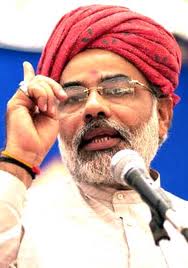
Cong builds house of dreams on Narendra Modi’s turf

August 21, 2012

Modi_TurfAhmedabad, August 21: Thousands of poor voters of Gujarat surged towards Congress camps for distributing forms for dirt-cheap urban housing — a promise the Congress has made only to women in a determined bid to prevent chief minister Narendra Modi from winning his third successive state election.

The scheme targets lower and lower-middle income groups in the cities and towns of Gujarat and gave a shot in the arm to the jaded Congress, just months away from the assembly elections. The Congress has not tasted power in Gujarat for more than two decades and the 'Ghar Nu Ghar' scheme was one of the aces it had up its sleeve to halt Modi's march to New Delhi in 2014 as a clear prime ministerial prospect.

There was commotion at form distribution centres and frayed nerves in the Modi camp when the distribution of forms began at 550 camps across Gujarat. The Congress, which marked Rajiv Gandhi's birthday with this blitzkrieg, has offered houses to be registered in the name of women. State Congress president Arjun Modhwadia said nearly 28 lakh forms were distributed in eight cities and 159 towns with a target of building 15 lakh homes in five years if the Congress was voted to power in the assembly elections due later this year.

"We have ordered for printing of 10 lakh more forms," senior Congress leader Narhari Amin said. Other Congress leaders were also pleasantly surprised at the mad rush, even as Modi went into a huddle with close aides. Even his 'Sadbhavana' towards Muslims seemed to be under threat as hundreds of Muslim women forgot the Eid festivities to queue up for the forms, which were available free on mere presentation of the voter's i-card.

BJP reacted by calling 'Ghar nu Ghar' a conspiracy to misguide the women voters of Gujarat. "Congress is in the habit of cheating people," said party spokesmen I K Jadeja and Mansukh Mandaviya. "In the last Lok Sabha election, they promised to check inflation within 100 days and look where we are today," Jadeja said.

The scheme seems to have hit the bull's eye as women are seen as more committed voters of Modi. Besides, the BJP has been traditionally stronger in urban areas of Gujarat. The Congress hopes that all those women who have taken the forms would elect it to power.

Housing for urban poor was a hallmark of previous Congress governments when the Gujarat Housing Board constructed precisely 1,76,830 homes in the 1970s and 1980s. Once the BJP came to power, the GHB went defunct and housing was a subject left to the builders.


Trouble for BJP on home front

The BJP had initially reacted with scorn at the Congress scheme 'Ghar nu Ghar'. Even chief minister Narendra Modi had brushed it aside stating that this was the brainchild of fly-by-night operators. But when the Congress launched the scheme on August 2, on the occasion of Rakshabandhan, nearly one lakh forms were distributed to women from the Gujarat Pradesh Congress Committee office in Ahmedabad and nine other centres across Gujarat.

The BJP had to sit up and take notice now. Former urban development minister I K Jadeja, now party spokesman, came with an announcement that the BJP will build 2.5 lakh houses for urban poor, once voted back to power. Questions were also raised by the BJP on where the Congress would get land for building these lakhs of houses. Congress campaign committee chief Shankersinh Vaghela had retorted that he would seize all the 'benami' land held by BJP leaders and also take back land gifted to large industrial houses.

Times View

The Congress has finally managed an emotional connect with the people of Gujarat with the 'Ghar nu Ghar' scheme. But it is after all an election promise and there is a massive gulf between the cup and the lip. What the Congress scheme has shown is that there is a massive demand for affordable housing in the state. The BJP has to explain why it has turned the Gujarat Housing Board, which built nearly 1.75 lakh affordable homes during previous Congress regimes, into a defunct entity. The GHB has to be revived and turned into the main agency to cater to the housing needs of those left without a dream home in this builder-driven set-up.


Comments

Add new comment

  • Coastaldigest.com reserves the right to delete or block any comments.
  • Coastaldigset.com is not responsible for its readers’ comments.
  • Comments that are abusive, incendiary or irrelevant are strictly prohibited.
  • Please use a genuine email ID and provide your name to avoid reject.
News Network
February 4,2020

New Delhi, Feb 4: Leader of Congress in Lok Sabha, Adhir Ranjan Chowdhury, on Tuesday attacked the BJP over Anantkumar Hegde's controversial remark on Mahatma Gandhi and termed the party as "Ravan ke aulad" (children of Ravana). "Aaj ye Mahatma Gandhi ko gaali dete hain. Ye Ravan ke aulad hain. Ram ke pujari ka ye apmaan kar rahe hain (Today, they abuse Mahatma Gandhi. They are children of Ravan. They are insulting Lord Ram's devotee)," Chowdhury said.

Later, BJP lawmakers object to Chowdhury's statement. Hegde, who is a Lok Sabha MP from Uttara Kannada, had on Saturday said that the freedom struggle led by Mahatma Gandhi was a "drama".

"None of these so-called leaders were beaten up by the cops even once. Their independence movement was one big drama. It was staged by these leaders with the approval of the British. It was not a genuine fight. It was an adjustment freedom struggle," Hegde had said while addressing a public event in Bengaluru. While several Congress leaders, including Karti Chidambaram and BK Hariprasad, have condemned Hegde's remark, BJP leaders too have distanced themselves from it.

Top leadership in BJP is unhappy with Anantkumar Hegde over his controversial remark on Mahatma Gandhi, party sources had said on Monday, adding that he has been asked to issue an unconditional apology.

Comments

Add new comment

  • Coastaldigest.com reserves the right to delete or block any comments.
  • Coastaldigset.com is not responsible for its readers’ comments.
  • Comments that are abusive, incendiary or irrelevant are strictly prohibited.
  • Please use a genuine email ID and provide your name to avoid reject.
News Network
June 12,2020

Jun 12: There have been complaints of non-availability of beds or denial of treatment to coronavirus patients in the national capital despite nearly 70 per cent of beds in five designated hospitals run by the Delhi government lying vacant, with experts attributing it to people''s aversion towards state-run facilities.

As per the latest information shared on the Delhi Corona app on Thursday afternoon, more than 3,000 beds are lying vacant in these five dedicated COVID-19 hospitals that have a total capacity of 4,344 beds.

However, almost all beds at several big private hospitals are shown to be occupied.

Families of many COVID-19 patients, confirmed or suspected, have alleged in the past few weeks that they have been denied admission at many facilities or have not been able to get a bed for their kin.

Medical and public health experts feel it may be because of the image associated with government hospitals, related to infrastructure and hygiene conditions, and perhaps shortage of staff.

According to the latest data available on Delhi Corona app on Thursday afternoon, a total of 9,444 beds are available in private facilities and hospitals run by the central and Delhi governments. Out of these, 4,371 are vacant.

The app shows that beds are available at Delhi government-run hospitals dedicated for COVID-19 treatment such as LNJP Hospital (1,219), GTB Hospital (1,314), Rajiv Gandhi Super Speciality Hospital or RGSSH (242).

However, almost all beds at several big private hospitals are shown to be occupied.

At LNJP Hospital, there are a total of 2,000 beds, out of these 781 are occupied. GTB Hospital has total 1,500 beds, only 186 of which are occupied. Even at RGSSH, 258 of the 500 beds are occupied.

Beds are available at other dedicated COVID-19 facilities in the national capital too, according to the app. Deep Chand Bandhu Hospital has 94 unoccupied beds out of a total 176 and Satyawadi Raja Harishchandra Hospital has 145 vacant beds out of a total 168.

This makes a total of 4,344 COVID-19 beds at these five dedicated Delhi government hospitals, out of which 3,014 or 69.38 per cent are vacant.

A senior doctor at the RGSSH said, "We are only admitting very serious COVID-19 patients in the hospital. Those with mild symptoms, or asymptomatic ones, are either being home quarantined or being sent to COVID Care Centres. Our beds are on stand-by also to accommodate serious patients in case there is a sudden rush."

Delhi Heath Minster Satyendar Jain had recently said that some private hospitals could have been denying admission, but the Delhi government-run hospitals have not denied beds to any needy COVID-19 patient.

He had also said that main private hospitals are almost full to their capacity in terms of number of COVID-19 beds.

According to the app, at prominent private hospitals like Indraprastha Apollo, Max Hospital in Shalimar Bagh, Fortis Hospital in Shalimar Bagh, BL Kapur Hospital are fully occupied.

Max Hospital in Saket has a total of 200 beds for COVID-19 patients, and only one is vacant.

On June 9, the Delhi government had directed 22 private hospitals in the national capital to dedicate a total of 2,015 extra beds for treatment of coronavirus patients, revising its earlier allocation limit of 20 per cent.

Lawyer and public heath activist Ashok Agarwal said infrastructure and hygiene are two main factors, and people still want to "avoid government facilities".

"I know of cases, where people were willing to be on waiting list of private hospitals but did not go to a government hospital, even though beds were available," he said.

Even those who went to a government hospital for COVID-19 treatment, complained of "dirty toilets, and these being used by multiple patients", Agarwal said.

"Also, as the cases erupted successively over the months, many people got scared and were in two minds to go to a government hospital, as admitted patients were making allegations in videos and on social media about lack of proper services. Besides, there is shortage of medical staff at various facilities, and each patient needs to be attended to," he argued.

Delhi government hospitals and private facilities were directed to prominently display information about the availability of beds on a flex board at their main gates.

Delhi Lt Governor Anil Baijal on Wednesday ordered Delhi hospitals to display the availability of COVID and non-COVID beds, charges for rooms or beds along with contact details on a LED board outside the hospital.

Max Hospital sources said they were already displaying the status of beds on LED screens near their reception area even before the government order.

A spokesperson from Fortis Hospital said, "We are in the process of arranging to put up the displays as per the prescribed format."

Delhi recorded 1,501 fresh coronavirus cases on Wednesday, taking the COVID-19 tally in the city to over 32,000, and the death toll due to the disease mounted to 984, authorities said.

Comments

Add new comment

  • Coastaldigest.com reserves the right to delete or block any comments.
  • Coastaldigset.com is not responsible for its readers’ comments.
  • Comments that are abusive, incendiary or irrelevant are strictly prohibited.
  • Please use a genuine email ID and provide your name to avoid reject.
Agencies
August 4,2020

New Delhi, Aug 4: Over 50 per cent of COVID-19 deaths in India have taken place among people aged 60 years and above and 37 per cent deaths have been reported among patients in the age group of 45 to 60 years, Health Ministry said on Tuesday.

Addressing a press conference, Rajesh Bhushan, Secretary, Health Ministry said that 11 per cent COVID-19 deaths took place in the age group of 26 to 44.

The 18 to 25 age group and those below 18 years reported one per cent deaths each.
"Currently, 5,86,298 active COVID-19 cases are in India and over 12 lakh people have recovered.

50 per cent deaths due to COVID19 have taken place among the age group of 60 years or above and 37 per cent deaths took place in the age group between 45 to 60 years," Bhushan said.

"A total of 11 per cent COVID-19 deaths took place in the age group of 26 to 44. Only 1 per cent in 18 to 25 age group and 1 per cent in below the age of 18 years," he added.

Bhushan said that 68 per cent of COVID-19 deaths have been reported among male patients and 32 per cent among female patients which is broadly in line with the global scenario.

The number of recovered COVID-19 patients in India is increasing daily and is now over double the number of active cases.

Bhushan said that the case fatality rate (CFR) is lowest since the first lockdown.

"More than 2 crore COVID-19 tests have been conducted, including more than 6.6 lakh tests in the last 24 hours. Recovered cases are now double of the active cases. 

The case fatality rate (CFR) is lowest since the first lockdown," he said
"This is the first time after the first lockdown that the fatality rate is at the lowest, at 2.10 per cent. The fatality rate has seen a progressive decline and it is continuing, which is a good sign," he added.

According to the World Health Organisation, CFR is a measure of the severity of a disease and is defined as the proportion of reported cases of a specified disease or condition which are fatal within a specified time.

Comments

Add new comment

  • Coastaldigest.com reserves the right to delete or block any comments.
  • Coastaldigset.com is not responsible for its readers’ comments.
  • Comments that are abusive, incendiary or irrelevant are strictly prohibited.
  • Please use a genuine email ID and provide your name to avoid reject.