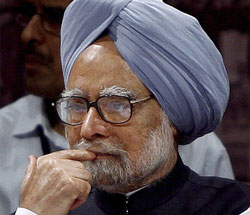
Coalgate: BJP to continue to press for PM's resignation

August 21, 2012

pmsingh

New Delhi, August 21: BJP today defended its decision to demand Prime Minister Manmohan Singh's resignation in the alleged irregularities in coal blocs allocation, saying it owes it to the people in the wake of "regular occurence" of scams and insisted it will continue to press for his removal.

"In both Houses of Parliament today, we demanded Prime Minister Manmohan Singh's resignation. We will continue to strongly press for it as the coal allocation issue is not an isolated incident.

The 2G spectrum issue, Commonwealth Games scam, public-private partnership issue of airports and now the coal blocks," Deputy Leader of BJP in Rajya Sabha Ravi Shankar Prasad told reporters.

He alleged these cases demonstrate that the Manmohan Singh government is one of "scam, shame, scandals, corruption and loot and that BJP is levelling these charges with all responsibility.

Claims by Congress of having taken action against corruption are "absolutely hollow", BJP charged. The party maintained that it was due to opposition pressure, media campaign and intervention of the judiciary that action was taken.

On coal allocation issue, BJP said Singh had held the Coal portfolio for five years since UPA came to power in 2004 and is hence responsible for the loss of revenue of Rs 1.86 lakh crore estimated by CAG.

He indicated BJP will continue to press for Singh's resignation in Parliament in the coming days.

"If scams keep happening with such regularity, we owe it to the people to demand the Prime Minister's resignation," Prasad said.

"This whole alibi of shifting the blame on states (on coal allocation) is completely untenable and motivated," Prasad said.

BJP also rubbished Congress' claim that the screening committee formed to look into the coal block allocations was opposed to auctions. Prasad said the decision has to get the assent of the PM and hence he is complicit.

Prasad said the decision to go for auction of coal blocks was taken in 2004 but it has not been implemented though eight years have passed.

The BJP leader said though the process did not start, the value of shares went up bringing "windfall gains" to those who were allocated the coal blocks.

Asked why BJP was not agreeing to a debate on coal allocation issue, the party maintained it does not bear the required results as discussions had taken place in Parliament on 2G spectrum issue, alleged involvement of then Finance Minister P Chidambaram in Aircel-Maxis deal and the Commonwealth Games scams but nothing much was done.

The main opposition is also unhappy about the manner in which some of the ruling party members of the Joint Parliamentary Committee are "not allowing" it to work effectively.

Earlier, Parliament's Public Accounts Committee had also faced a lot of opposition from the ruling party members when the body was discussing the CAG report on 2G spectrum.

This has firmed up the opposition resolve to demand PM's resignation in the coal allocation scam, Prasad said.

Comments

Add new comment

  • Coastaldigest.com reserves the right to delete or block any comments.
  • Coastaldigset.com is not responsible for its readers’ comments.
  • Comments that are abusive, incendiary or irrelevant are strictly prohibited.
  • Please use a genuine email ID and provide your name to avoid reject.
News Network
June 5,2020

New Delhi, Jun 5: On World Environment Day, Prime Minister Narendra Modi on Friday urged citizens to ensure that the flora and fauna thrive and take a pledge to preserve our planet's rich biodiversity.

"On #WorldEnvironmentDay, we reiterate our pledge to preserve our planet's rich biodiversity. Let us collectively do whatever possible to ensure the flora and fauna with whom we share the Earth thrive. May we leave an even better planet for the coming generations," the Prime Minister tweeted.

He also shared a clip from his last 'Mann Ki Baat' programme where he mentioned about conservation of rainwater and protecting the rich diversity of nature.

"On June 5, the entire world will celebrate 'World Environment Day'. The theme for this year's 'World Environment Day' is bio-diversity. This theme is especially pertinent in the current circumstances. During lockdown in the last few weeks the pace of life may have slowed down a bit but it has also given us an opportunity to introspect upon the rich diversity of nature or biodiversity around us," the Prime Minister had said.

"Much of the avian fauna had sort of disappeared due to sound and air pollution, and now after years people can once again listen to their melodic chirping in their homes," he said.

The Prime Minister also said that water conservation, in particular the conservation of rainwater, is essential and exhorted everyone to strive for saving rainwater in the upcoming monsoons.

Comments

Add new comment

  • Coastaldigest.com reserves the right to delete or block any comments.
  • Coastaldigset.com is not responsible for its readers’ comments.
  • Comments that are abusive, incendiary or irrelevant are strictly prohibited.
  • Please use a genuine email ID and provide your name to avoid reject.
Agencies
May 27,2020

New Delhi, May 27: India’s fourth recession since Independence, first since liberalisation, and perhaps the worst to date is here, according to rating agency, Crisil.

CRISIL sees the Indian economy shrinking 5 per cent in fiscal 2021 (on-year), because of the Covid-19 pandemic. The first quarter will suffer a staggering 25 per cent contraction.

About 10 per cent of gross domestic product (GDP) in real terms could be permanently lost. "So going back to the growth rates seen before the pandemic is unlikely in the next three fiscals", Crisil said.

Crisil has revised its earlier forecast downwards. "Earlier, on April 28, we had slashed our prediction to 1.8 per cent growth from 3.5 per cent growth. Things have only gone downhill since", it said.

While we expect non-agricultural GDP to contract 6 per cent, agriculture could cushion the blow by growing at 2.5 per cent.

In the past 69 years, India has seen a recession only thrice as per available data in fiscals 1958, 1966 and 1980. The reason was the same each time a monsoon shock that hit agriculture, then a sizeable part of the economy.

"The recession staring at us today is different," it added. For one, agriculture could soften the blow this time by growing near its trend rate, assuming a normal monsoon. Two, the pandemic-induced lockdowns have affected most non-agriculture sectors. And three, the global disruption has upended whatever opportunities India had on the exports front.

Economic conditions have slid precipitously since the April-end forecast of 1.8 per cent GDP growth for fiscal 2021 (baseline), Crisil said.

On the lockdown extension, it said that the government has extended the lockdown four times to deal with the rising number of cases, curtailing economic activity severely (lockdown 4.0 is ending on May 31).

The first quarter of this fiscal will be the worst affected. June is unlikely to see major relaxations as the Covid-19 affliction curve is yet to flatten in India.

"Not only will the first quarter be a washout for the non-agricultural economy, services such as education, and travel and tourism among others, could continue to see a big hit in the quarters to come. Jobs and incomes will see extended losses as these sectors are large employers," Crisil said.

CRISIL also foresees economic activity in states with high Covid-19 cases to suffer prolonged disruption as restrictions could continue longer.

A rough estimate based on a sample of eight states, which contribute over half of India's GDP, shows that their 'red zones' (as per lockdown 3.0) contributed 42 per cent to the state GDP on average regardless of the share of such red zones.

On average, the orange zones contribute 46 per cent, while the green zones where activity is allowed to be close to normal contribute only 12 per cent to state GDP.

The economic costs are higher than earlier expectations, according to Crisil. The economic costs now beginning to show up in the hard numbers are far worse than initial expectations.

Industrial production for March fell by over 16%. The purchasing managers indices for the manufacturing and services sectors were at 27.4 and 5.4, respectively, in April, implying extraordinary contraction. That compares with 51.8 and 49.3, respectively, in March.

Exports contracted 60.3 per cent in April, and new telecom subscribers declined 35 per cent, while railway freight movement plunged 35 per cent on-year.

"Indeed, given one of the most stringent lockdowns in the world, April could well be the worst performing month for India this fiscal," it said.

Added to that is the economic package without enough muscle. The government recently announced a Rs 20.9 lakh crore economic relief package to support the economy. The package has some short-term measures to cushion the economy, but sets its sights majorly on reforms, most of which will have payoffs only over the medium term.

"We estimate the fiscal cost of this package at 1.2 per cent of GDP, which is lower than what we had assumed in our earlier estimate (when we foresaw a growth in GDP)," it said.

"We believe a catch-up to the pre-crisis trend level of GDP growth will not be possible in the next three fiscals despite policy support. Under the base case, we estimate a 10 per cent permanent loss to real GDP (from the decadal-trend level), assuming average growth of about 7 per cent between fiscals 2022 and 2024," Crisil said.

Interestingly, after the Global Financial Crisis (GFC), a sharp growth spurt helped catch up with the trend within two years. GDP grew 8.2 per cent on average in the two fiscals following the GFC. Massive fiscal spending, monetary easing and swift global recovery played a role in a V-shaped recovery.

To catch-up would require average GDP growth to surge to 11 per cent over the next three fiscals, something that has never happened before.

The research said that successive lockdowns have a non-linear and multiplicative effect on the economy a two-month lockdown will be more than twice as debilitating as a one-month imposition, as buffers keep eroding.

Partial relaxations continue to be a hindrance to supply chains, transportation and logistics. Hence, unless the entire supply chain is unlocked, the impact of improved economic activity will be subdued.

Therefore, despite the stringency of lockdown easing a tad in the third and the fourth phases, their negative impact on GDP is expected to massively outweigh the benefits from mild fiscal support and low crude oil prices, especially in the April-June quarter. "Consequently, we expect the current quarter's GDP to shrink 25 per cent on-year," it said.

Counting lockdown 4.0, Indians have had 68 days of confinement. S&P Global estimates that one month of lockdown shaves 3 per cent off annual GDP on average across Asia-Pacific.

Since India's lockdown has been the most stringent in Asia, the impact on economic growth will be correspondingly larger.

Google's Community Mobility Reports show a sharp fall in movement of people to places of recreation, retail shops, public transport and workplace travel. While data for May shows some improvement in India, mobility trends are much below the average or baseline, and lower compared with countries such as the US, South Korea, Brazil and Indonesia.


Comments

Add new comment

  • Coastaldigest.com reserves the right to delete or block any comments.
  • Coastaldigset.com is not responsible for its readers’ comments.
  • Comments that are abusive, incendiary or irrelevant are strictly prohibited.
  • Please use a genuine email ID and provide your name to avoid reject.
News Network
February 5,2020

New Delhi, Feb 5: Union Home Minister Amit Shah on Tuesday announced that the Shri Ram Janmabhoomi Teertha Kshetra, set up by the government for construction of a temple in Ayodhya, will have 15 trustees and one of them will be from the Dalit community.

The statement comes a little over an hour after Prime Minister Narendra Modi announced in Lok Sabha about the constitution of the trust.

"There will be 15 trustees in the Shri Ram Janmabhoomi Teertha Kshetra Trust out of which one trustee will always be from the Dalit society," he tweeted.

Shah congratulated Modi "for such an unprecedented decision" that strengthens social harmony.

The home minister said the trust will be independent to take every decision related to the temple and 67 acres of land will be transferred to it.

"I fully believe that the waiting of millions of people for centuries will be over soon and they will be able to pay obeisance to Lord Shri Ram in his grand temple at his birthplace," he said.

Comments

Add new comment

  • Coastaldigest.com reserves the right to delete or block any comments.
  • Coastaldigset.com is not responsible for its readers’ comments.
  • Comments that are abusive, incendiary or irrelevant are strictly prohibited.
  • Please use a genuine email ID and provide your name to avoid reject.