


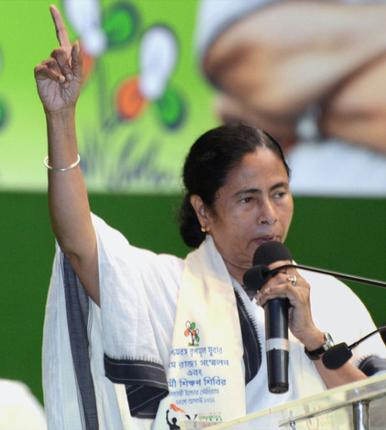
Mamata warns media against ‘spreading lies’

August 26, 2012
mma
Kolkata, August 26: Even as she claimed that no government in the world had ushered in so much development as her administration since it came to power last year, West Bengal Chief Minister Mamata Banerjee on Saturday continued her tirade against a section of the media and said the police would register cases against “those who are spreading lies.”

It was spreading canards against her government, she alleged and cautioned it against being a “nuisance” or transgressing its limits.

“Do not teach me about law. I am aware of the codes of the police, media and even political parties,” Ms. Banerjee said while addressing the first convention of Trinamool Yuva — the party’s youth wing.

Alleging that this section of the media was paying people to entice them into making false allegations against her government, she said political parties were being used as “guinea pigs” for the business interests of media houses.

Ms. Banerjee urged the Trinamool Yuva representatives to use social networking sites to counter the misleading, anti-government campaign with well-argued statements. “The most important work of the Trinamool Yuva is building up the party’s image.”

Highlighting the various activities taken up by her government, she said peace was restored in Darjeeling and Jangalmahal but her critics persisted with hollow allegations.

“Those who underestimate the Trinamool Congress should bear in mind that the party will be a force to reckon with at the all-India level.”

Criticism against the government started with infant deaths in state-run hospitals, followed by ‘farmer suicides’ where any suicide was labelled as that of a farmer, and now there was a conspiracy to insult women by referring to the frequent rape cases, Ms. Banerjee said.

She assured the people that action would be taken against any genuine incident of crime against women, but said it was becoming difficult to ascertain whether there was truth in such allegations.

Stating that it had been only a year since the Left Front government was voted out of power, Ms. Banerjee asserted that “people will not forgive those who are working as agents to bring them back to power.”

Police complaints would have to be made and strong action should be taken, as documents and files related to the Left Front government had gone missing, she added.

Comments

Add new comment

  • Coastaldigest.com reserves the right to delete or block any comments.
  • Coastaldigset.com is not responsible for its readers’ comments.
  • Comments that are abusive, incendiary or irrelevant are strictly prohibited.
  • Please use a genuine email ID and provide your name to avoid reject.
News Network
January 9,2020

Mumbai, Jan 9: India's weddings are famously lavish -- lasting days and with hundreds if not thousands of guests -- but this season many families are cutting costs even if it risks their social standing.

It is symptomatic of a sharp slowdown in the world's fifth-largest economy, with Indians spending less on everything from daily essentials to once-in-a-lifetime celebrations.

Growth has hit a six-year low and unemployment a four-decade high under Prime Minister Narendra Modi. Prices are rising too, squeezing spending on everything from shampoo to mobile data.

Chartered accountant Palak Panchamiya, for example, has already slashed the budget on her upcoming Mumbai nuptials by a third, trimming spending on clothing and the guest list.

"Initially I chose a dress that cost 73,000 rupees ($1,000)," Panchamiya told news agency as she picked through outfits at a recent marriage trade fair.

"But my partner felt it was too expensive, and so now I am here reworking my options and looking for something cheaper."

India's massive wedding industry is worth an estimated $40-50 billion a year, according to research firm KPMG.

The celebrations can last a week and involve several functions, a dazzling variety of cuisines, music and dance performances, and lots of gifts.

Foreigners can even buy tickets to some events.

But these days, except for the super-rich -- a recent Ambani family wedding reportedly cost $100 million -- extravagance is out and frugality is in as families prioritise saving.

"Earlier Indian weddings were like huge concerts, but now things have changed," said Maninder Sethi, founder of Wedding Asia, which organises marriage fairs around the country.

Cracks emerged in 2016 when the Indian wedding season, which runs from September to mid-January, was hit by the government's shock withdrawal of vast amounts of banknotes from circulation in a bid to crack down on undeclared earnings.

Mumbai-based trousseau maker Sapna Designs Studio shut for months as the economy was turned on its head by Modi's move.

"No exhibitions were happening and there were no avenues for us to sell either," said Vishal Hariyani, owner of the clothing studio.

Hopes for a recovery proved short-lived when the cash ban was followed by a botched rollout of a nationwide goods and services tax (GST) in 2017 that saw many small-scale businesses close.

Since then, keeping his studio afloat has been a challenge, with consumers increasingly reluctant to spend too much, says Hariyani.

"We customise our clothes as per their budgets, and now week-long weddings have been converted to just a 36-hour ceremony," he told news agency.

"We have to pay GST, pay workers and even offer discounts to customers," he added.

"The whole economy has slowed down and reduced spending on weddings is a by-product of that. Everyone except the super-rich are affected," Pradip Shah from IndAsia Fund Advisors told news agency.

"It is reflective of how sombre the mood is," he said.

In a country where families traditionally spend heavily on weddings -- including taking on debt in some cases -- the downturn is also a source of sadness and shame, with elaborate celebrations often seen as a measure of social status.

"We haven't even invited our neighbours. It is embarrassing but the current situation doesn't offer us much respite," 52-year-old Tara Shetty said ahead of her son's wedding.

"In my era, we always spent a lot and had thousands of people attending the weddings," she explained.

"My wedding was supremely grand, and now my son's is the polar opposite."

Comments

Add new comment

  • Coastaldigest.com reserves the right to delete or block any comments.
  • Coastaldigset.com is not responsible for its readers’ comments.
  • Comments that are abusive, incendiary or irrelevant are strictly prohibited.
  • Please use a genuine email ID and provide your name to avoid reject.
News Network
January 7,2020

Jan 7: India’s monetary authority allowed banks to offer foreign-currency transactions outside of local market hours, a move aimed at boosting trading volumes at home.

Interbank deals, as well as those with customers in and outside India, can be undertaken by banks or their overseas branches and units at all times, the Reserve Bank of India said in a statement late Monday. It stopped short of saying whether the timing of the onshore over-the-counter market has been extended from the current 9 a.m. to 5 p.m.

The move is in line with recent recommendations to reverse the trend of the partially convertible rupee being traded more abroad than in India. London has overtaken Mumbai to become the top center for trading the rupee, adding to a sense of urgency among local authorities to deepen the onshore market.

Average daily volumes for rupee in the U.K. soared to $46.8 billion in April, a more than fivefold jump from $8.8 billion in 2016, according to a survey from the Bank for International Settlements published in September. That exceeded the $34.5 billion recorded in India.

Analysts say more trading abroad could amplify volatility in the domestic market and reduce the effectiveness of policy actions.

India’s decision comes as the London Stock Exchange Group Plc has started asking market participants if they want the bourse to function fewer hours, signaling it’s open to an argument driven by changing trading patterns and calls for a better work-life balance.

Comments

Add new comment

  • Coastaldigest.com reserves the right to delete or block any comments.
  • Coastaldigset.com is not responsible for its readers’ comments.
  • Comments that are abusive, incendiary or irrelevant are strictly prohibited.
  • Please use a genuine email ID and provide your name to avoid reject.
News Network
May 27,2020

Mumbai, May 27: The Maharashtra government on Tuesday ordered re investigation by the CID into the suicide of a 53-year-old interior designer and his mother, allegedly over non-payment of dues by TV journalist Arnab Goswami and two others.

State Home Minister Anil Deshmukh said he ordered re investigation after Adnya Naik, daughter of interior designer Anvay Naik, claimed that Alibag Police in neighbouring Raigad district did not probe the non-payment of dues which had driven her father and grandmother to suicide.

"Adnya Naik had complained to me that #AlibaugPolice had not investigated non-payment of dues from #ArnabGoswami's @republic which drove her entrepreneur father & grandmom to suicide in May 2018," Deshmukh tweeted.

"I've ordered a CID re-investigation of the case," the minister, an NCP leader, added.

He also used the hashtag "Maharashtra government cares" while sharing the tweet. Earlier this month, the police registered an abetment of suicide case against Republic TV editor-in-chief Goswami and two others.

The suicide note purportedly written by Anvay Naik, managing director of Concorde Designs Private Limited, said he was forced to take his life as he was not paid dues of Rs 5.40 crore by the three accused.

Republic TV denied the allegation and said that certain vested interest groups were running "a false and malicious campaign and making false statements and innuendos against the company by exploiting the tragic event".

Mumbai Police are also conducting a probe against Goswami over his statements about the Palghar lynching case of April this year.

Comments

Add new comment

  • Coastaldigest.com reserves the right to delete or block any comments.
  • Coastaldigset.com is not responsible for its readers’ comments.
  • Comments that are abusive, incendiary or irrelevant are strictly prohibited.
  • Please use a genuine email ID and provide your name to avoid reject.