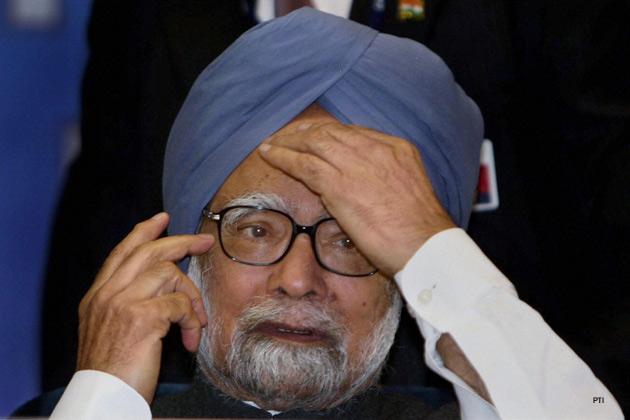
My silence is better than a thousand answers: Manmohan Singh

August 27, 2012

silent_mohan

New Delhi, August 27: Often at the receiving end of opposition's silence jibe, Prime Minister Manmohan Singh today invoked an Urdu couplet to hit back at his critics.

"Hazaron jawabo se achchi hai khamoshi meri, na jaane kitne sawalo ki aabru rakhe. (My silence is better than a thousand answers, it keeps intact the honour of innumerable questions)," Singh said reciting the couplet, asserting this has been his "general attitude".

"It has been my general practice not to respond to motivated criticism directed personally at me," he added.

The Prime Minister's remarks came outside Parliament on a day he read out amid din in both the Houses his statement on the controversial coal block allocations.

But the Prime Minister's way of sending a message across on his silence did not convince BJP leader and Leader of the Opposition in the Lok Sabha Sushma Swaraj.

Taking a jibe at the prime minister, Sushma said the questions were so pointed that he would have been embarrassed in answering them and that was why he chose to remain silent.

"Really the questions were so harsh and straightforward that by answering them he would have embarrassed himself and that's why you(prime minister) preferred to keep silent," she added.


Comments

Add new comment

  • Coastaldigest.com reserves the right to delete or block any comments.
  • Coastaldigset.com is not responsible for its readers’ comments.
  • Comments that are abusive, incendiary or irrelevant are strictly prohibited.
  • Please use a genuine email ID and provide your name to avoid reject.
News Network
July 1,2020

Jul 1: Gold prices in India hit an all-time high on Wednesday, tracking a global rally, as surging coronavirus cases in many countries raised the metal's safe-haven appeal.

Local gold futures hit an all-time high of Rs 48,871 ($646.66) per 10 grams in early trade, taking their gains to 25% in 2020 so far. The contract had gained nearly 25% in 2019.

However, this dampened the retail demand for gold in India, the world's second-largest consumer of the precious metal.

"Retail demand is negligible. Buyers are postponing purchases anticipating a correction in prices," said a Mumbai-based bank dealer with a bullion importing bank.

In thin trade, dealers were offering a discount of up to $22 an ounce over official domestic prices on Wednesday afternoon, up from the last week's $18. The domestic price includes a 12.5% import tax and 3% sales tax.

The country's gold imports in May plunged 99% from a year earlier as international air travel was banned and jewellery shops were closed amid a nationwide lockdown to curb the spread of coronavirus.

In overseas market, spot gold firmed near an eight-year peak on Wednesday, as a spike in coronavirus cases in the United and States and many other countries has cast a shadow on hopes for a quicker global economic recovery, driving inflows into safe-haven assets.

According to a latest Reuters tally, the coronavirus has infected more than 10.48 million people worldwide so far.

Comments

Add new comment

  • Coastaldigest.com reserves the right to delete or block any comments.
  • Coastaldigset.com is not responsible for its readers’ comments.
  • Comments that are abusive, incendiary or irrelevant are strictly prohibited.
  • Please use a genuine email ID and provide your name to avoid reject.
News Network
January 14,2020

New Delhi, Jan 14: The curative petitions of Vinay Sharma and Mukesh, who were sentenced to death in the Nirbhaya gang rape and murder case, was on Tuesday rejected by a five-judge Supreme Court Bench led by Justice N.V. Ramana.

In a three-page order, the Bench concluded, after an in chamber consideration that began about 1.45 p.m., that there was no merit in their pleas to spare them from the gallows.

“We have gone through the curative petitions and relevant documents. In our opinion, no case is made out within the parameters indicated in the decision of this Court in Rupa Ashok Hurra versus Ashok Hurra. Hence, the curative petitions are dismissed,” the court held.

Curative is a rare remedy devised by a Constitution Bench of the Supreme Court in its judgment in the Rupa Ashok Hurra case in 2002. A party can take only two limited grounds in a curative petition - one, he was not heard by the court before the adverse judgment was passed, and two, the judge was biased. A curative plea, which follows the dismissal of review petition, is the last legal avenue open for convicts in the Supreme Court. Sharma was the first among the four convicts to file a curative.

The Bench also rejected their pleas to stay the execution of their death sentence and for oral hearing in open court.

Besides Justice Ramana, the Bench comprised Arun Mishra, Rohinton Nariman, R. Banumathi and Ashok Bhushan.

Curative petitions were filed in the Supreme Court by both convicts on January 9. The petitions had come just days after a Delhi sessions court schedulled the execution of all the four convicts in Tihar jail on January 22.

Sharma and Mukesh, in separate curative petitions, argued that there was a “sea change” in the death penalty jurisprudence since their convictions. Carrying out the death sentence on such changed circumstances would be a “gross miscarriage of justice”.

In his plea, Sharma said the Court had commuted the death penalty in several rape and murder cases since 2017, when it first confirmed the death penalty to the Nirbhaya convicts.

“fter the pronouncement of judgment in 2017, there have been as many as 17 cases involving rape and murder in which various three-judge Benches of the Supreme Court have commuted the sentence of death,” the petition contended.

The Supreme Court recently dismissed a review petition filed by Akshay Singh, another of the four four condemned men, to review its May 5, 2017 judgment confirming the death penalty. It also refused his plea to grant him three weeks' time to file a mercy petition before the President of India.

A Bench led by Justice R. Banumathi had said it was open for the Nirbhaya case convicts to avail whatever time the law prescribes for the purpose of filing a mercy plea.

Akshay (33), Mukesh (30), Pawan Gupta (23) and Sharma (24) had brutally gang-raped a 23-year-old paramedical student in a moving bus on the intervening night of December 16-17, 2012. She died of her injuries a few days later.

The case shocked the nation and led to the tightening of anti-rape laws. Rape, especially gang rape, is now a capital crime.

One of the accused in the case, Ram Singh, allegedly committed suicide in the Tihar jail. A juvenile, who was among the accused, was convicted by a juvenile justice board. He was released from a reformation home after serving a three-year term.


Comments

Add new comment

  • Coastaldigest.com reserves the right to delete or block any comments.
  • Coastaldigset.com is not responsible for its readers’ comments.
  • Comments that are abusive, incendiary or irrelevant are strictly prohibited.
  • Please use a genuine email ID and provide your name to avoid reject.
News Network
March 29,2020

Mumbai, Mar 29: Virologist Minal Dakhave Bhosale led from the front to create India's first coronavirus testing kit even when she was in the last stage of her pregnancy.

Bhosale's efforts paid the price with her team delivering the testing kit in a record time of six weeks.

Bhosale gave birth to a baby girl just a day before submitting the kit to the authorities for evaluation.

"It was like giving birth to two babies," Bhosale told PTI over the phone.

The virologist said both the journeys - that happened in parallel - were not without challenges.

"There were complications in the pregnancy while work on the test kit was on. The baby was delivered through cesarean," she said.

Bhosale said she felt that it was the right time to serve the people to help them in combating the coronavirus threat.

"I had been working for five years in this field and if I don't work in emergency situations when my services are needed the most, then what is the use?" she said.

Though Bhosale was not able to visit the office due to the pregnancy, she was guiding a team of 10 persons working on the project at Mylab Discovery in Pune.

The strong bonds forged with the team over the years and their support made it possible, she said.

Company's co-founder Shrikant Patole said just like drug discovery, test kits too go through a lot of quality checks to improve the precision.

He credited Bhosale for the success of the project.

The COVID-19 testing kit delivered by Bhosale's team will reduce the time taken for delivering a result to 2.5 hours from the prevalent practice of eight hours.

A pioneering approach to testing without compromising on the results was adopted, Bhosale said.

The Maylab test kit will cost Rs1,200, a quarter of Rs 4,500 per kit that the government has been spending on testing so far.

"I'm happy that I could do something for the country," Bhosale said.

As of Friday, only 27,000 of the 1.3 billion people were tested for the virus in the country.

According to experts, high scale testing is essential because it alone can ensure an early diagnosis of COVID-19 and lower down the fatalities.

The company is confident of ramping up the capacity at its plant in Lonavala to deliver 100,000 kits a week, Patole said.

He said the authorities are helping the company, including giving priority for shipping of the raw materials.

Comments

Add new comment

  • Coastaldigest.com reserves the right to delete or block any comments.
  • Coastaldigset.com is not responsible for its readers’ comments.
  • Comments that are abusive, incendiary or irrelevant are strictly prohibited.
  • Please use a genuine email ID and provide your name to avoid reject.