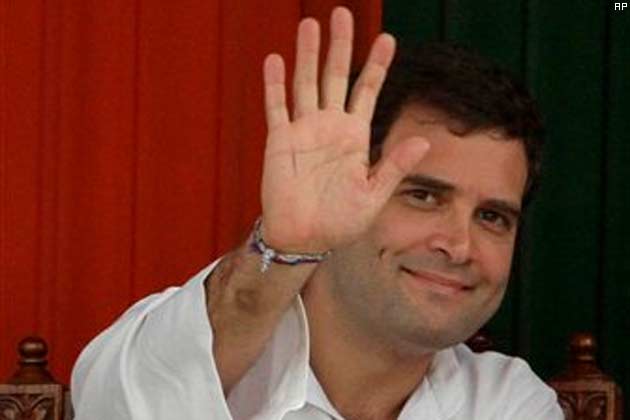
Congress may use Coalgate to make Rahul PM: SP

August 28, 2012

rahul_pm

New Delhi, August 28: Samajwadi Party, which is supporting UPA from outside, today saw "internal Congress politics" behind the disruptions by the BJP in Parliament wondering whether it was for replacing Prime Minister Manmohan Singh with Rahul Gandhi.

"Some people from inside Congress want to remove Manmohan Singh and bring in the Yuvraaj. I have my doubts if this politics (demand of PMs resignation by BJP) is being played out from within Congress," senior SP leader Mohan Singh said.

Congress, however, outrightly rejected this statement with party general secretary Janardan Dwivedi saying, "There can be no bigger false imagination than this."

"The party has repeated this several times...before 2009 elections, said in our manifesto that our Prime Ministerial candidate is Manmohan Singh. After that also, we have said this several times that he will continue to remain the Prime Minister till 2014. He (Mohan Singh) should not bother about this," he said.

Regretting the repeated adjournment of Parliament, Singh alleged BJP was raking up the CAG report to prepare the grounds for the coming elections.

Meanwhile, SP General Secretary Ramgopal Yadav refused to offer any comments on the remarks made by party leader Mohan Singh.


Comments

Add new comment

  • Coastaldigest.com reserves the right to delete or block any comments.
  • Coastaldigset.com is not responsible for its readers’ comments.
  • Comments that are abusive, incendiary or irrelevant are strictly prohibited.
  • Please use a genuine email ID and provide your name to avoid reject.
Agencies
July 6,2020

New Delhi, Jul 6: The Indian Academy of Sciences, a Bengaluru-based body of scientists, has said the Indian Council for Medical Research's (ICMR) target to launch a coronavirus vaccine by August 15 is "unfeasible" and "unrealistic".

The IASc said while there is an unquestioned urgent need, vaccine development for use in humans requires scientifically executed clinical trials in a phased manner.

While administrative approvals can be expedited, the "scientific processes of experimentation and data collection have a natural time span that cannot be hastened without compromising standards of scientific rigour", the IASc said in a statement.

In its statement, the IASc referred to the ICMR's letter which states that "it is envisaged to launch the vaccine for public health use latest by 15th August 2020 after completion of all clinical trials".

The ICMR and Bharat Biotech India Limited, a private pharmaceutical company, are jointly developing the vaccine against the novel coronavirus -- SARS-CoV-2.

The IASc welcomes the exciting development of a candidate vaccine and wishes that the vaccine is quickly made available for public use, the statement said.

"However, as a body of scientists including many who are engaged in vaccine development IASc strongly believes that the announced timeline is unfeasible. This timeline has raised unrealistic hope and expectations in the minds of our citizens," it said.

Aiming to launch an indigenous COVID-19 vaccine by August 15, the ICMR had written to select medical institutions and hospitals to fast-track clinical trial approvals for the vaccine candidate, COVAXIN.

Experts have also cautioned against rushing the process for developing a COVID-19 vaccine and stressed that it is not in accordance with the globally accepted norms to fast-track vaccine development for diseases of pandemic potential.

The IASc said trials for a vaccine involve evaluation of safety (Phase 1 trial), efficacy and side effects at different dose levels (Phase 2 trial), and confirmation of safety and efficacy in thousands of healthy people (Phase 3 trial) before its release for public use.

Clinical trials for a candidate vaccine require participation of healthy human volunteers. Therefore, many ethical and regulatory approvals need to be obtained prior to the initiation of the trials, it added.

The IASc said the immune responses usually take several weeks to develop and relevant data should not be collected earlier.

"Moreover, data collected in one phase must be adequately analysed before the next phase can be initiated. If the data of any phase are unacceptable then the clinical trial is required to be immediately aborted," it said.

For example, if the data collected from Phase 1 of the clinical trial show that the vaccine is not adequately safe, then Phase 2 cannot be initiated and the candidate vaccine must be discarded.

For these reasons, the Indian Academy of Sciences believes that the announced timeline is "unreasonable and without precedent", the statement said.

"The Academy strongly believes that any hasty solution that may compromise rigorous scientific processes and standards will likely have long-term adverse impacts of unforeseen magnitude on citizens of India," it said.


Comments

Add new comment

  • Coastaldigest.com reserves the right to delete or block any comments.
  • Coastaldigset.com is not responsible for its readers’ comments.
  • Comments that are abusive, incendiary or irrelevant are strictly prohibited.
  • Please use a genuine email ID and provide your name to avoid reject.
News Network
July 18,2020

Ayodhya, Jul 18: The Shri Ram Janmabhoomi Teertha Kshetra Trust has invited Prime Minister Narendra Modi to lay the foundation stone of a grand Ram Temple in Ayodhya either on August 3 or 5, both auspicious dates, said a spokesperson.

PM Modi had announced the formation of the Shri Ram Janmabhoomi Teertha Kshetra Trust on February 5.

Mahant Kamal Nayan Das, the spokesperson of Ram Mandir Trust president Nritya Gopal Das said, "We have suggested two auspicious dates -- August 3 and 5 -- for the prime minister's visit based on calculations of movements of stars and planets."

After a protracted legal tussle, the Supreme Court had on November 9 last year paved the way for the construction of a Ram Temple by a Trust at the disputed site in Ayodhya and directed the Centre to allot an alternative 5-acre plot to the Sunni Waqf Board for building a new mosque at a "prominent" place in the holy town in Uttar Pradesh.

Comments

Add new comment

  • Coastaldigest.com reserves the right to delete or block any comments.
  • Coastaldigset.com is not responsible for its readers’ comments.
  • Comments that are abusive, incendiary or irrelevant are strictly prohibited.
  • Please use a genuine email ID and provide your name to avoid reject.
Agencies
July 15,2020

New Delhi, Jul 15: Air India has started the process of identifying employees, based on various factors like efficiency, health and redundancy, who will be sent on compulsory leave without pay (LWP) for up to five years, according to an official order.

The airline's board of directors have authorised its Chairman and Managing Director Rajiv Bansal to send employees on LWP "for six months or for a period of two years extendable upto five years, depending upon the following factors - suitability, efficiency, competence, quality of performance, health of the employee, instance of non-availability of the employee for duty in the past as a result of ill health or otherwise and redundancy", the order said on Tuesday.

The departmental heads in the headquarter as well as regional directors are required to assess each employee "on the above mentioned factors and identify the cases where option of compulsory LWP can be exercised", stated the order dated July 14.

"Names of such employees need to be forwarded to the General Manager (Personnel) in headquarter for obtaining necessary approval of CMD," the order added.

In response to queries regarding this matter, Air India spokesperson said,"We would not like to make any comment on the issue."

Aviation sector has been significantly impacted due to the travel restrictions imposed in India and other countries due to the coronavirus pandemic. All airlines in India have taken cost-cutting measures such as pay cuts, LWP and firings of employees in order to conserve cash flow.

For example, GoAir has put most of its employees on compulsory LWP since April.

India resumed domestic passenger flights from May 25 after a gap of two months due to the coronavirus pandemic.

However, the airlines have been allowed to operate only a maximum of 45 per cent of their pre-COVID domestic flights. Occupancy rate in Indian domestic flights has been around 50-60 per cent since May 25.

Scheduled international passenger flights continue to remain suspended in India since March 23.

The passenger demand for air travel will contract by 49 per cent in 2020 for Indian carriers in comparison to 2019 due to COVID-19 crisis, said global airlines body IATA on Monday.

Comments

Add new comment

  • Coastaldigest.com reserves the right to delete or block any comments.
  • Coastaldigset.com is not responsible for its readers’ comments.
  • Comments that are abusive, incendiary or irrelevant are strictly prohibited.
  • Please use a genuine email ID and provide your name to avoid reject.