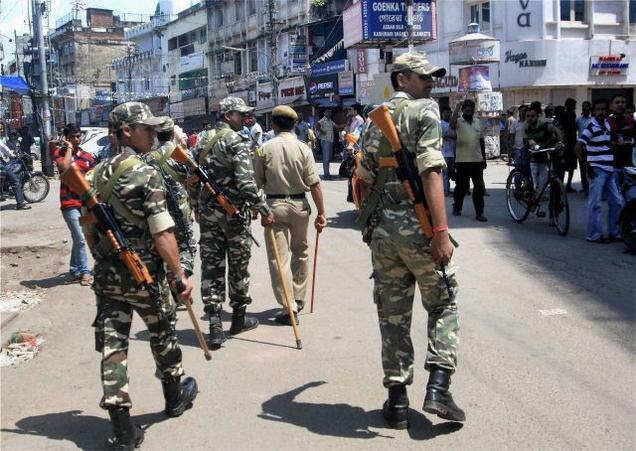
Situation in lower Assam remains tense, army conducts flag marches

August 28, 2012
aassam

Guwahati, August 28: Army staged flag marches at various places in BTAD as the All Assam Minority Students Union (AAMSU)-sponsored day-long Assam bandh turned violent with the attack on government officials and mediapersons leading to imposition of curfew in some areas.

Assam IGP (BTAD) S N Singh told PTI “Flag marches by the Army are on at various places. The situation in the Bodoland Territorial Area Districts (BTAD) is tense but under control.”

The death toll in the violence, which began on July 19-20 has reached 88, he said.

As the 12-hour bandh called by the AAMSU turned violent police opened fire on the supporters who blocked NH 31 at Joghighopa in Bongaigaon district, neighbouring lower Assam’s Bodoland Territorial Autonomous Districts, injuring three of them.

CRPF and police opened fire also in Dhubri district in lower Assam to disperse bandh supporters, who burnt an effigy of Bodoland Territorial Council chief Hagrama Mohilary near Kali Mandir on NH 31 at Gauripur.

The bandh supporters attacked the vehicle of Sonitpur Deputy Commissioner Tapan Chandra Sarmah and three police vehicles escorting him near Idgah Maidan in Tezpur in central Assam.

A youth was critically injured by bandh supporters when he tried to stop them from forcibly closing down shops near Mahabhairab Temple in the heart of the town leading to the imposition of indefinite curfew there.

Indefinite curfew was also imposed in 26 villages of Ambagan in Nagaon district after a clash between bandh supporters and local people who opposed the shutdown.

Mediapersons were attacked in Barpeta in lower Assam and Sibsagar in upper Assam, while sporadic violence was reported along with Morigaon and Nagaon districts of central Assam.

Chief Minister Tarun Gogoi has meanwhile urged political parties and outfits to refrain from calling bandhs which were ‘inflaming passions’ in violence-hit areas.

“I am not happy about the way in which BJP and All India United Democratic Front and some other outfits are conducting themselves. I appeal to them not to make any more provocative statements,” he told reporters here.

Referring to Monday’s bandh in the state by Bajrang Dal and the one on Tuesday by AAMSU, Mr. Gogoi said “This is not a time to call bandhs. Instead of bringing calm, bandhs only flare the temper and also affect the economy. I urge all parties and outfits to refrain from calling bandhs.”

Admitting that the state continued to be rocked by incidents of violence, Gogoi said the army has been given power to seize arms and was confident that results would soon be visible.

The state government has directed several ministers and parliamentary secretaries to visit the violence-hit areas of lower Assam to restore confidence among victims and oversee the return to normalcy.

Among others, Revenue Minister Prithibi Majhi, Planning Minister Tanka Bahadur Rai and Social Welfare Minister Akan Bora, Agriculture Minister Nilomoni Sen Deka, Transport Minister Chandan Brahma and Environment and Forest Minister Rockybul Hussain have left for BTAD and adjacent districts.

Comments

Add new comment

  • Coastaldigest.com reserves the right to delete or block any comments.
  • Coastaldigset.com is not responsible for its readers’ comments.
  • Comments that are abusive, incendiary or irrelevant are strictly prohibited.
  • Please use a genuine email ID and provide your name to avoid reject.
News Networkwork
May 14,2020

Bengaluru, May 14: ABB India has posted a profit after tax of Rs 66 crore during the first quarter (January to March) due to lower volumes including service revenue and unfavourable mix.

In Q1 CY19, it had reported a profit after tax of Rs 89 crore. ABB India follows calendar year as its fiscal year.

The company reported a profit including exceptional items and before tax of Rs 87 crore. The resultant under-absorption and mark-to-market impact due to forex volatility were partly offset by refund incomes and a one-time gain on sale of solar business during the quarter.

Revenues for the first quarter stood at Rs 1,522 crore, impacted by lower sales, non-receipt of delivery clearance, lower service revenue in the nationwide lockdown due to the COVID-19 pandemic. This impact primarily occurred in March, the company said in a statement.

ABB India said it continues to maintain a stable cash position of Rs 1,464 crore as on March 31 in a market where cash collection continues to be a challenge.

Besides, despite many activities coming to a standstill in March, the quarter was marked by commissioning for a mining major at Raigarh in Chhattisgarh, electrical and automation systems for a cement major and port and electrics, drives and automation for a leading mill in Bangladesh.

Terminal installation and commissioning for LPG, power management electrical control system for a leading refinery and commissioning of two units of a power plant in Kerala are some of the other projects where ABB's involvement ensured continuity and safe operations, it said.

On a global scale, the impact of COVID-19, as well as the fall in oil prices, has significantly impacted the short-term outlook. The global economy is expected to contract in 2020 after a rapid deterioration in outlook driven by the pandemic.

Despite unprecedented stimuli by governments and central banks around the world and initial signs of recovering economic activity in China, macro-indicators point to a global recession of uncertain duration as many countries continue to face restrictions with anticipated long-term economic consequences, said ABB India.

While the company is taking prompt action to adapt its operations and cost base to safeguard profitability, it expects the results in the coming quarter to be impacted due to the loss of volumes.

Comments

Add new comment

  • Coastaldigest.com reserves the right to delete or block any comments.
  • Coastaldigset.com is not responsible for its readers’ comments.
  • Comments that are abusive, incendiary or irrelevant are strictly prohibited.
  • Please use a genuine email ID and provide your name to avoid reject.
News Network
April 24,2020

New Delhi, Apr 24: The trajectory of COVID-19 cases could have plateaued and might even fall for some weeks after the lockdown is lifted but India is likely to see a second wave in late July or August with a surge in the number of cases during the monsoon, say scientists.

The timing of the peak will depend on how India is able to control physical distancing and on the level of infection spreads after restrictions are relaxed, they said.

It looks apparent that the trajectory of daily new cases has reached a plateau and eventually it will take a downward fall, maybe for some weeks or even months, Samit Bhattacharya, associate professor at the Department of Mathematics, Shiv Nadar University, said.

Still, we may get a surge of new cases of the same coronavirus and this will be considered a second wave, Bhattacharya explained.

The second epidemic may come back in late July or August in the monsoon, although the peak timing will depend on how we control social distancing during that time, he said.

Rajesh Sundaresan, professor at Bengaluru's Indian Institute of Science (IISc), agreed.

“Once we return to normal activity levels, there is a chance that infection may begin to rise again. China is seeing this to some extent post easing of some restrictions on travel,” Sundaresan, corresponding author of a working paper by researchers at IISc and the Tata Institute of Fundamental Research (TIFR) in Mumbai, said.

On March 25, when the number of coronavirus cases was 618 with 13 deaths, the government announced a nationwide lockdown that was later extended to May 3.

On Friday, the death toll due to COVID-19 rose to 718 and the number of cases to 23,077, according to the Union Health Ministry.

In good news, officials said this week that the doubling rate of cases has slowed down in the period, going from 3.4 days before lockdown to 7.5 days, with 18 states doing better than the national average. The recovery rate has also almost doubled in the last 10 days.

"Looking at the new cases in the past few days, it seems the growth of new daily infection is much slower than earlier. This apparently indicates that we might have reached at the plateau of the growth curve, Bhattacharya said.

He noted that recent studies in China and Europe observed that the infection might relapse in those people who have already recovered from earlier phases.

So, there is no evidence that the earlier infection may help acquire immunity against the second infection. And in that way, the entire population may be vulnerable to the second wave to some extent, said the scientist.

In their study unveiled this week, IISc and TIFR researchers analysed the impact of strategies such as case isolation, home quarantine, social distancing and various post-lockdown restrictions on COVID-19 that might remain in force for some time.

The study modelled on Bengaluru and Mumbai suggests the infection is likely to have a second wave and the public health threat will remain, unless steps are taken to aggressively trace, localise, isolate the cases, and prevent influx of new infections.

The new levels and the peaking times for healthcare demand depend on the levels of infection spreads in each city at the time of relaxation of restrictions, they said.

The lockdown is currently upon us. It has given us valuable time. Let us test, trace, quarantine, isolate, practice better hygiene, search for a vaccine, etc. We should do these anyway, and these are being done. When and how to lift the lockdown is going to be a difficult decision to make, said Sundaresan.

It's clear that it's going to be phased. What our team is focusing on is to come up with tools to help the decision makers assess the public health impact of various choices, he said.

According to the experts, infectious diseases spread via contact between infectious and susceptible people. In the absence of any control measures, an outbreak will grow as long as the average number of people infected by each infectious person is more than one.

Once enough people are immune there will be fewer people susceptible to the infection and the outbreak will die.

However, when an outbreak is brought under control by social distancing and other interventions, it is possible only a small proportion of the population will have been infected and gained immunity, they said.

This means enough susceptible people may remain to fuel a second wave if controls are relaxed and infection is reintroduced.

Until the vaccine comes on the market, we have to remain alert Once sporadic cases occur here and there in the country, we immediately need to implement quarantine or social distancing locally for the people in that region, and also need to perform tests to identify positive cases irrespective of showing symptoms, Bhattacharya explained.

Note that these monsoon months are also flu season in many places of India. So, we should not ignore the early signs of the flu symptoms. Irrespective of symptoms, we need to increase tests in the hotspots to identify people and contain the surge, he said.

Sundaresan added that the timeline for a second wave will depend on a lot of circumstances which may change as the time passes.

Significant testing may have been underway, there may be behavioural changes with people becoming more careful about their hygiene, wearing masks may become more common, etc. All these responses may help restrict the second wave, he said.

A study published in The Lancet journal earlier this month modelled the potential adverse consequences of premature relaxation of interventions, and found it might lead to a second wave of infections.

The finding is critical to governments globally, because it warns against premature relaxation of strict interventions, the researchers said.

While interventions to control the spread of SARS-CoV-2 are in place, countries will need to work toward returning to normalcy; thus, knowledge of the effect of each intervention is urgently required, they said in the study.

According to a recent analysis by the Harvard Chan School of Public Health, the best strategy to ease the critical care burden and loss of life from COVID-19 might be on-again, off-again social distancing.

In the absence of such interventions, surveillance and intermittent distancing may need to be maintained into 2022, which would present a substantial social and economic burden, the researchers wrote.p


Comments

Add new comment

  • Coastaldigest.com reserves the right to delete or block any comments.
  • Coastaldigset.com is not responsible for its readers’ comments.
  • Comments that are abusive, incendiary or irrelevant are strictly prohibited.
  • Please use a genuine email ID and provide your name to avoid reject.
Agencies
June 2,2020

Singapore, Jun 2: Moody's Investors Service on Tuesday downgraded 11 Indian banks along with as many non-financial companies and infrastructure majors besides four government-related issuers following a downgrade of the Indian government's issuer rating to Baa3 from Baa2 with a negative outlook.

The rapid and widening spread of the coronavirus outbreak, deteriorating global economic outlook, volatile oil prices and asset price declines are creating a severe and extensive credit shock across many sectors, regions and markets, said Moody's.

The Indian banking sector has been affected given the disruptions to India's economic activity from the coronavirus outbreak, which is weakening borrowers' credit profiles, it added.

The 11 lenders include Bank of Baroda, Bank of India, Canara Bank, Central Bank of India, Export-Import Bank of India, HDFC Bank, Indian Overseas Bank, IndusInd Bank, Punjab National Bank, State Bank of India and Union Bank of India.

The 11 non-finance companies are Oil and Natural Gas Corporation, Hindustan Petroleum Corporation, Oil India, Indian Oil Corporation, Bharat Petroleum Corporation, Petronet LNG, Tata Consultancy Services, Infosys, Reliance Industries, UPL Corporation and Genpact.

The 11 infrastructure companies are NTPC, NHPC, National Highways Authority of India, Power Grid Corporation, Gail India, Adani Green Energy Restricted Group (RG-2), Adani Transmission Restricted Group, Adani Ports and Special Economic Zone, Adani Transmission, Adani Electricity Mumbai and Azure Power Solar Energy.

The four Indian government-related issuers are Indian Railway Finance Corporation, Housing and Urban Development Corporation, Power Finance Corporation and REC Ltd.

"Government-related issuers in India have been affected because of disruptions to India's economy which will weaken borrowers' credit profiles," said Moody's.

Comments

Add new comment

  • Coastaldigest.com reserves the right to delete or block any comments.
  • Coastaldigset.com is not responsible for its readers’ comments.
  • Comments that are abusive, incendiary or irrelevant are strictly prohibited.
  • Please use a genuine email ID and provide your name to avoid reject.