



‘But for Kasab’s capture, blame might have fallen on Indian Muslims’

August 31, 2012

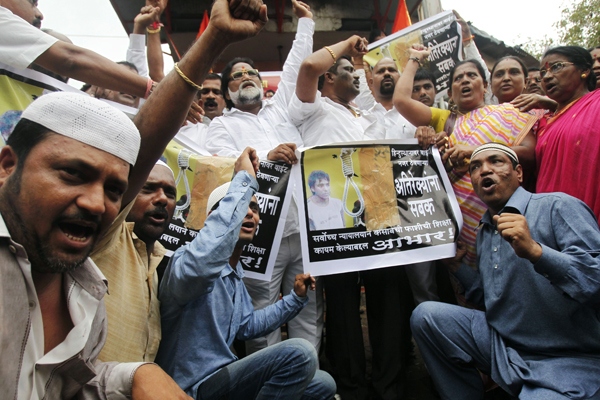
New Delhi, August 30: While lauding police efforts in apprehending gunman Ajmal Kasab alive during the 26/11 attacks in Mumbai, the Supreme Court on Wednesday said “the deception, the falsehood that the terrorists were Indian Muslims coming from Hyderabad connected with some fictitious organisation called Mujahideen, Hyderabad Deccan, is one of the most ominous and distressing parts of the conspiracy.”

A Bench of Justices Aftab Alam and C.K. Prasad said, “If the appellant [Kasab] had not been caught alive and the investigating agencies had not been able to unravel the conspiracy fully and in all its devious ways, the terrorists might have passed [off] as Indian Muslims and that would have led to devastating short-term and equally debilitating long-term consequences. It would have caused… distrust and suspicion between communities and disturbed the communal peace and harmony of the country. It is not impossible that conflagrations would have erupted in different parts of the country, which the governments would have found difficult to contain.”

The Bench said: “In this regard, the selection of the CST [Chhatrapati Shivaji Terminus] as one of the targets for carnage assumes great importance. Trains leave for many parts of the country from the CST. Thus, as news of the carnage spread across the country through the media, travellers would start arriving in different parts of the country, some having lost their near and dear ones at CST, some with a wounded companion and others shell-shocked by the experience of a terrorist attack on the railway station. Their first-hand, eyewitness accounts of the carnage, added to reports in the print media and visuals in the electronic media, could be highly inflammatory and could easily evoke communal violence that would be difficult to contain.”

The Bench said the deception was “ominous because it aimed at destabilising Indian society and its governments. But it was equally distressing for being so deeply untruthful. Indian Muslims may have a long list of grievances against the establishment. Some of the grievances may be fanciful, some may be of their own making and some may be substantive. Nevertheless, no Indian Muslim would even think of venting his grievance like an animal, killing, maiming and wounding innocent people, his own countrymen. This is because he is not only loyal to his faith and community but equally loves his country and fellow countrymen.

“The case presents the element of previous planning and preparation as no other case. For execution of the conspiracy, the appellant and the nine other dead accused, his accomplices were given rigorous and extensive training as combatants. The planning for the attack was meticulous and greatly detailed. The route from Karachi to Mumbai, the landing site at Mumbai, the different targets at Mumbai were all predetermined.”

The court said: “All the terrorists, including the appellant, actually acted according to the previous planning. A channel of communication between the attacking terrorists and their handlers and collaborators from across the border, based on advanced computer technology and procured through deception, was already arranged and put in place before the attack was launched. We are unable to accept the submission that the appellant was a mere tool in the hands of the Lashkar-e-Taiba. He joined the LeT around December 2007 and continued as its member till the end, despite a number of opportunities to leave it. This shows his clear and unmistakable intention to be a part of the organisation and participate in its designs. Even after his arrest he regarded himself as a ‘watan parast’, a patriotic Pakistani at war with this country.”

“The saddest and most disturbing part of the case,” the Bench said, “was that the appellant never showed any remorse for the terrible things he did.”

It rejected the charge that the confession of Kasab was not voluntary and it could not be accepted. “As for his knowing the names of many people in LeT, their respective positions in the hierarchy and their roles in the organisation, again there is nothing unusual about it. It is to be noted that the appellant was not a mercenary hired for the operation. He was a highly committed and devoted member of the organisation and, therefore, there is nothing strange or wrong in his coming to know many people in the organisation during the course of his training. Further, it is to be kept in mind that his being caught alive was not part of the plan of the handlers.”

No rights violation

In view of these facts, the Bench said, “We are firmly of the view that there is no question of any violation of any of the rights of the appellant under the Indian Constitution.”

On the acquittal of Fahim Ansari and Sabauddin Ahamed, who had been linked with the 26/11 attacks, the Bench said: “We are in full agreement with the reasons assigned by the trial court and the High Court for acquitting the two accused of all the charges. The view taken by the trial court and the High Court is not only correct but on the facts of the case, that is the only possible view.”

indian_muslims


Comments

Add new comment

  • Coastaldigest.com reserves the right to delete or block any comments.
  • Coastaldigset.com is not responsible for its readers’ comments.
  • Comments that are abusive, incendiary or irrelevant are strictly prohibited.
  • Please use a genuine email ID and provide your name to avoid reject.
News Network
January 31,2020

New Delhi, Jan 31: The central government has decided that pensioners' life certificates will be collected from their doorstep, saving them from hassles of visiting pension disbursing banks.

The service will be charged an amount not exceeding Rs 60, according to a statement issued on Thursday by the Department of Pension and Pensioners' Welfare (DoPPW).

Every year a pensioner is required to give proof of him being alive to banks in order to ensure continued pension. These certificates can be submitted online or by visiting the bank.

"The department has taken a landmark step to make life easier for senior citizens to submit their annual life certificate for continued pension," it said.

Directions have been issued to all pension disbursing banks to send SMS or emails to all their pensioners on October 24, November 1, November 15 and November 25 every year reminding them to submit their annual life certificates by November 30, the statement said.

"The bank in addition will also ask such pensioners through SMS/email as to whether they are interested in submission of life certificate through a chargeable doorstep service, the charge not exceeding Rs 60, it said.

The department for stricter monitoring and in order to ensure that no pensioners are left out has also directed the banks to make an exception list on December 1 every year of those pensioners who fail to submit their life certificate and issue another SMS or email to them for submitting it.

The Central Pension Processing Cells (CPPC) of the pension disbursing banks shall now be duty bound to submit a report to the DoPPW in January, February and March.

The report will indicate the total number of pensioners who have not given their life certificate along with a breakup of the certificates submitted physically and through digital means, the statement said.

This is a landmark step from the side of the central government showing due care for pensioners, it said.

This step is in addition to the order issued in July last year, vide which all pensioners aged 80 years and above have been given an exclusive window to submit their life certificate w.e.f. 1st October every year instead of 1st November every year, the statement added.

Comments

Add new comment

  • Coastaldigest.com reserves the right to delete or block any comments.
  • Coastaldigset.com is not responsible for its readers’ comments.
  • Comments that are abusive, incendiary or irrelevant are strictly prohibited.
  • Please use a genuine email ID and provide your name to avoid reject.
News Network
April 11,2020

New Delhi, Apr 11: Calling upon chief ministers to popularise Aarogya Setu app, Prime Minister Narendra Modi on Saturday said it will an essential tool in India's fight against coronavirus and referred to the possibility of the app being an "e-pass which could subsequently facilitate travel from one place to other".

Interacting with chief ministers through video conference, the Prime Minister mentioned how South Korea and Singapore had got success in contact tracing and said India has made its own effort through the app amid efforts to contain the spread of coronavirus.

A PMO release said that the Prime Minister spoke about popularizing the Aarogya Setu app to ensure downloads in greater numbers.

"He referred to how South Korea and Singapore got success in contact tracing. Based on those experiences, India has made its own effort through the app which will be an essential tool in India's fight against the pandemic, he said. He also referred to the possibility of the app being an e-pass which could subsequently facilitate travel from one place to another," the release said.

The Prime Minister had earlier this week urged people to download the app saying it is an important step in the fight against COVID-19 and its effectiveness will increase as more people use it.

"Aarogya Setu is an important step in our fight against COVID-19. By leveraging technology, it provides important information. As more and more people use it, it's effectiveness will increase. I urge you all to download it," he had said in a tweet.

The app launched earlier this month in public-private partnership enables people to themselves assess the risk for their catching the coronavirus infection.

The app makes its calculations based on a person's interaction with others, using Bluetooth technology, algorithms and artificial intelligence.

Comments

Add new comment

  • Coastaldigest.com reserves the right to delete or block any comments.
  • Coastaldigset.com is not responsible for its readers’ comments.
  • Comments that are abusive, incendiary or irrelevant are strictly prohibited.
  • Please use a genuine email ID and provide your name to avoid reject.
News Network
February 14,2020

London, Feb 14: Liquor tycoon Vijay Mallya once again asked the Indian banks to take back 100 per cent of the principal amount owed to them at the end of his three-day British High Court appeal on Thursday against an extradition order to India.

The 64-year-old former Kingfisher Airlines boss, wanted in India on charges of fraud and money laundering amounting to an alleged Rs 9,000 crores in unpaid bank loans, said the Enforcement Directorate (ED) and the Central Bureau of Investigation (CBI) are fighting over the same assets and not treating him reasonably in the process.

“I request the banks with folded hands, take 100 per cent of your principal back, immediately,” he said outside the Royal Courts of Justice in London.

“The Enforcement Directorate attached the assets on the complaint by the banks that I was not paying them. I have not committed any offenses under the PMLA (Prevention of Money Laundering Act) that the Enforcement Directorate should suo moto attach my assets," he said.

"I am saying, please banks take your money. The ED is saying no, we have a claim over these assets. So, the ED on the one side and the banks on the other are fighting over the same assets,” he added.

Asked about heading back to India, he noted: “I should be where my family is, where my interests are.

"If the CBI and the ED are going to be reasonable, it’s a different story. What all they are doing to me for the last four years is totally unreasonable.”

Lord Justice Stephen Irwin and Justice Elisabeth Laing, the two-member bench presiding over the appeal, concluded hearing the arguments in the case and said they will be handing down their verdict at a later date after considering the oral as well as written submissions in the “very dense” case over the next few weeks.

On a day of heated arguments between Mallya’s barrister, Clare Montgomery, and Crown Prosecution Service (CPS) counsel Mark Summers, arguing on behalf of the Indian government, both sides clashed over the prima facie case of fraud and deception against Mallya.

“We submit that he lied to get the loans, then did something with the money he wasn’t supposed to and then refused to give back the money. All this could be perceived by a jury as patently dishonest conduct,” said Summers.

“What they [Kingfisher Airlines] were saying [to the banks] about profitability going forward was knowingly wrong,” he said, as he took the High Court through evidence to counter Mallya’s lawyers’ claims that Westminster Magistrates Court Judge Emma Arbuthnot had fallen into error when she found a case to answer in the Indian courts against Mallya.

Mallya, who remains on bail on an extradition warrant, is not required to attend the hearings but has been in court to observe the proceedings since the three-day appeal opened on Tuesday. A key defence to disprove a prima facie case of fraud and misrepresentation on his part has revolved around the fact that Kingfisher Airlines was the victim of economic misfortune alongside other Indian airlines.

However, the CPS has argued that “there is enough in the 32,000 pages of overall evidence to fulfil the [extradition] treaty obligations that there is a case to answer”. “There is not just a prima facie case but overwhelming evidence of dishonesty… and given the volume and depth of evidence the District Judge [Arbuthnot] had before her, the judgment is comprehensive and detailed with the odd error but nothing that impacts the prima facie case,” said Summers.

At the start of the appeal, Mallya’s counsel claimed Arbuthnot did not look at all of the evidence because if she had, she would not have fallen into the multiple errors that permeate her judgment. The High Court must establish if the magistrates’ court had in fact fallen short on a point of law in its verdict in favour of extradition.

Representatives from the Enforcement Directorate (ED) and Central Bureau of Investigation (CBI), as well as the Indian High Commission in London, have been present in court to take notes during the course of the appeal hearing.

Mallya had received permission to appeal against his extradition order signed off by former UK home secretary Sajid Javid last February only on one ground, which challenges the Indian government's prima facie case against him of fraudulent intentions in acquiring bank loans.

At the end of a year-long extradition trial at Westminster Magistrates’ Court in London in December 2018, Judge Arbuthnot had found “clear evidence of dispersal and misapplication of the loan funds” and accepted a prima facie case of fraud and a conspiracy to launder money against Mallya, as presented by the CPS on behalf of the Indian government.

Mallya remains on bail since his arrest on an extradition warrant in April 2017 involving a bond worth 650,000 pounds and other restrictions on his travel while he contests that ruling.

Comments

Add new comment

  • Coastaldigest.com reserves the right to delete or block any comments.
  • Coastaldigset.com is not responsible for its readers’ comments.
  • Comments that are abusive, incendiary or irrelevant are strictly prohibited.
  • Please use a genuine email ID and provide your name to avoid reject.