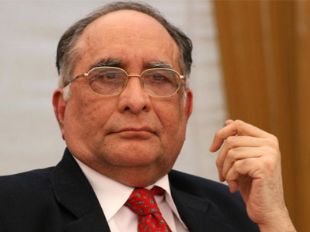
Indians can find God in Constitution: Justice Kapadia

September 2, 2012
God_Of_Constitution

Aurangabad, September 2: The Constitution can replace the religious texts in today's times, Chief Justice of India SH Kapadia said in Aurangabad.

"The Constitution should be studied by Indians to know about citizens' rights. If you read it, there is no need to read the religious books as you may find God in our Constitution. Gaining knowledge of the Constitution would be a real homage to Dr Babasaheb Ambedkar," he said, delivering a lecture on 'Constitutional Ethics' at Dr Babasaheb Ambedkar Marathwada University.

Chief Justice of Bombay High Court Justice Mohit Shah was also present on this occasion. "I belong to the Parsi community and would have never thought of becoming the Chief Justice anywhere (else) in the world. It is only in India that it was possible due to the Constitution," said the CJI.

The judges should be acquainted with multiple fields of knowledge, which can help them in the court, he said. Judges can learn a lot from "constructive criticism" but not from "destructive criticism", he said.

Poverty was "a basic violation of human rights", he said, talking about the need to have a "balanced" society.


Comments

Add new comment

  • Coastaldigest.com reserves the right to delete or block any comments.
  • Coastaldigset.com is not responsible for its readers’ comments.
  • Comments that are abusive, incendiary or irrelevant are strictly prohibited.
  • Please use a genuine email ID and provide your name to avoid reject.
News Network
April 26,2020

Thiruvananthapuram, Apr 26: Kerala Chief Minister Pinarayi Vijayan on Saturday urged media houses not to resort to layoffs and pay cuts while the whole community is facing the COVID-19 pandemic.

The Chief Minister said the state government will also take necessary steps to test the media personnel in the state to ensure they have not contracted the deadly virus.

He also pointed out that the pandemic has severely impacted the media sector with many newspapers even reducing the number of pages.

"Journalists are among those who have been affected the most. Journalists on the field are also in danger. We have come to know about the reporters affected with coronavirus in other states. The government will take necessary precautions including testing to ensure that journalists don't contract the disease," Vijayan said.

He said the newspapers were not receiving advertisements these days because there are no social or public events resulting in less commercial activities in the society.

"I would like to urge the media houses not to engage in layoffs or salary cuts during this pandemic. Journalists are working shoulder to shoulder with health workers. During this pandemic, scribes are out in the field collecting news, despite the threat of disease and it was admirable," Vijayan said.

The chief minister said the government has asked the PRD to release the dues to various media houses.

Comments

Add new comment

  • Coastaldigest.com reserves the right to delete or block any comments.
  • Coastaldigset.com is not responsible for its readers’ comments.
  • Comments that are abusive, incendiary or irrelevant are strictly prohibited.
  • Please use a genuine email ID and provide your name to avoid reject.
News Network
May 4,2020

Munbai/New Delhi, May 4: India expects bad debts at its banks could double after the coronavirus crisis brought the economy to a sudden halt, a senior government official and four top bankers said.

Indian banks are already grappling with 9.35 trillion rupees ($123 billion) of soured loans, which was equivalent to about 9.1% of their total assets at the end of September 2019.

"There is a considered view in the government that bank non-performing assets (NPAs) could double to 18-20% by the end of the fiscal year, as 20-25% of outstanding loans face a risk of default," the official with direct knowledge of the matter said.

A fresh surge in bad debt could hit credit growth and delay India's recovery from the coronavirus pandemic.

"These are unprecedented times and the way it's going we can expect banks to report double the amount of NPAs from what we've seen in earlier quarters," the finance head of a top public sector bank told Reuters.

The official and bankers declined to be named as they were not officially authorized to discuss the matter with media.

India's finance ministry declined to comment, while the Reserve Bank of India and Indian Banks' Association, the main industry body, did not immediately respond to emails seeking comment.

The Indian economy has ground to a standstill amid a 40-day nationwide lockdown to rein in the spread of coronavirus cases.

The lockdown has now been extended by a further two weeks, but the government has begun to ease some restrictions in districts that are relatively unscathed by the virus.

India has so far recorded nearly 40,000 cases of the coronavirus and more than 1,300 deaths from COVID-19, the respiratory disease caused by the coronavirus.

'RIDING THE TIGER'

Bankers fear it is unlikely that the economy will fully open up before June or July, and loans, especially those to small- and medium-sized businesses which constitute nearly 20% of overall credit, may be among the worst affected.

This is because all 10 of India's largest cities fall in high-risk red zones, where restrictions will remain stringent.

A report by Axis Bank said that these red zones, which contribute significantly to India's economy, account for roughly 83% of the overall loans made by its banks as of December.

One of the sources, an executive director of a public sector bank, said that economic growth had been sluggish and risks had been heightened, even ahead of the coronavirus crisis.

"Now we have this Black Swan event which means without any meaningful government stimulus, the economy will be in tatters for several more quarters," he said.

McKinsey & Co last month forecast India's economy could contract by around 20% in the three months through June, if the lockdown was extended to mid-May, and growth in the fiscal year was likely to fall 2% to 3%.

Bankers say the only way to stem the steep rise in bad loans is if the RBI significantly relaxes bad asset recognition rules.

Banks have asked the central bank to allow all loans to be categorized as NPAs only after 180 days, which is double the current 90-day window.

"The lockdown is like riding the tiger, once we get off it we'll be in a difficult position," a senior private sector banker said.


Comments

Add new comment

  • Coastaldigest.com reserves the right to delete or block any comments.
  • Coastaldigset.com is not responsible for its readers’ comments.
  • Comments that are abusive, incendiary or irrelevant are strictly prohibited.
  • Please use a genuine email ID and provide your name to avoid reject.
News Network
March 5,2020

New Delhi, Mar 5: Retirement fund body EPFO on Thursday lowered interest rate on provident fund deposits to 8.5 per cent for the current financial year, said Labour Minister Santosh Gangwar on Thursday.

The EPFO had provided 8.65 per cent rate of interest on EPF for 2018-19 to its around six crore subscribers. The decision was taken at a meeting of the the Employees' Provident Fund Organisation's (EPFO) apex decision making body -- the Central Board of Trustee.

"The EPFO has decided to provide 8.5 per cent interest rate on EPF deposits for 2019-20 in the Central Board of Trustees (CBT) meeting today," Gangwar told reporters after the meeting here.

Now, the labour ministry requires the finance ministry's concurrence on the matter. Since the Government of India is the guarantor, the finance ministry has to vet the proposal for EPF interest rate to avoid any liability on account of shortfall in the EPFO income for a fiscal.

The finance ministry has been nudging the labour ministry for aligning the EPF interest rate with other small saving schemes run by the government like the public provident fund and post office saving schemes.

The EPFO had provided 8.65 per cent rate of interest to its subscribers for 2016-17 and 8.55 per cent in 2017-18. The rate of interest was slightly higher at 8.8 per cent in 2015-16.

It had given 8.75 per cent rate of interest in 2013-14 as well as 2014-15, higher than 8.5 per cent for 2012-13.

Comments

Add new comment

  • Coastaldigest.com reserves the right to delete or block any comments.
  • Coastaldigset.com is not responsible for its readers’ comments.
  • Comments that are abusive, incendiary or irrelevant are strictly prohibited.
  • Please use a genuine email ID and provide your name to avoid reject.