


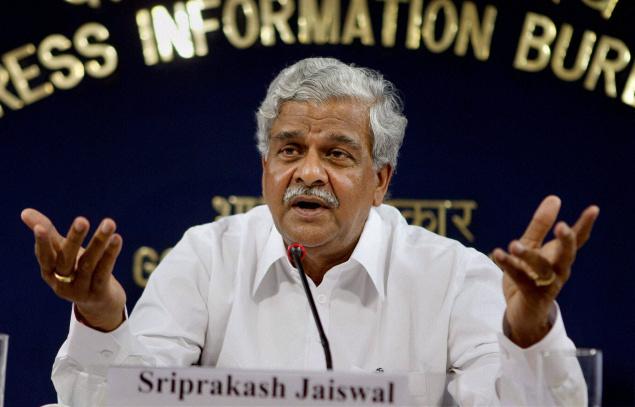
Cancellation of coal blocks after IMG report: Jaiswal

September 2, 2012
Sriprakash

Kanpur/New Delhi, September 2: Against the backdrop of opposition pressure, the fate of 58 coal blocks will be reviewed on Monday at a meeting of an Inter-Ministerial Group (IMG), on whose recommendations wrongful allotments and cases in which mining has not started can be cancelled.

Coal Minister Sriprakash Jaiswal said an IMG has been set up to examine the pros and cons and based on its report any number of allocations can be cancelled.

He said the IMG will give its report by September 15.

"Right now, no allocations are being cancelled. On the basis of the IMG report, the allocations which were made in a wrongful manner or those allottees who have failed to start production of coal in a time-bound manner may face action. Any number of coal blocks can be cancelled," Mr. Jaiswal told reporters in Kanpur.

The government has already issued de-allocation notices to 33 government firms and 25 private entities in this regard. But the opposition has demanded cancellation of all 142 allocations mentioned in the CAG report.

In its report tabled recently in Parliament, the CAG stated that undue benefits to the tune of Rs 1.86 lakh crore were extended to private firms on account of allocation of 57 mines to them.

The IMG comprising representatives from different Ministries may recommend cancellation of such blocks, which did not comply to the development norms.

Sources said the firms in their replies furnished to the Ministry have cited various reasons, including land acquisition problems, delays in forestry and environment clearances and law and order problems for delays in developing the blocks.

The government in April began the process of issuing notices to companies that failed to develop the 58 coal blocks within the stipulated time.

The notices were issued to firms like Reliance Power's Sasan, Tata Power, Hindalco and Grasim Industries, ArcelorMittal, GVK Power, MMTC and others.

In June, the government formed an IMG to review progress of coal blocks allocated to companies for captive use.

Of the total 195 coal blocks allocated to both public and private firms over a decade, only 30 mines have begun production as per the government records.

The government, last year had cancelled the allocation of 14 coal mines and one lignite mine to companies, including NTPC and DVC for failure to develop the blocks.


Comments

Add new comment

  • Coastaldigest.com reserves the right to delete or block any comments.
  • Coastaldigset.com is not responsible for its readers’ comments.
  • Comments that are abusive, incendiary or irrelevant are strictly prohibited.
  • Please use a genuine email ID and provide your name to avoid reject.
Agencies
August 3,2020

The Drugs Controller General of India (DCGI) has given nod to the Serum Institute of India (SII) for conducting phase 2 and 3 human clinical trials of the Oxford University developed Covid-19 vaccine candidate in the country.

Government officials said that the approval for conducting phase 2 and 3 clinical trials by the SII was granted by DCGI Dr V G Somani late Sunday night after a thorough evaluation based on the recommendations of the Subject Expert Committee (SEC) on Covid-19.

"The firm has to submit safety data, evaluated by the Data Safety Monitoring Board (DSMB), to the CDSCO before proceeding to phase 3 clinical trials," a senior official said.

"As per the study design, each subject will be administered two doses four weeks apart (first dose on day one and second dose on day 29) following which the safety and immunogenicity will be assessed at predefined intervals," the official said.

As a rapid regulatory response, the expert panel at the Central Drugs Standard Control Organisation (CDSCO) on Friday, after a detailed deliberation and considering the data generated on the vaccine candidate in phase 1 and 2 of the Oxford University trial, had recommended granting permission for phase 2 and 3 clinical trials of the potential vaccine, 'Covishield', on healthy adults in India,  the officials said.

Currently, phase 2 and 3 clinical trials of the Oxford vaccine candidate is going on in the United Kingdom, phase 3 clinical trial in Brazil and phase 1 and 2 clinical trials in South Africa.

The officials said that the SII had submitted a revised proposal on Wednesday after the SEC on July 28, following deliberation over its application, had asked it to revise its protocol for the phase 2 and 3 clinical trials besides seeking some additional information.

The panel had also recommended that the clinical trial sites which have been proposed for the study be distributed across India.

According to the revised proposal by the SII, 1,600 people aged above 18 years will participate in the trials across 17 selected sites, including AIIMS-Delhi, B J Medical College in Pune, Rajendra Memorial Research Institute of Medical Sciences (RMRIMS) in Patna, Post Graduate Institute of Medical Education and Research in Chandigarh, AIIMS-Jodhpur, Nehru Hospital in Gorakhpur, Andhra Medical College in Visakhapatnam and JSS Academy of Higher Education and Research in Mysore.

"According to the application, it would conduct an observer-blind, randomised controlled study to determine the safety and immunogenicity of 'Covishield' on healthy Indian adults," the official said.

The SII, which has partnered with AstraZeneca, for manufacturing the Oxford vaccine candidate for Covid-19 had submitted its first application to the DCGI on July 25 seeking permission for conducting the phase 2 and 3 trials of the potential vaccine. 

Initial results of the first two-phases of trials of the vaccine conducted in five trial sites in the UK showed that it has an acceptable safety profile and homologous boosting increased antibody response, sources had said.

To introduce the vaccine, SII, the world's largest vaccine maker by number of doses produced and sold, has signed an agreement to manufacture the potential vaccine developed by the Jenner Institute (Oxford University) in collaboration with British-Swedish pharma company AstraZeneca. 

Comments

Add new comment

  • Coastaldigest.com reserves the right to delete or block any comments.
  • Coastaldigset.com is not responsible for its readers’ comments.
  • Comments that are abusive, incendiary or irrelevant are strictly prohibited.
  • Please use a genuine email ID and provide your name to avoid reject.
News Network
July 18,2020

Washington, Jul 18: The government of India has agreed to allow US air carriers to resume passenger services in the US-India market starting July 23, the US Transportation Department said on Friday.

The Indian government, citing the coronavirus, had banned all scheduled services, prompting the US Transportation Department in June to accuse India of engaging in "unfair and discriminatory practices" on charter air carriers serving India.

The Transportation Department said it was withdrawing an order it had issued requiring Indian air carriers to apply for authorization prior to conducting charter flights, and said it had approved an Air India application for passenger charter flights between the United States and India.

A group representing major US airlines and the Indian Embassy in Washington did not immediately comment on Friday.

India's Ministry of Civil Aviation said on Twitter it was moving to "further expand our international civil aviation operations" and arrangements from some flights "with US, UAE, France & Germany are being put in place while similar arrangements are also being worked out with several other countries."

"Under this arrangement," it added, "airlines from the concerned countries will be able to operate flights from & to India along with Indian carriers."

The US Transportation Department order was set to take effect next week. The Trump administration said in June it wanted "to restore a level playing field for US airlines" under the US-India Air Transport Agreement. The Indian government had banned all scheduled services and failed to approve US carriers for charter operations, it added.

The US government said in June that Air India had been operating "repatriation" charter flights between India and the United States in both directions since May 7.

Comments

Add new comment

  • Coastaldigest.com reserves the right to delete or block any comments.
  • Coastaldigset.com is not responsible for its readers’ comments.
  • Comments that are abusive, incendiary or irrelevant are strictly prohibited.
  • Please use a genuine email ID and provide your name to avoid reject.
News Network
January 21,2020

Jan 21: Indian policymakers may make it easier for companies to tap foreign funding, as a prolonged cash squeeze makes it tough for firms to borrow at home.

Investors are speculating about potential steps Finance Minister Nirmala Sitharaman could unveil when she presents the nation’s budget on Feb. 1. These measures may include freeing up firms to borrow at higher rates and offering tax breaks to global funds.

“The government will need to relax local rules to make it easier for Indian companies to raise debt overseas and tide over the funding crunch in the onshore market,” said Raj Kothari, London-based head of trading at Jay Capital Ltd. “At the same time, they need to ensure that the borrowers tapping offshore markets abide with stricter corporate governance so as to avoid further defaults.”

A prolonged crisis in India’s shadow bank sector and a pile of bad loans at traditional lenders is making it expensive for Indian companies, other than the best-rated firms, to access funding. The government has tried a series of measures to spur domestic credit, including providing so-called credit enhancement and allowing tiny firms to restructure debt.

Here are some steps Sitharaman may consider to spur foreign borrowing:

• She could raise the cap of 450 basis points above Libor, which limits overall foreign debt costs for Indian companies

• This could help lower-rated firms sell bonds abroad. Indian companies rated BBB currently borrow at more than 10%, about 3.8 percentage points more than their top-rated peers;

• Sitharaman could waive the withholding tax foreign investors need to pay on holdings of rupee-denominated debt sold by Indian companies abroad

• The waiver was offered between September 2018 to March 2019, but wasn’t extended as the highest global interest rates since the financial crisis deterred Indian borrowers. Since then, the three-month Libor has dropped by about 1 percentage point

• She could permit Indian property developers and housing finance lenders to sell overseas bonds for reasons beyond affordable housing projects

• New funding lines to the real estate sector, arguably ground zero of India’s economic slowdown, could help kickstart consumption and investment as the industry is the nation’s biggest job-creator.

Comments

Add new comment

  • Coastaldigest.com reserves the right to delete or block any comments.
  • Coastaldigset.com is not responsible for its readers’ comments.
  • Comments that are abusive, incendiary or irrelevant are strictly prohibited.
  • Please use a genuine email ID and provide your name to avoid reject.