



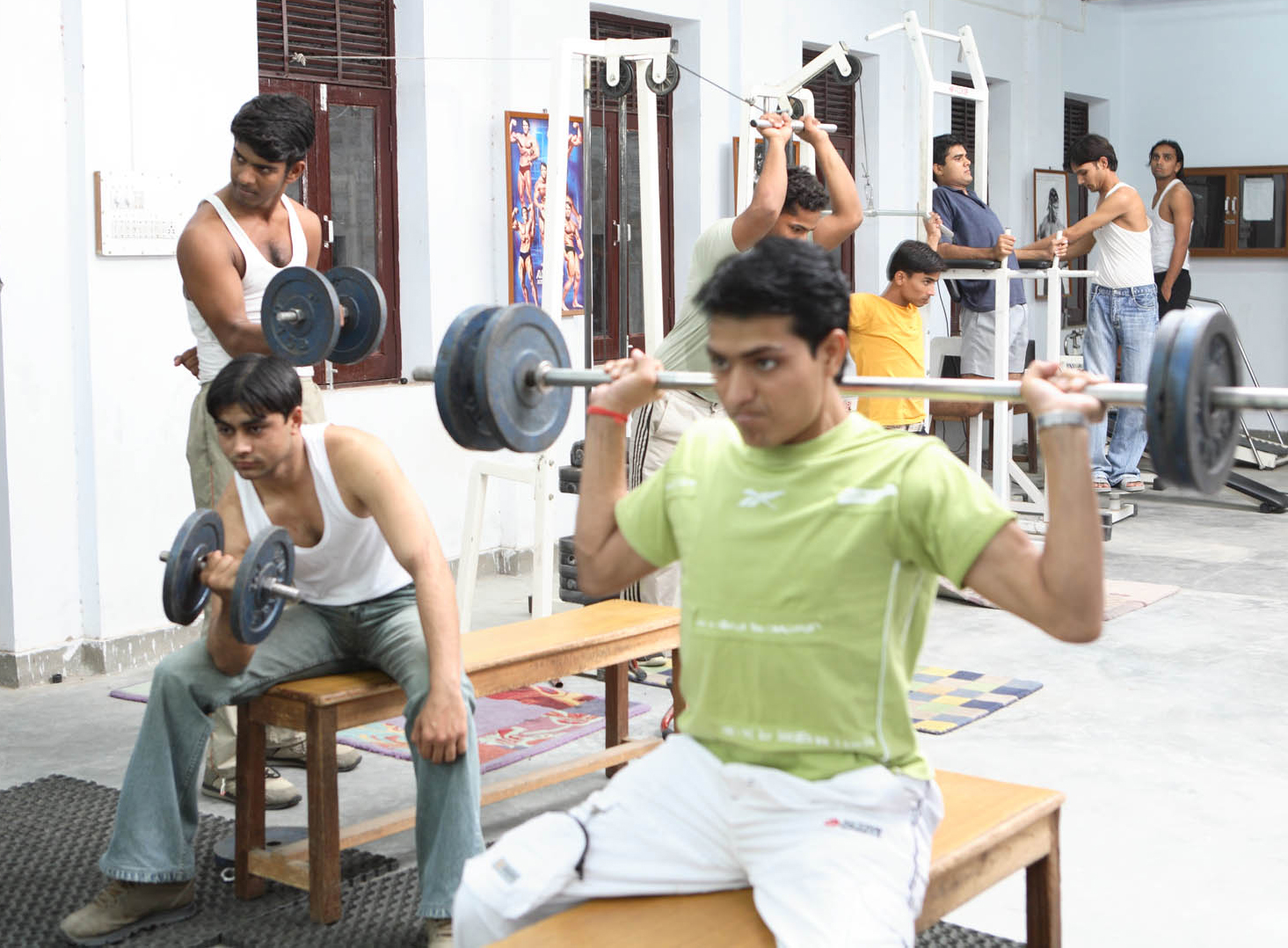
Gym goers beware, killer steroids in supplements

September 3, 2012

gym_2

Kochi/New Delhi, September 3: A growing number of fitness gyms are selling and encouraging the use of body-building steroids. A family lost its young son Rijo to these drugs.

"My son was very healthy and he used to go to the gym to maintain himself. His gym instructor lured him to take supplementary powders and six months later we lost our son after he got a sudden stroke," said Rijo's father George, who is still trying to come to terms with the death of his 29-year-old son.

Rijo George's mother bursts into tears when she recollects her only son's tragic end. He has left behind a young wife and their one and half-year-old son.

Hailing from a Kochi suburb in Kerala, Rijo was initiated into the world of body building by the instructor of his new neighbourhood gym. He told his family that the instructor asked him to take supplementary powders to bulk up. Six months later, Rijo was rushed to the hospital and was declared dead on arrival.

Rijo's post-mortem report says that he died of occlusive coronary artery disease. The surgeon told his family that excess amount of fat was found to be deposited in the valves and that the supplementary powders that he used to take for body building could be the reason.

Recently the drug controllers' department confiscated consignments of imported veterinary steroids from Malappuram district. It included a steroid called Boldenone, which is given to racing horses. Steroids used for increasing broiler chicken body mass, and testosterone capsules were also found.

Waking up to the reality of widespread abuse, the drug controllers' department is planning a crackdown on gyms.

MR Pradeep, Assistant Drug Controller, Kochi, said, "The gym instructors are misusing steroids that are specific for certain body conditions. They are not experts, just by word of mouth the information spreads, and these drugs are used unethically."

It is time to bring in regulations and standardise the fitness industry before more Rijos fall prey to this obsession with perfection.


Comments

Add new comment

  • Coastaldigest.com reserves the right to delete or block any comments.
  • Coastaldigset.com is not responsible for its readers’ comments.
  • Comments that are abusive, incendiary or irrelevant are strictly prohibited.
  • Please use a genuine email ID and provide your name to avoid reject.
Agencies
June 30,2020

Seventy-seven per cent children below five years of age in Jammu and Kashmir were not able to access basic healthcare services like immunisation during the lockdown imposed to curb the spread of COVID-19, CRY said on Monday citing a study.

The 'Rapid Online Perception Study about the Effects of COVID-19 on Children' was conducted during the first and second phases of the lockdown based on responses of parents and primary caregivers from all across the country, including Jammu and Kashmir, the NGO said in a statement.

It said a total of 387 respondents from Jammu and Kashmir participated in the study.

"Seventy-seven per cent children of age 0-5 years were not able to access basic healthcare services such as immunisation during lockdown - necessarily imposed to curb the spread of COVID-19 pandemic in Jammu and Kashmir," Child Rights and You (CRY) said.

It said as immunisation programmes witnessed a major setback during the lockdown across the country, the results of the survey across 23 states and Union Territories found nearly 50 per cent of parents with children below five years of age unable to access immunisation services.

"Worryingly, the figure was considerably high in Jammu and Kashmir with 77.14 per cent children below five years unable to get immunisation services," it added.

According to the study, in Jammu and Kashmir, nearly 35 per cent of the respondents said their children did not receive medical help during the lockdown, resulting in difficulties to cope with their children's illnesses and health hazards.

The study also talks about more systemic arrangements and logistical preparedness to ensure that children with no or compromised digital reach are not deprived from their Right to Education.

With online classes introduced as a substitute of schools during the lockdown, access to education for children remained a major issue of concern, as many of them, especially the ones from marginalised and financially poorer backgrounds found it difficult without smartphones and internet access.

The survey's findings revealed that nationally only 41 per cent households with children of school-going age could access online classes on a regular basis.

"Almost 90 per cent parents and primary caregivers reported that the lockdown has increased the screen time of their child to great or some extent. About half of the households recorded an increase of children's exposure to online activities during lockdown," it said.

The NGO said around 76 per cent parents agreed that they could keep a watch of their children's online activity to some extent.

Comments

Add new comment

  • Coastaldigest.com reserves the right to delete or block any comments.
  • Coastaldigset.com is not responsible for its readers’ comments.
  • Comments that are abusive, incendiary or irrelevant are strictly prohibited.
  • Please use a genuine email ID and provide your name to avoid reject.
News Network
January 10,2020

New Delhi, Jan 10: The Supreme Court while hearing petitions challenging restrictions in Jammu and Kashmir on Friday stated that the right to access the internet is a fundamental right under Article 19 of the Constitution of India.

"It is no doubt that freedom of speech is an essential tool in a democratic setup. The freedom of Internet access is a fundamental right under Article 19(1)(a) of the Constitution," a two-judge bench headed by Justice N V Ramana stated while reading out the judgment.

The top court said that Kashmir has seen a lot of violence and that it will try to maintain a balance between human rights and freedoms with the issue of security.

It also directed the Jammu and Kashmir administration to review the restrictive orders imposed in the region within a week. “The citizens should be provided highest security and liberty,” the apex court added.

The top court made observations and issued directions while pronouncing the verdict on a number of petitions challenging the restrictions and internet blockade imposed in Jammu and Kashmir after the abrogation of Article 370 in August last year.

The Supreme Court had on November 27 reserved the judgment on a batch of petitions challenging restrictions imposed on communication, media and telephone services in Jammu and Kashmir pursuant to revocation of Article 370.

The court heard the petitions filed by various petitioners including Congress leader Ghulam Nabi Azad and Kashmir Times editor Anuradha Bhasin.

The petitions were filed after the central government scrapped Article 370 in August and bifurcated Jammu and Kashmir into two Union Territories -- Jammu and Kashmir and Ladakh. Following this, phone lines and the internet were blocked in the region.

The government had, however, contended that it has progressively eased restrictions.

Comments

Add new comment

  • Coastaldigest.com reserves the right to delete or block any comments.
  • Coastaldigset.com is not responsible for its readers’ comments.
  • Comments that are abusive, incendiary or irrelevant are strictly prohibited.
  • Please use a genuine email ID and provide your name to avoid reject.
News Network
February 16,2020

Varanasi, Feb 16: Amidst continuing protests against the amended citizenship law, Prime Minister Narendra Modi on Sunday said his government stood by the decision despite all pressure.

"Be it the decision on Article 370 or the Citizenship Amendment Act, it was necessary in the interest of the country. Despite pressure, we stand by our decision and will remain so," he said.

Modi was addressing a public meeting in his Lok Sabha constituency.

Prime Minister Narendra Modi also asserted that the trust set up for construction of the Ram temple in Ayodhya will work "rapidly".

"A trust has been formed for construction of a grand Ram temple in Ayodhya. This trust will work rapidly," he said at a public meeting during his day-long visit to his Lok Sabha constituency.

The government had recently set up the Shri Ram Janmabhoomi Teerth Kshetra on the Supreme Court's directive to the Union government to form a trust that can look into the construction and management of the temple.

Comments

Add new comment

  • Coastaldigest.com reserves the right to delete or block any comments.
  • Coastaldigset.com is not responsible for its readers’ comments.
  • Comments that are abusive, incendiary or irrelevant are strictly prohibited.
  • Please use a genuine email ID and provide your name to avoid reject.